19 december 2025, Yves Joris
Argent at Coppejans Gallery: on taxidermy and references to the art canon
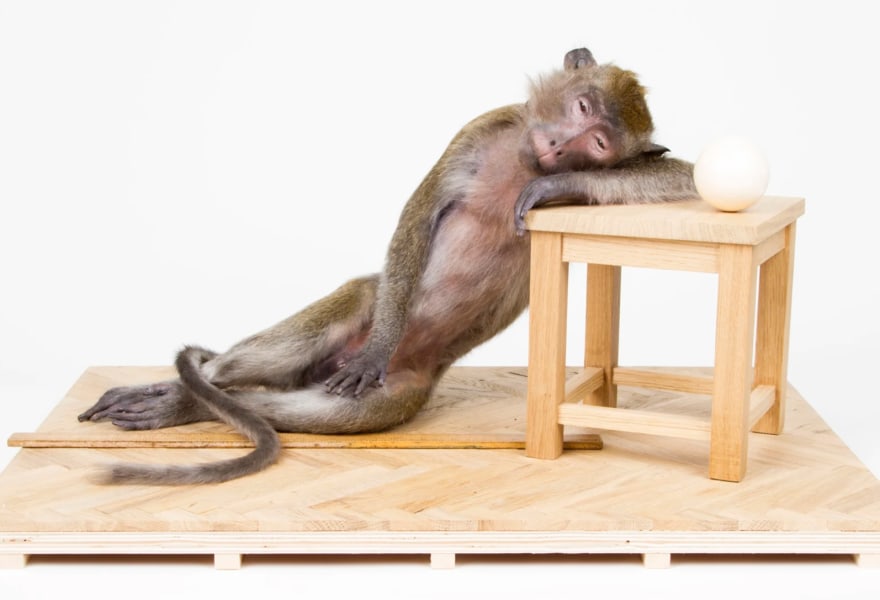
There is something uncomfortable about taxidermy, especially within the context of a gallery. I feel it every time I find myself face-to-face with a mounted animal: not so much revulsion, but a mild moral friction. It is not the dead body itself that disturbs me, but the ambition preceding it. The attempt to hold onto life the very moment it ebbs out. The glass eyes, the tightly stretched skin, the posture that suggests movement could resume at any instant, as if death were only a temporary interruption. Taxidermy is not necessarily a memory, but a frozen fiction. It does not lie, but it does not tell the truth either.
Perhaps that is precisely why I feel such a sharp affinity with art history. It, too, preserves, classifies, freezes what was once mobile. It, too, arranges the past into proportions and positions that seem convincing, yet retain something forced. In that sense, every museum is an elegant form of taxidermy: the life of ideas carefully mounted, stripped of risk, fixed in vitrines of meaning.
As I walked into the exhibition Argent at Coppejans Gallery, that thought seems to impose itself almost naturally. The exhibition is the brainchild of Atelier Les Deux Garçons, an artistic joint venture between Michel Vanderheijden van Tinteren and Roel Moonen, who recently celebrated 25 years of artistic practice with an impressive publication by Lannoo Publishers.
The reference to art history is equally prominent—though a playful one. There are no quotations shouting or references forcing themselves on the viewer, but echoes: a wheel suggesting Duchamp, with the stool on which it rests carrying echoes of Ai Weiwei.

Atelier les deux garçons, Le Reveur / De Dromer, COPPEJANS GALLERY
The Dreamer
Before long, I find myself stopping in front of The Dreamer. Small as it is, the work does not allow itself to be passed by. A small metal children’s bed on wheels, worn out, as if it had been rolled away from a forgotten room. On the bed lies a mouse. Dead. Carefully placed on a striped cloth, like an improvised mattress. The animal seems to be sleeping and its posture is one of rest, not drama. And it is precisely that fact that is so disturbing. Death is not presented here as rupture, but as silence. I feel both tenderness and a slight shiver. As with taxidermy, life is not shown, but carefully suggested. What is actually being preserved here? Not the body, I later realise, but the illusion of rest.
The little bed is not a vitrine. It offers little to no protection. It is a gesture of tenderness that comes too late. Here, preservation itself is the subject of reflection. Not the triumph of conservation, but its fragility. Let’s be honest, we prefer to see a mouse dead rather than alive. It has no economic meaning, no cultural status. And precisely for that reason is priceless here. I notice that I cannot move on immediately. The Dreamer demands proximity. I cannot casually walk past it. It makes me drift for a moment to Ryan Gander’s animatronic mice at the Bourse de Commerce. The work asks for no indignation, no shock, but attention. What happens when even the slightest form of life is not immediately reduced to waste? When something that is barely seen suddenly becomes the centre of my gaze?
Silver and residual value
Argent (‘silver’), the title of the exhibition, meanwhile continues to smoulder throughout the show as a quiet metaphor. It is a material that shines and oxidises, that promises and crumbles. Silver has never been innocent, used for coins that have passed through thousands of hands, cutlery that has known celebrations and mourning, mirrors that held faces long since gone. Silver stores time in its patina.
Argent (‘money’) does not, to me, pertain to financial value, although money is never far away. The exhibition is about value in general, especially what remains of value when exchange value disappears and usage value evaporates. What remains is a moral residue, objects that no longer do anything, yet still mean something. Like the dead animal in the little bed: functionless, yet poignant.
I see how the works do not present themselves as statements, but as remnants. Not as illustrations, but as leftovers. What once functioned, circulated or was desired now stands still. Not dead, but suspended. Like a body that no longer breathes, yet still occupies space.

Atelier les deux garçons, Ai Weiwei rencontre Duchamp, COPPEJANS GALLERY
A wheel that does not turn
This reflection absolutely includes Ai Weiwei meets Duchamp. An (antique) Chinese stool with a bicycle wheel placed on top. The reference to Duchamp’s Bicycle Wheel is unmistakable. Here, too, an object is removed from its context and declared an idea. But I immediately feel: this is not merely a reference, but is shifting something.
The stool carries a history of craftsmanship, of daily use, of collective labour. The wheel—a symbol of movement, progress, circulation—rests here on something that was never meant to move. The dynamic is suspended. What remains is tension: between mobility and stillness, between use and contemplation.
The title opens up an additional layer. Ai Weiwei is the artist who reread Duchamp’s legacy in the light of power, censorship and collective memory. Whereas Duchamp used the object to disrupt art, Ai Weiwei uses it to expose systems. Atelier Les Deux Garçons move within that tradition, but their tone is different. Their iconoclasm is gentle. Playful. They do not disrupt through shock, but through mere proximity.
Like The Dreamer, this work refuses a definitive reading. I remain in doubt: homage, irony, philosophical footnote? Perhaps it is above all an artistic gesture. An idea that was once revolutionary is set up again—not to revive it, but to make its enduring strangeness visible.
Slowness as an attitude
It gradually becomes clear to me that Argent is not a collection of separate works, but a constellation of silences. The little bed, the stool, the wheel, the mounted animals—they belong to different registers, yet share the same position. They have been stilled. Not to disappear, but to remain. Not to explain, but to ask questions.
In my mind, this makes Coppejans Gallery not a neutral white cube, but a space of concentration. This exhibition demands slowness, a way of looking that does not immediately want to understand, but is willing to stay. Just as taxidermy does not bring life back nor leave emptiness behind, Argent leaves me with objects that refuse to disappear.
When I leave the gallery, I do not take a conclusion with me, but a sensation, a slight heaviness. The realisation that value is not fixed, but arises in the relationship between object, history and gaze. Just as silver loses its shine in order to gain patina, Argent sheds every form of immediate legibility in order to make something more durable possible.
On the occasion of 25 years of Atelier Les Deux Garçons, a book was recently published presenting their 25 years of artistic practice.
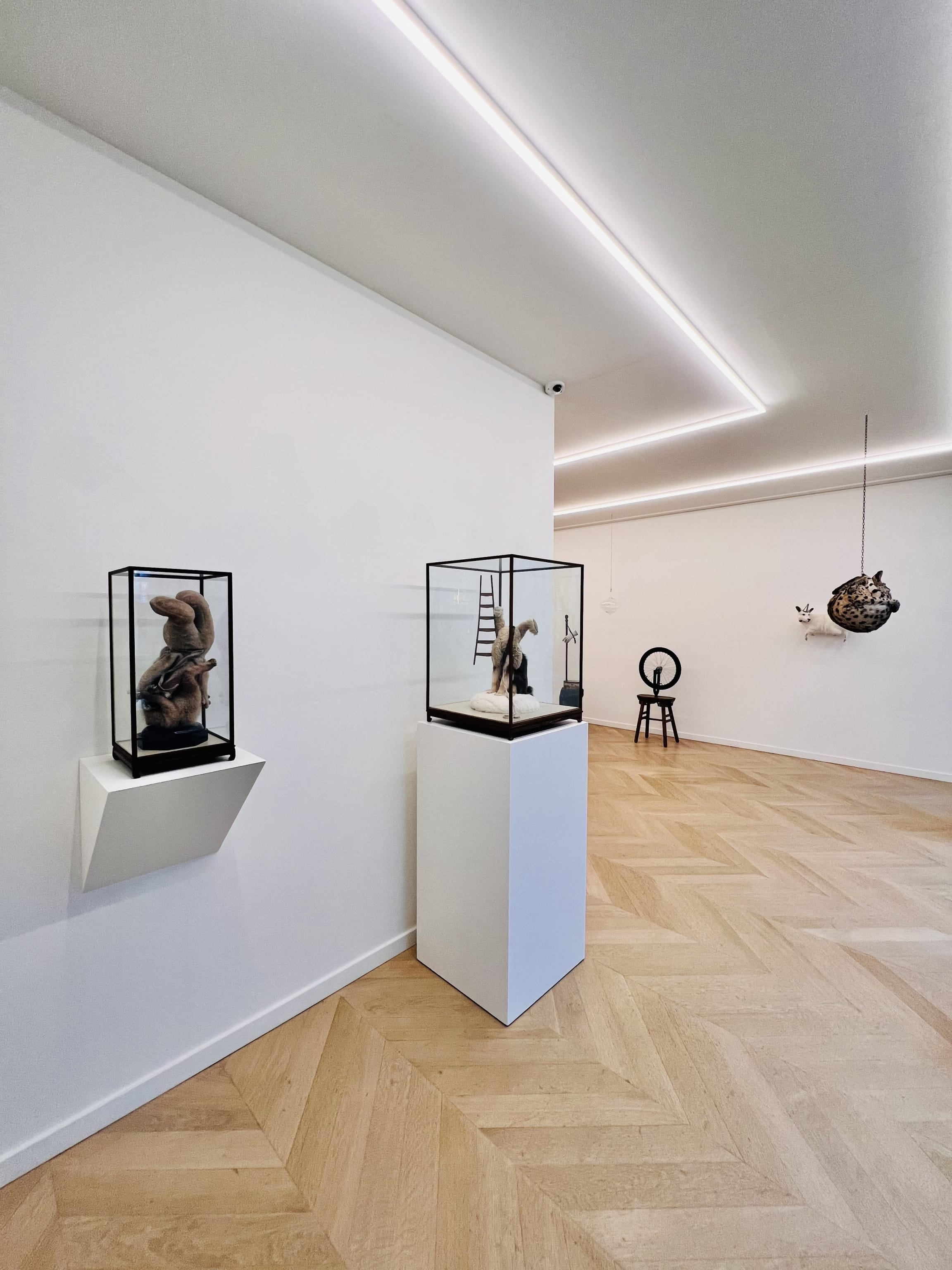
Atelier les deux garçons, Argent, COPPEJANS GALLERY
