02 december 2025, Wouter van den Eijkel
Nowhere but the Night: 13 kindred artists who, like Erwin Olaf, link nightlife with activism
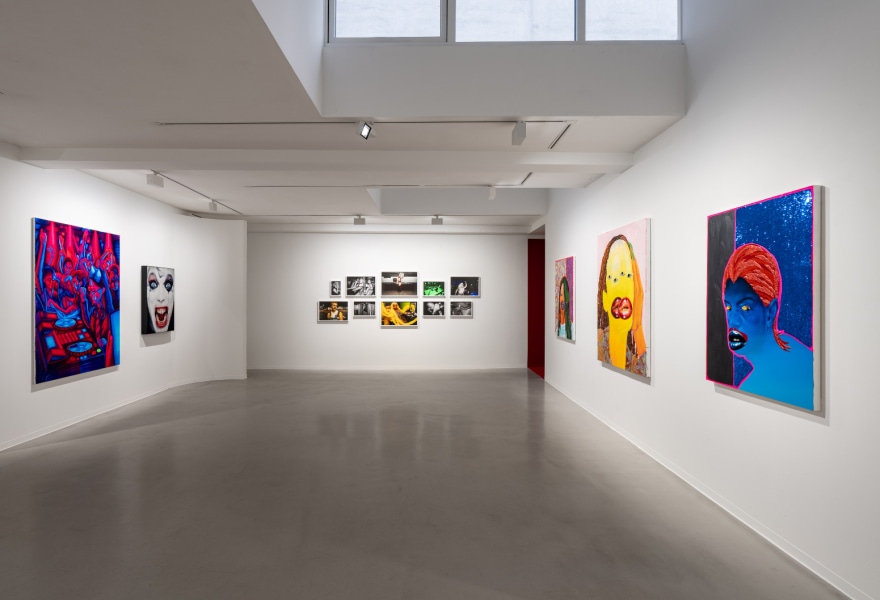
If you plan to visit Freedom, the major retrospective exhibition of the work of Erwin Olaf at the Stedelijk Museum, do yourself a favour and head straight to Galerie Ron Mandos afterwards, where curator Gemma Rolls-Bentley has programmed Nowhere but the Night, featuring 13 kindred artists who, like Olaf, link nightlife with activism.
Nowhere but the Night is an exhibition that highlights two elements from the oeuvre of photographer Erwin Olaf, who passed away in 2023: nightlife and the activism of the queer community linked to it. “From the moment he moved to Amsterdam in the early 1980s, he was always part of local nightlife. Erwin organised many parties of his own,” says Lars Been of Galerie Ron Mandos. These parties took place at places like the Roxy and Paradiso and he was also involved in the founding of the Milkshake Festival. “The parties often had an activist element, inviting speakers from politics or civil society to make a statement.”
“We really wanted to present something different from the Stedelijk. That’s why we asked a curator to put together an exhibition,” says Been. Curator Gemma Rolls-Bentley selected 13 artists from around the world to engage in dialogue with the work of Erwin Olaf.
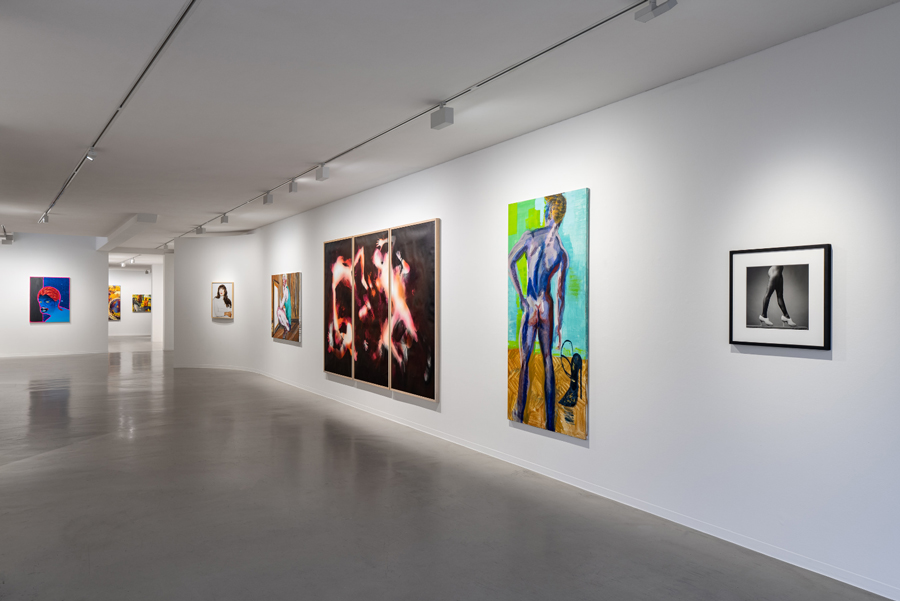
Nowhere but the Night, Galerie Ron Mandos. Installation view Jonathan de Waart
Rolls-Bentley has been curating exhibitions of queer art for nearly 20 years and is the author of the book Queer Art: From Canvas to Club, and the Spaces Between. “For queer people, the pathways to existing have not been straightforward, so the art of the community is not always going to be found in a gallery or a museum, or the traditional places where you might find art. It might be in the street, at a protest, on a dancefloor, or on a podium,” she told The Guardian last year.
The importance of nightlife for the queer community can therefore not be underestimated. The title of the show underscores this. Rolls-Bentley borrowed Nowhere but the Night from an essay by Australian writer McKenzie Wark, in which she argues that the night is the only part of the day when queers and trans people can express themselves freely. Like Oaf, the artists selected by Rolls-Bentley link the subject of freedom—the freedom to be who you want to be—to nightlife.
That nightlife already starts with preparations for a night out—or even earlier, with the lack of acceptance by society. A major name selected by Rolls-Bentley is German artist Rainer Fetting. In the life-sized painting Sebastian + Fetish (2003), we see a naked man from the back with a black stiletto heel to his right, getting ready to head into the nightlife.
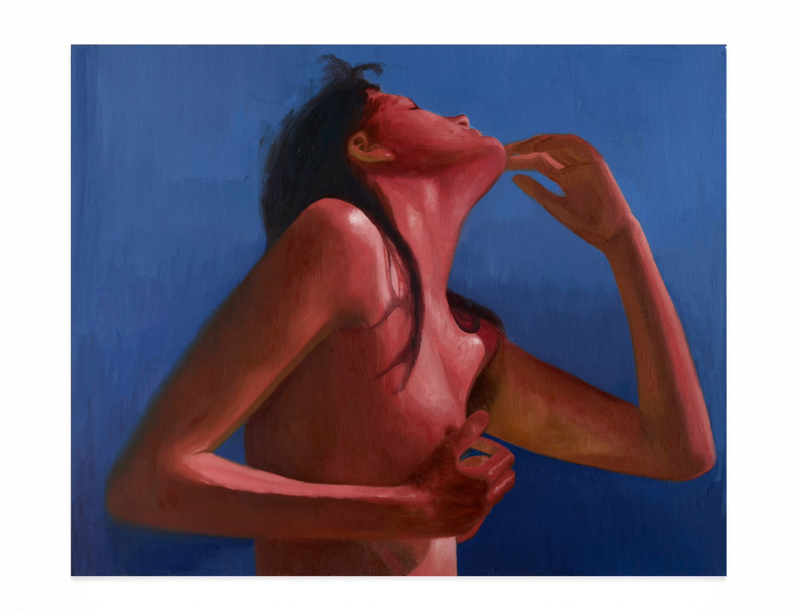
Erin Holly, Like a celestial mountain, 2025 Galerie Ron Mandos.
The charcoal drawings by British artist Erin Holly also revolve around home scenes, but the atmosphere is completely different. Silence and tension are almost tangible in the sparse interiors. Holly is a trans person, as are the subjects portrayed. They are physically present, but nothing indicates that they are mentally available. Rubie is lost in her own thoughts—her eyes are open, but do not perceive their surroundings—whereas Ailo has closed their eyes and exists in a similar limbo between presence and absence. “These drawings show the isolation and heavy feelings that people also experience outside of going out.”
The Latinx and queer nightlife experience in Los Angeles is documented by Amina Cruz, who encountered punk culture at a young age, which is reflected in her raw visual language. Her images are a mix of rebellion, tenderness and deep engagement with her subjects. It is the gaze of an insider, producing images you would never see as an outsider. Cruz takes you to the dance floor, the dressing rooms and the back alleys.
Olaf’s work hangs among these kindred spirits: portraits from his Paradise series hang next to Cruz’s work. This is the first time Cruz’s work has been shown in Europe. In the U.S., she is often regarded as the apprentice of renowned queer artist Catherine Opie. While Cruz highlights the freedom that nightlife offers, Olaf, on the wall beside her, emphasises its social insecurity in his Paradise series—something that is, unfortunately, also inseparable from a night out.
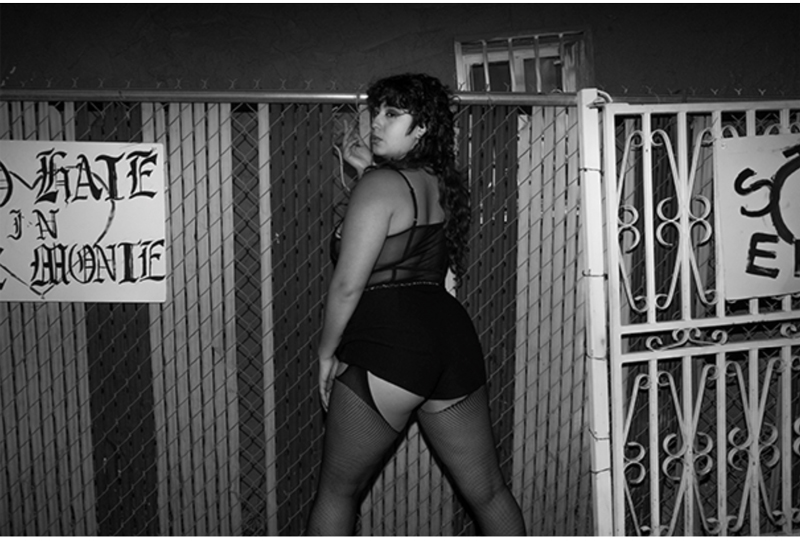
Amina Cruz, Monie, Los Angeles, CA, 2021, Galerie Ron Mandos.
Museum quality
A special red room at the back of the gallery is dedicated to Erwin Olaf’s work. The selection consists mainly of black-and-white photographs he took while out at night. Almost all of them date from the early 1980s. The photos offer vivid insight into nightlife in the capital around that time. Some men pose provocatively, while other images are tender—such as a lesbian couple embracing. What stands out most is the spontaneity of the images. Instead of the perfect lighting, art direction and stillness we associate with Olaf, these are shots of friends and acquaintances, bursting with energy against the backdrop of a nightclub.
The design and presentation of the red room are of museum quality. In addition to the red walls and floor, there is also a wall-sized sticker showing how Olaf made his selections from his photographs: short notes on contact sheets, scribbles, crosses and circles. “This is literally how Erwin worked in his studio. He made an A, B, C and D selection. He put a circle around the works he wanted to show. The A selection became part of his oeuvre, the B selection he thought was good but didn’t know what to do with, while C and D meant not to be shown.”
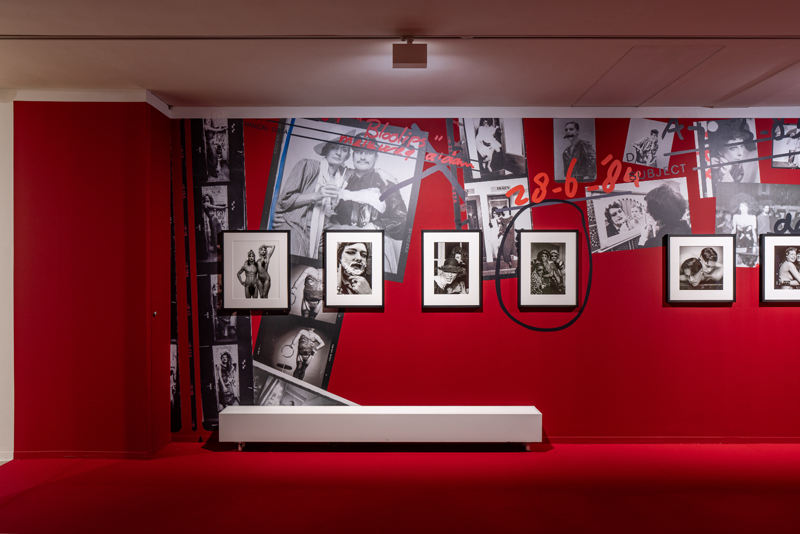
Nowhere but the Night, Galerie Ron Mandos. Installation view Jonathan de Waart
Aside from his well-known photograph of Grace Jones, many of the photos are being shown for the first time. “After his death, boxes in his archive were opened and suddenly thousands of photos of people in toilets or at hip-hop nights at Paradiso—entire series with punks—emerged.”
There is also the video work Rouge (2005), as well as several works from the Berlin series that Olaf made in the German capital in 2012. This was also the first series he made outside his studio. The red room also includes two works by Isaac Julien—stills from his film Looking for Langston—and a video by Miles Greenberg, the performance artist who recently presented his seven-hour performance Flaying of Marsyas at the Stedelijk.
Nowhere but the Night can be seen at Galerie Ron Mandos through 11 January.
James Bartolacci, J. Carino, Amina Cruz, Rainer Fetting, Miles Greenberg, Erin Holly, Leasho Johnson, Isaac Julien, Vidar Logi, Zanele Muholi, Erwin Olaf, Elsa Rouy, Devan Shimoyama and Zoe Walsh.
