28 november 2025, Redactieteam
The portraits of Jan Banning
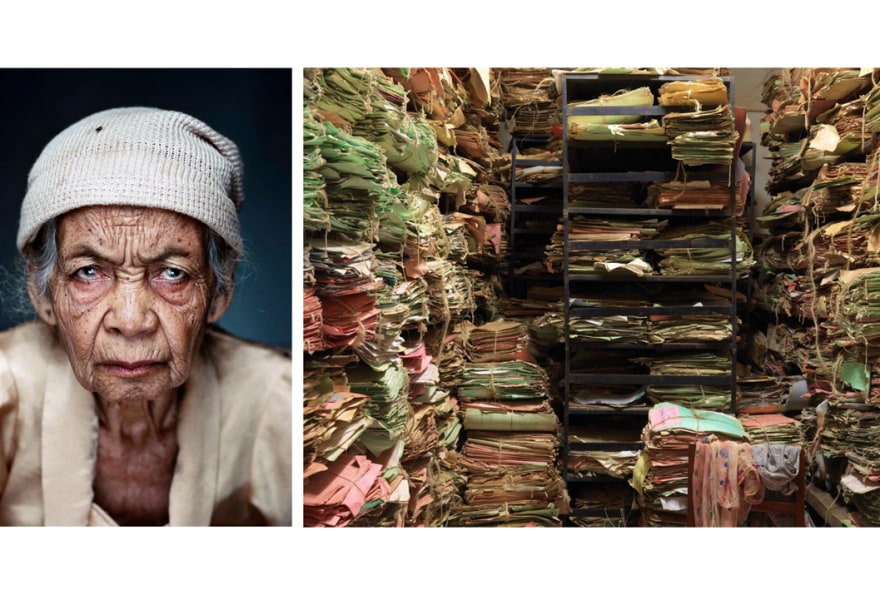
The new exhibition Between Rules and Reality at Galerie Fontana in Brussels brings together a concentrated selection from the extensive oeuvre of Jan Banning. Well-known works from series including Bureaucratics, Comfort Women, Law & Order, Down and Out in the South, and Red Utopia are shown alongside new work from his most recent project in Rwanda, Blood Bonds. Together, they chart a practice that has revolved for more than forty years around one central axis: the portrait as a meeting place, a space where human dignity, trauma, systemic critique, and empathy intersect.
Although Banning is internationally recognised for his portrait photography, the genre was not always self-evident to him. “I used to find portraiture the worst,” he says. “I thought I had to capture the essence of someone’s personality while not knowing them at all.” That resistance shifted when he realised that a portrait can never be absolute. “It clicked when I understood that a portrait is relative. If someone else stands behind the camera, a different aspect of that person will surface.”
Today, portrait photography forms the vast majority of his practice. Central to this is the way he works: extensive interviews before taking a single image, sometimes lasting hours, to create the fragile climate in which a portrait can emerge. It is what makes his photographs so distinctive: clear, direct, and rooted in a generous, open hand reaching outward.
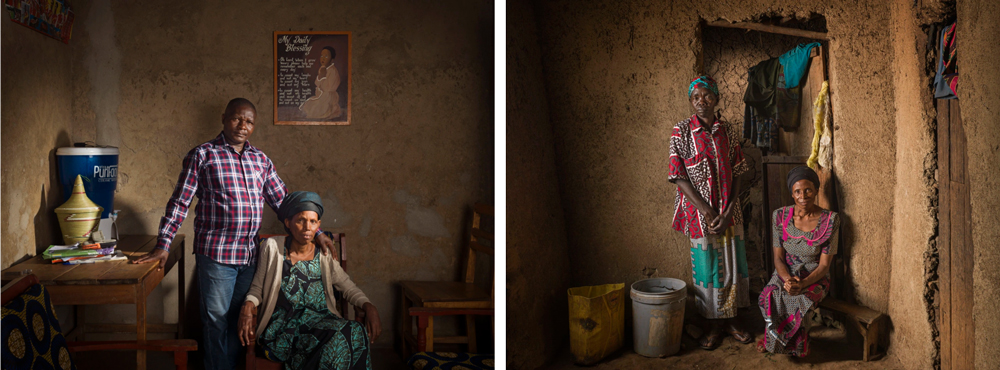
Jan Banning, Ezechiel Niyibizi (46) and Rose Mukarusagara (60), 2024, Ancile Unabagira (57) and Ancile Nyiramimani (52), 2024, Galerie Fontana
The red thread: the long aftershock of trauma
Across several projects in the exhibition, Banning shows not the moment of violence itself, but its long aftershocks. In Traces of War, he photographed men who, during the Second World War in Southeast Asia, were forced labourers under the Japanese army. His own father and grandfather belong to that history. “I wasn’t interested in the suffering as such,” he says. “I wasn’t waiting for someone to break down in tears. I wanted to understand the impact decades later. How do you live with such a past?”
That question runs through many of his projects and takes a new, deeply affecting form in his recent work in Rwanda, Blood Bonds, in which victims and perpetrators are portrayed together as new friends. It is a study of reconciliation, of the almost unthinkable capacity to share a life again. “In Rwanda I saw something I could barely comprehend,” Banning says. “People who had lost their entire families, yet chose to reconcile with someone who took part in the killing. Even to love them. It was astonishing.” That encounter also touched his own history. His parents and their generation never reconciled with their perpetrators; they left for the Netherlands and tried to close that chapter behind them.
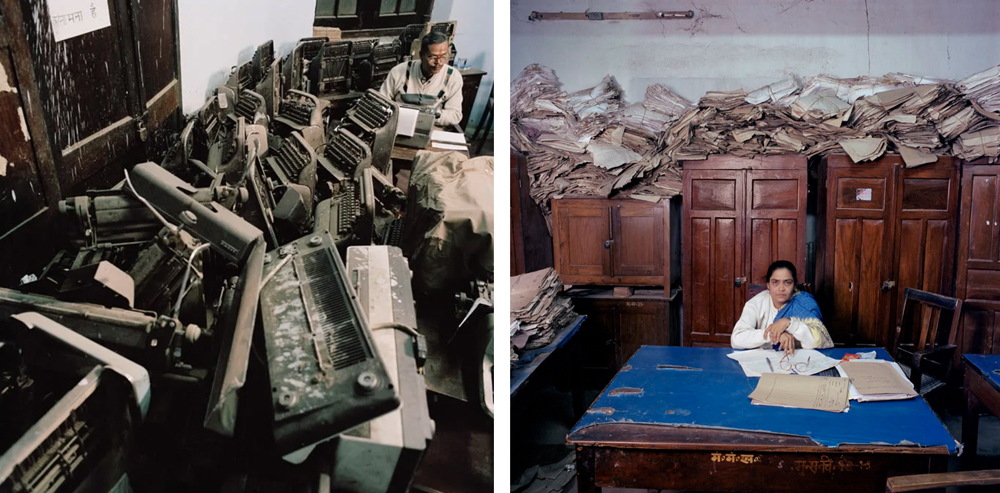
Jan Banning, Type Room, 2003, India 17, 2003, Galerie Fontana
Bureaucratics: the portrait of a system
Amid these human stories, Bureaucratics remains an iconic anchor point. The series is a conceptual study of civil servants in eight countries. Banning visited hundreds of offices unannounced, while writer Will Tinnemans engaged staff in conversation to prevent anything from being rearranged or hidden. The photographs reveal not only individuals but also the systems of power, hierarchy, and daily ritual that shape their environments. The result unites an anarchist heart, a historian’s mind, and an artist’s eye. Shown and collected worldwide, the series gave Banning the financial space to pursue more vulnerable projects.
Adora: a portrait that gained a second life
The exhibition includes a portrait of a blonde woman, Adora, from Down and Out in the South. In that series, Banning photographed unhoused people. “I photographed them the way I would photograph my friends,” he says. “Without labels, without stereotypical visual language. Just as people. The difference between them and us is small. They’ve had bad luck, we’ve had luck. If it had been the other way around, they would be standing behind the camera.”
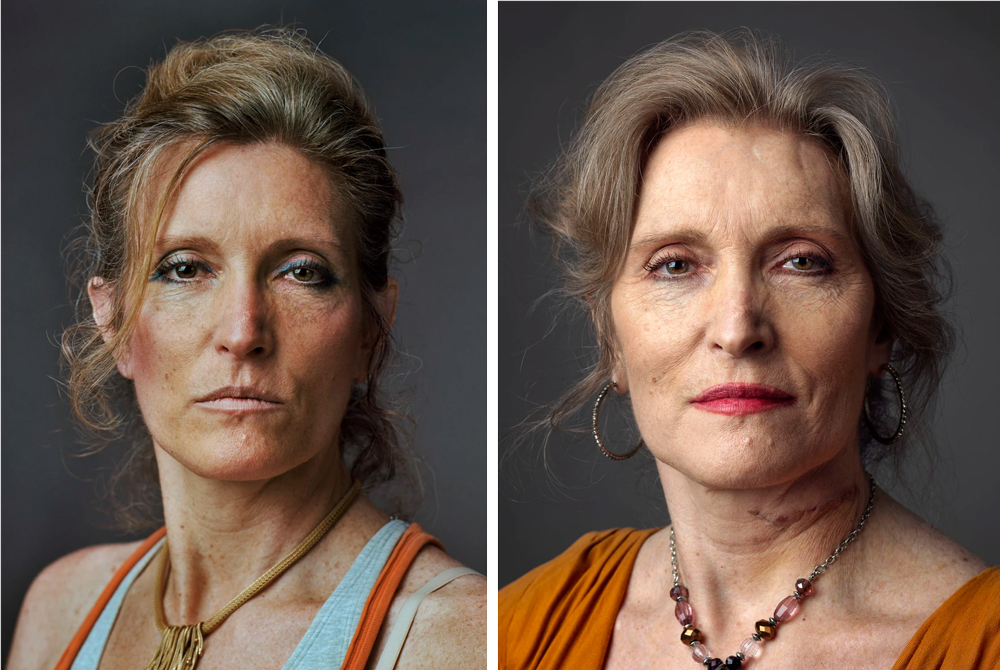
Jan Banning, Adora, homeless in Atlanta, Georgia, 2011, Adora, living in Orange City, Iowa, 2022, Galerie Fontana
A company doctor’s office later purchased three large portraits from the series, including Adora’s. Years on, the director asked Banning if he would try to find her again because the portrait had stayed with him. For Banning it became both a challenge and an ethical test. After a long search, he located her in Orange City, Iowa, a small town with Dutch roots. “It was wonderful,” he says. “We spent three days together. We laughed, caught up, and even ended up at a Dutch festival that happened to be going on windmills, clogs, Sinterklaas characters. I even taught her how to wave from the car like she was Queen Máxima haha.”
The reunion was not only moving for Banning. “I wanted to know what she thought of her portrait being shown in museums and broadcast on CNN,” he says. “I always work with release forms, but still, I wanted to hear how she felt about it herself. She could have been angry. But she felt seen. That made everything lighter.”
The essence
Visitors to Between Rules and Reality at Galerie Fontana in Brussels will recognise that Banning is not a photographer who collects stories, but an artist who builds meaningful relationships. His projects deal with war, justice, reconciliation, power, and loss, and again and again one question seems to return: how does someone remain human in conditions that make that nearly impossible? That is what Banning, with deep sincerity, tries to capture in his portraits.
Between Rules and Reality runs until 17 January at Galerie Fontana in Brussels.
