25 november 2025, Yves Joris
Between skin and halo: where the body reinvents itself
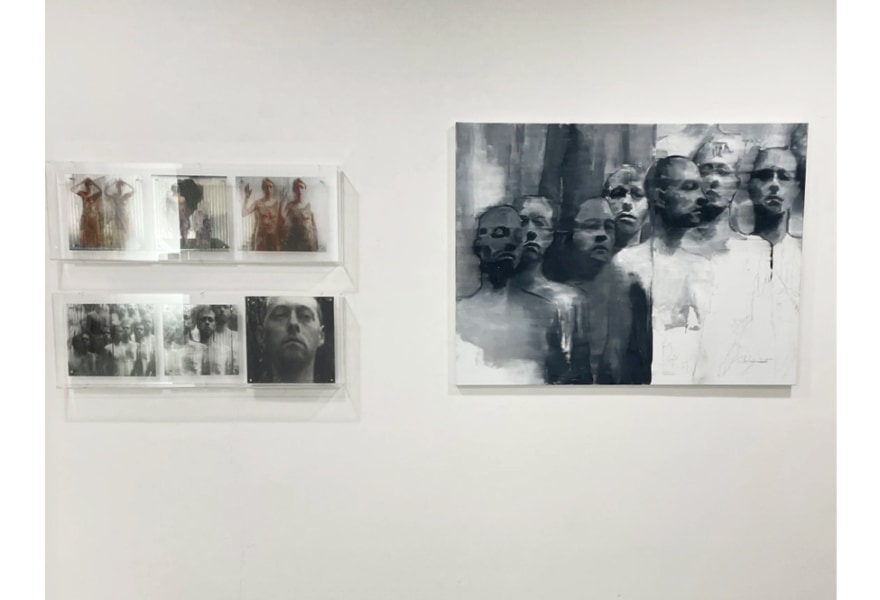
The title of the first solo show by Ulrike Bolenz, Real Humans, brings me back to the Swedish TV series of the same name (now more than 10 years ago) in which humanoid robots call into question our relationship to what it means to be human. In the series, the boundary between flesh and code, between presence and simulation, begins to blur.
With her exhibition Real Humans, Bolenz enters a similar universe. Not science fiction, but an open form of reflection. Not fear of what humans might lose, but curiosity about what the body can become when extended by technology. At Galerie Sofie Van den Bussche, a show unfolds in which the human body is not reduced to an algorithm, but expanded into transparent layering, light, memory and potential. Preparations for the exhibition are still in full swing when the artist and gallery owner take a break for a moment to explain the concept in more detail.
Preparations for the exhibition are still in full swing when the artist and gallery owner take a break for a moment to explain the concept in more detail.
The body keeps moving, even when standing still (Bolenz)
The body keeps moving, even when standing still (Bolenz) In the first part of the interview, Ulrike Bolenz explains how her artistic practice is rooted in the skin of the material itself. Between still-to-be-hung panels and testing light points in the gallery, she talks about 30 years of working with transparent polymers and bodies that seem to breathe with every shift of light. She does not consider these polymers a neutral carrier, but a second skin that changes in line with its surroundings. Her technique, monopolymer printing, consists of multiple layers of transparent materials. “I don’t want an eternal material,” she says, “but a material that lives.”
That idea resonates throughout her entire oeuvre. For years, Bolenz collected video fragments of models approaching the viewer, laughing, turning, recoiling. She calls these moments ‘archetypal gestures’, something that shows body language before meaning solidifies. And yet she felt that the images did not go far enough, that they were always cut off prematurely. It is precisely here that artificial intelligence intersects with her practice—not as spectacle, not as a futuristic gesture, but as an extension of a faltering recording. “AI gives me the possibility to let a movement that has come to an abrupt end to continue,” she says. “Not to replace the human, but to let the moment that was lacking continue to exist.”
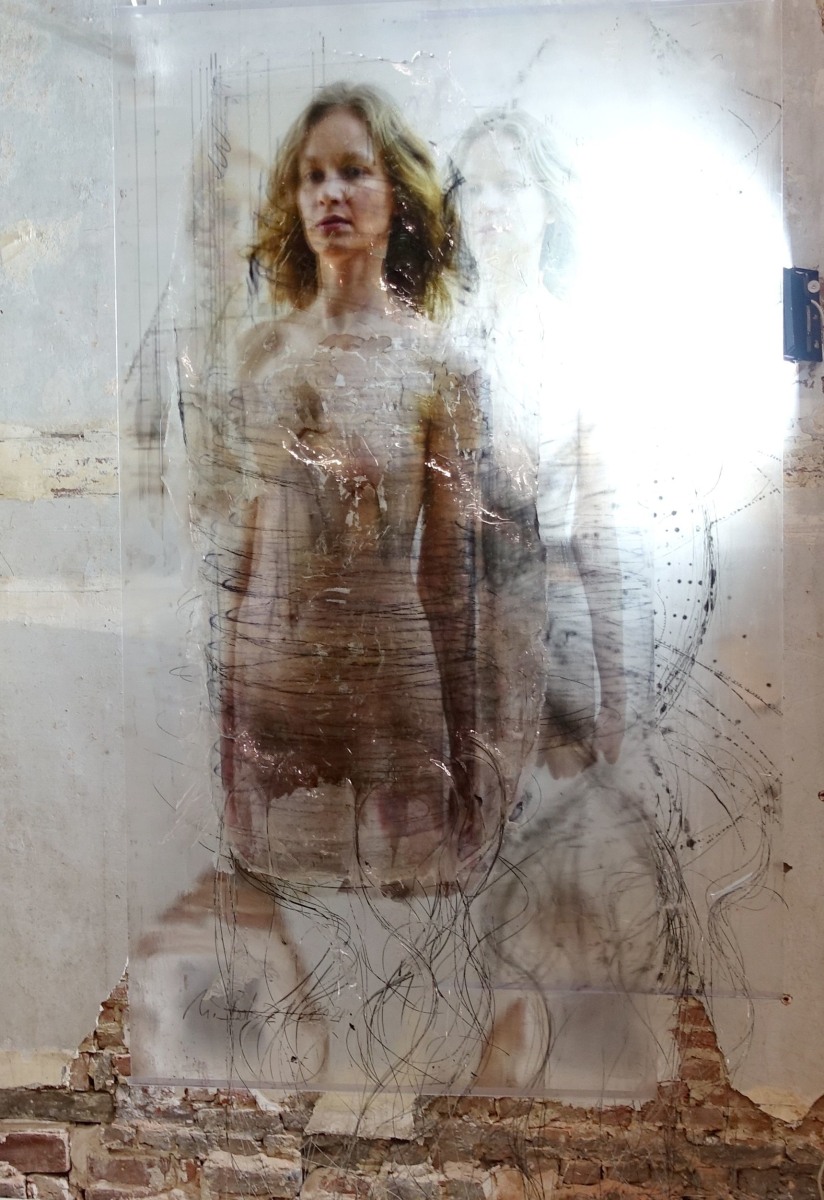
Ulrike Bolenz, Installatie Gemini, 2025, Gallery Sofie Van den Bussche
One of the works, Gemini, embodies this notion without becoming the centrepiece of the exhibition. It shows a human figure doubling and shifting within transparent layers, as if the body is observing itself while dissolving into light. What you see is not an exact copy, but a possible version—a sliver of identity rather than a depiction of technology. Bolenz emphasises that to her, identity is never cut-and-dried. She speaks of the body as a layered organism intertwining memory, time, projection and presence.
She refuses to let her work be dictated by market logic. “I can only make what is a step forward,” she says. “Every new work has to be an opening.” In that simplicity lies her strength: autonomy, devotion and the belief that art must keep moving. She laughs when she says she wants to go to bed early every evening so she can start faster in the morning. It doesn’t sound like discipline, but gratitude.

Ulrike Bolenz, Female Icarus floating II, 2025, Gallery Sofie Van den Bussche
The gallery as a space of trust and expansion (Sofie Van den Bussche)
During the second part of the interview, Sofie Van den Bussche takes the floor. She describes how Bolenz walked into her gallery a few years ago and how it immediately became clear that her work has an exceptional sensitivity. “There’s a consistency in her work,” she says. “But she also keeps evolving. That’s what I find most powerful about her: she changes, yet remains recognisable.”
For Sofie, it is essential to show the materiality of Bolenz’s work. The transparent carriers that hold so many meanings lose their strength on screens. “You have to see them move with the light,” she says. That is why the exhibition includes both monumental installations and more intimate drawings and smaller prints. The gallery becomes a space where scale and vulnerability co-exist. Sofie emphasises that the exhibition intentionally includes accessible elements. “Curiosity must be able to find an entry point,” she says. “Not everyone walks in here with prior knowledge. But everyone should be able to enter with wonder.”
Her view on the technological elements in Bolenz’s work is equally clear. “It’s never technology for technology’s sake,” she says. “It’s always a means to give the body more space. She doesn’t work with gadgets, but with possibilities.” In her opinion, that is precisely what distinguishes Bolenz’s work from that of many other contemporary artists who dive into digitality: the human remains the core, not the concept.

Ulrike Bolenz,Cloning Evolution Marie, 2025, Gallery Sofie Van den Bussche
The human as transparent layer, as echo, as ongoing possibility
Real Humans iis an exhibition that does not illustrate, but questions. The reference to the TV series is coincidental but fitting, as Bolenz occupies herself with what is missing there: not the robot-human, but the human who constantly transforms into a new version of itself. The body in her work is not an entity, but a field of changes. The transparency of her materials becomes a metaphor for both the visible and invisible in the human condition.
In all the work on display, the same principle flickers: humanity lies not in completion, but in incompleteness, not in a single identity, but in the layering of identities that slide across one another. In a time when virtual versions of ourselves float across screens, Bolenz shows not a fear of disappearance, but the potential of multiplication. Her layers make tangible that the human is never a single image.
With its windows, walls and paths of light, the gallery becomes an in-between space that invites visitors to look with a subtle readiness to doubt. What happens when the body doubles? Where does the digital begin and the physical end? And why should we still consider those boundaries to be divisions?
What Real Humans ultimately shows is that the image of the human does not stop when technology joins in. Instead, it starts anew. The body keeps moving, even when standing still. The skin keeps breathing, even when it becomes transparent. The human remains real, even when dissolving into layers.
