14 november 2025, Martine Bontjes
The studio of... Anouk Griffioen

Over the past twenty years, Anouk Griffioen has been working on her monumental black-and-white drawings from her studio in a former girls’ school in Rotterdam. Through her lens, trees seem to grow out of concrete, while in her drawings mythical forests emerge from charcoal. At the heart of her work lies nature’s resilience and its endless ability to reinvent itself. This coming weekend, her work will be on show in the exhibition ‘Where I End and You Begin’ at Yellow Gallery, which offers a preview of her solo show opening in March 2026 at the Kröller-Müller Museum.
Griffioen has observed landscapes in cities including New York, Lisbon and Lagos. Wherever she goes, her gaze turns to the green: “How people engage with green, the history of a park, a single tree or a bush, I can lose myself in such details endlessly.” The work of Griffioen will be shown alongside the sculptures of Bram Ellens.
Where is your studio and how would you describe this place?
My studio is in Rotterdam, in a former girls’ school in the Robert Fruinstraat. I’ve been there since 2005, and it’s a wonderful place with lots of light, within walking distance of my home. That convenience is probably why I’ve never moved, although I often struggle with a lack of space. Whenever I start something large, it’s a matter of measuring and fitting, which I’m really not good at. More than once I’ve gotten stuck in the stairwell or had to work horizontally because the ceiling was too low. When the children were small, it was perfect to walk the dog and then spend a quiet evening at the studio. It allowed me to draw around family life. Last summer I finally built an extra wall, something I should have done years ago. Now everything fits in storage behind it, arranged like a Tetris puzzle where I can’t find anything anymore, but I’m happy with it.
If I would shadow you in the studio for a day, what kinds of activities, meet-ups or routines would I witness?
I usually arrive between eight and half past eight. The first thing I do is turn on the coffee machine. My laptop sits faithfully on my desk but stays closed all day. Once I have my coffee, I lock the door. My phone is always on silent, to the great frustration of my family. I prefer to work in silence, all day long. When I get home in the evening, I often have to relearn how to talk. I always know exactly what I’ll do; I can see it the day before. Working never feels like going to work, it’s simply part of who I am. Inspiration is there constantly; my mind is usually three drawings ahead. I still get goosebumps when a piece suddenly clicks or connects with another work. I rarely receive studio visitors, probably because I’m not good at promotion. I don’t work with a fixed gallery, so I don’t get requests from that direction either. Once a year, during the Groot Rotterdams Atelier Weekend, the doors open.
You draw without erasing. Is that a technical decision or also a philosophical one?
I sometimes use an eraser for smudges or fingerprints, but it’s rarely necessary. My technique allows me to work in such a way that nothing needs to be removed. When you erase, you always leave traces. The white spaces are essential, they’re a kind of drawing through absence. By leaving things out, something can become even more visible. My work is half looking: spending a long time studying the whole until I know for sure it’s finished.

Where I End and You Begin, Yellow Gallery
You work on both large and smaller scales. Does your way of looking and observing change with the size you work with?
I love working large. I can’t resist dragging huge panels into the studio and spending months covering them with fine lines. Financially, it’s trickier: I can only buy new materials when I sell a work, so sometimes smaller pieces have to be made too. My teacher at the academy, Arie van Geest, once said: “Once you go big, you can never go back.” And he was right. The large gesture suits me. But at openings I’d rather stand quietly in a corner—or be at home on the couch. I don’t need to stand next to the work.
In your photography you look at visible reality, while in your drawings you create your own landscapes. Is it difficult to switch between observation and interpretation?
I don’t really think about it. Photography feels very natural to me. I always carry my camera with me, just in case. I can’t stand taking pictures with a phone, so I always regret not pulling out the Leica in time. Sometimes I photograph natural structures or a patch of weeds as preparation for drawings, but often the photograph itself is the final image. What comes out of the camera is either right or wrong. I also work a lot with Polaroid. I’ve built an archive since I was eighteen. My old camera broke last year, but I’ve found a new one that I love. Every holiday I secretly leave behind socks and a warm sweater to make room for more Polaroid film. I rarely show my photography because I’m still searching for a way to present both media, drawing and photography, on an equal level. How do you make a photograph as important as a two-meter charcoal drawing? That’s still an open question. This year I started working on a book together with Studio Joost Grootens and publisher Jap Sam Books. It will be an archive of my work, placing photography and drawings side by side, at the same scale.

Anouk Griffioen, Central Park, Yellow Gallery
You’ve observed landscapes in New York, Lisbon and Lagos. Which one of these inspired you the most?
New York. I feel homesick sometimes, t’s the only place that gives me that feeling. The moment I step out of a taxi there, I feel at home. I don’t have that in Rotterdam; I could live in another city without hesitation. New York remains special, it’s always alive. Walking the streets and sitting in museums, I love it deeply. I’d move my whole family to Brooklyn or Greenwich Manhattan today if I could. America is strange and so different from the Netherlands. It’s endlessly fascinating. In 2024 I had the opportunity to work with Magnum Photos on a project about greening the city. For a week I met with a photographer daily, and on the final day we collaborated with a book designer to create a cohesive whole from my images. That week taught me a lot about my own perspective. It felt like a hangover when it ended. Since then, "Life Between Buildings" has been a continuing theme. In every city I visit, I look at the green: how people engage with green, the history of a park, a single tree or a bush, I can lose myself in such details endlessly.
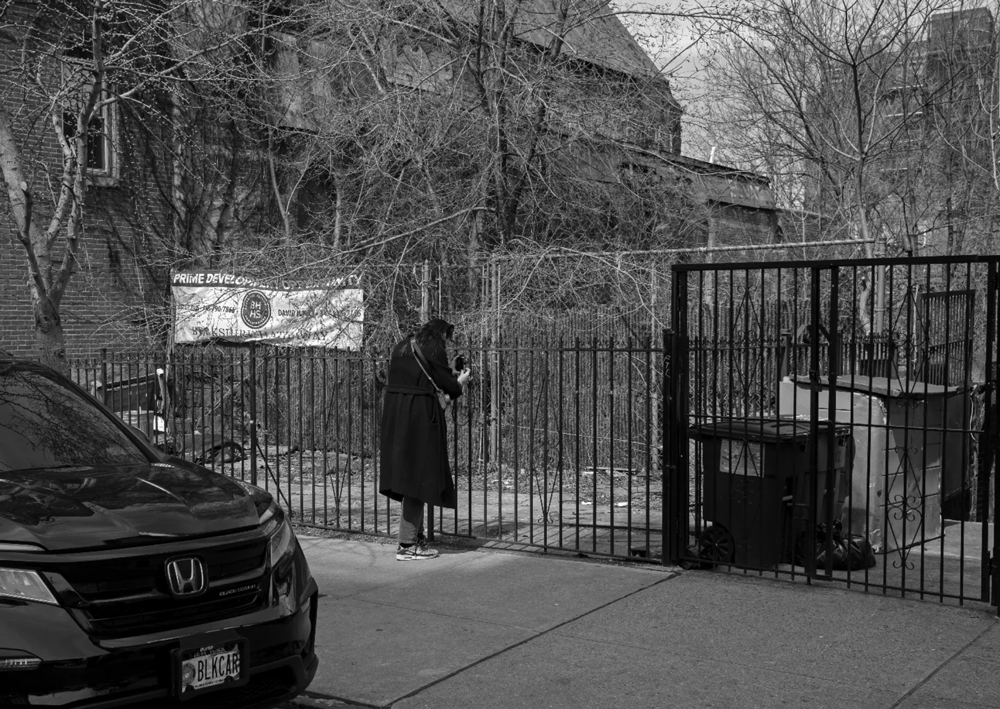
Photo in New York by Marten van Dijl
What draws you to the tension between the natural and the urban, such as your trees that seem to grow out of concrete?
Nature cannot be contained. I find it beautiful when a tree breaks through concrete or survives on a patch of dry ground. In New York, residents could plant a tree themselves through the “Million Trees Project” and then care for it. That created a new sense of responsibility for the street. In Florence, cypresses rise above the city. They were often planted in the garden of a deceased family member, to guide the spirit toward the sky. Such connections between nature and people move me deeply.
Which landscapes would you still like to photograph?
I don’t have a specific landscape in mind, but I would love to return to New York to see how the “Million Trees Project” has evolved. Several years ago I began a "Museum of Nature," a project that still lingers in my mind. It began as a doomsday scenario in which trees existed only in museums, but it grew into something hopeful. Part of the installation now stands at Erasmus University, a concrete complex where nature suddenly asserts its presence. That contrast continues to fascinate me. Next year I’ll continue building my “museum.”
Are there new projects or future plans you are already excited about?
Yes, my first museum solo is on the horizon. In March 2026, "Nu het er nog is" (curated by Jochem Rotteveel) will open at the Kröller-Müller Museum. The idea that it’s actually happening still feels unreal. The exhibition at Yellow Gallery is a preview of what is coming at the Kröller-Müller Museum. The idea for it emerged while I was working on my book. A book forces you to take a step back, to see who you are and why you do what you do. Through that process, I realized how much influence my father has had on the way I look and work. He always photographed nature, carefully pasting the prints into albums. I’ve become the same kind of collector. One photograph that used to hang in our home, in several houses even, became the starting point for the exhibition. I revisited the places from my childhood where he took his pictures. The exhibition tells a story of survival and remembrance. In one of the drawings I secretly hid him. The search also brought me to the Veluwe, where I’m creating a large work that functions like a window to the outside. My mother, who spent long periods in hospitals, often sat by the window, gazing out but unable to go outside. I always carry that image of her with me. Perhaps that’s why I myself want to go outdoors, into nature. My father took walks to forget home; I find that a comforting thought.

Anouk Griffioen, Tiengemeten, Yellow Gallery
