10 november 2025, Martine Bontjes
The studio of... Jaume Amigó
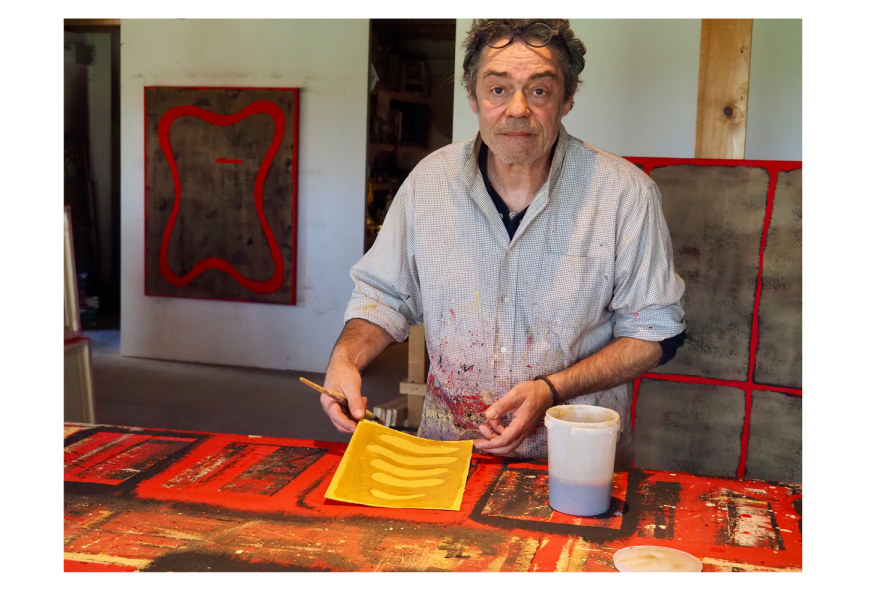
Jaume Amigó describes his studio as an island, a temporary place where he can easily detach himself from the outside world. He has worked in Ifitry, Osaka and Tokyo, each time setting up short-term studios that moved with his adventurous life. In his newest exhibition "Islands" at Galerie Roger Katwijk, Amigó translates his travel experiences into his work. In his warm scarlet paintings, he captures the shapes, scents and memories of the places where he stayed.
Amigó’s work was on view last weekend at booth #69 at the PAN art fair in the RAI conference centre in Amsterdam. After the fair, his work will be on view until 29 November at Galerie Roger Katwijk in Amsterdam.
You describe your studio as a mobile and permeable space for creation. What do you mean by that?
In fact, my studio is wherever I am at any given moment. I have had studios in Japan, Morocco and in many other places. I like setting up a studio that I know will be temporary; this allows me to absorb the essence of a place and translate it into my paintings.
Do you ever invite other artists into your studio, or is your studio a place of solitude?
To paint, I need to be alone. I understand the studio as a space of solitude and concentration. The only living being I can share it with while I paint is my dog.
What is the first thing you do when you enter your studio? Are there certain rituals that help you get into your work mode?
I have many rituals when I enter the studio. I like to look at what I painted the day before; it gives me a way back into the work. Often, before I begin, I put on music and light incense. There are days when, if I don’t know where to start, I sweep the studio. It’s a kind of Zen exercise that helps me visualise what I am going to do.

Jaume Amigó White Islands 3, 2025, Galerie Roger Katwijk
Your notebooks seem essential to your process. How do they function, are they more sketches or full written diaries?
I’ve always believed that when you have an idea for a painting and don’t write it down, that idea dies and disappears. In my notebooks I make sketches, write ideas and concepts, create lists, I keep leaves from trees that slowly dry over time. They are a way of organising my thoughts. I often revisit them, and I always find something that inspires me.
You work with many different materials, what are your favorite materials to work with?
I use a wide variety of materials in my work. I love paper; I feel very comfortable painting on it. Paper is a living material, it changes shape, wrinkles and it always brings something unexpected to the work. I often work with Japanese paper, which has excellent quality and is perfect for what I want to achieve in my drawings. I have worked with clay since I was very young because it allows me to express ideas in three dimensions, and I have created a lot of ceramic pieces over the years.

Jaume Amigó Winter leaves, 2025, Galerie Roger Katwijk
You describe yourself as a ‘collectioneur des formes’. Can you explain what you mean by that?
When I travel, to Morocco, Japan or anywhere else I always pay attention to shapes around me that surprise me because they are unfamiliar. That’s why I like to draw them in my notebooks. It’s a way of collecting these new forms that I discover, which are very diferent from the shapes I know and keep in my studio.
Your new exhibition at Galerie Roger Katwijk is centered around the idea of islands. What drew you to that concept and which islands do we encounter?
The island as a concept has been present in my work for a long time. Beyond being a geographical space, I am interested in it metaphorically. My studio is like an island, a place where I am isolated from the outside world. Almost all the works in the exhibition at Galerie Roger Katwijk represent islands. While painting them, I recalled scents, sensations and memories from the islands I have visited, lived on or worked on throughout the years.

Jaume Amigó, Archipelago, 2025, Galerie Roger Katwijk
You’ve referenced the Japanese poet Matsuo Bashō. What fascinates you about this poet? When did you first encounter his work?
One way of travelling is through reading. Many years ago I read The Narrow Road to the Interior by the Japanese poet Matsuo Bashō (1644–1694), and I immediately connected with it. It was like reliving my own journeys in Japan. What captivated me about the book is the simplicity with which he describes everything. His haiku capture a great amount of meaning in very few words, they are very Zen.
Red is the dominant color in your work. What draws you to this color?
I have always worked with pigments, and I often use scarlet red. Years ago, red had a very secondary role in my work. Gradually, it gained more presence until it flled entire compositions. The colours in my work are always linked to my emotional state, to the place where I am painting, or to the specifc nature of the project I am working on.
What are your next steps? Are there any new places, materials, techniques or collaborations you would like to explore?
My next steps always begin in the studio, painting. At the moment I am preparing for an exhibition in Osaka, Japan, and a working residency in Morocco. This year I have also produced a series of bronze sculptures, an entirely new world to explore.
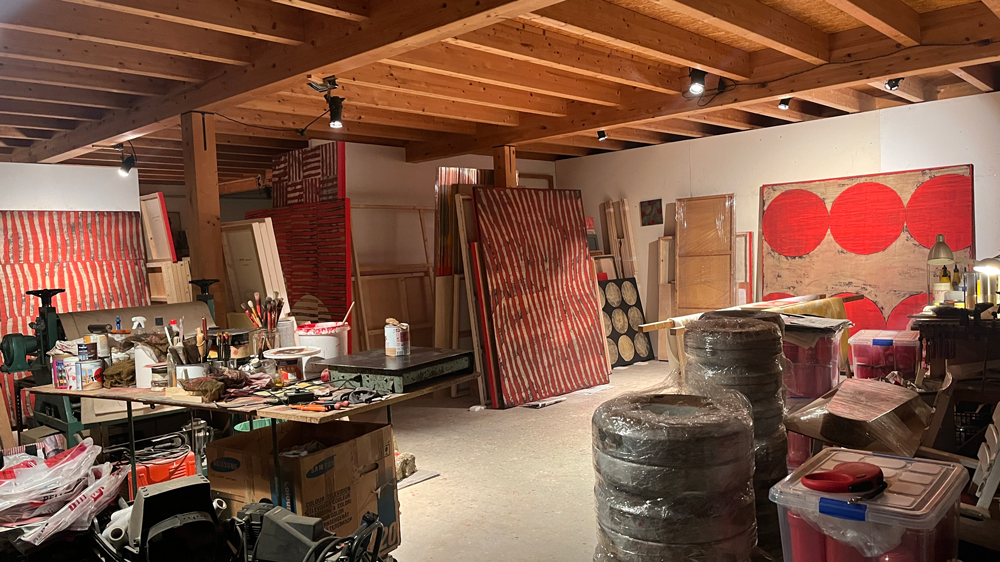
Studio Jaume Amigó
