03 november 2025, Flor Linckens
Adam Colton and the anatomy of light
Light is never static in the work of Adam Colton. It shifts, refracts and dissolves. It is caught in plaster, escapes through openings in the material, reflects off silver and is absorbed by paper or a dark background. In his solo exhibition ‘Shining Through’ at Slewe Gallery, his sixth with the gallery, the British-Dutch artist explores how light can be made tangible. He examines reflection and transparency, and the ways in which matter can capture and hold light.
Each of Colton’s sculptures seems to have been slowly liberated from its material. The artist drills, sands and polishes until an organic form emerges that feels balanced, a transformation that often unfolds between two and three dimensions. His focus lies on perception, on the ways in which we observe reality. His practice is, in essence, a study of form, of how something can be understood and then allowed to breathe within a space.

Adam Colton was born in Manchester in 1957. He started his education at Ateliers ’63 in Haarlem at the age of twenty-four and has lived in the Netherlands ever since. Before that, he attended the Camberwell School of Art and Crafts and Manchester Polytechnic. Over the course of his career, he has received various awards, including the Charlotte van Pallandt Prize (1987) and the Sandberg Prize from the Amsterdam Art Fund (1991). Colton has had solo exhibitions at Museum Boijmans Van Beuningen, the Kröller-Müller Museum, the Bonnefanten museum and Stedelijk Museum Bureau Amsterdam, and has participated in group exhibitions at De Oude Kerk, the Henry Moore Institute in Leeds, Museum Arnhem and the Stedelijk Museum Amsterdam. His work has been included in the collections of the Stedelijk Museum, Museum Boijmans Van Beuningen, the Bonnefanten museum, Museum Voorlinden, the Kröller-Müller Museum, the Frans Hals Museum, ABN AMRO, KPN, SNS, LUMC and the AkzoNobel Art Foundation. His sculptures can also be found in public spaces in cities such as Amsterdam, Zwolle and The Hague, as well as in the sculpture garden of the Kröller-Müller Museum. Last summer, one of his works was featured in the ArtZuid exhibition.
Colton began his career by creating plaster constructions based on the proportions and patterns of his own body. In the resulting sculptures, the body is only present as an echo, as a structural memory. Later, his attention shifted to other sources of inspiration, including everyday objects, debris, architecture and nature. His choice of materials also evolved: from plaster, wood and sandstone to aluminium and synthetics such as polyurethane foam. For the works in this exhibition, he once again returned to plaster. The artist also works extensively on paper, both as an autonomous practice and as a starting point for his three-dimensional pieces.
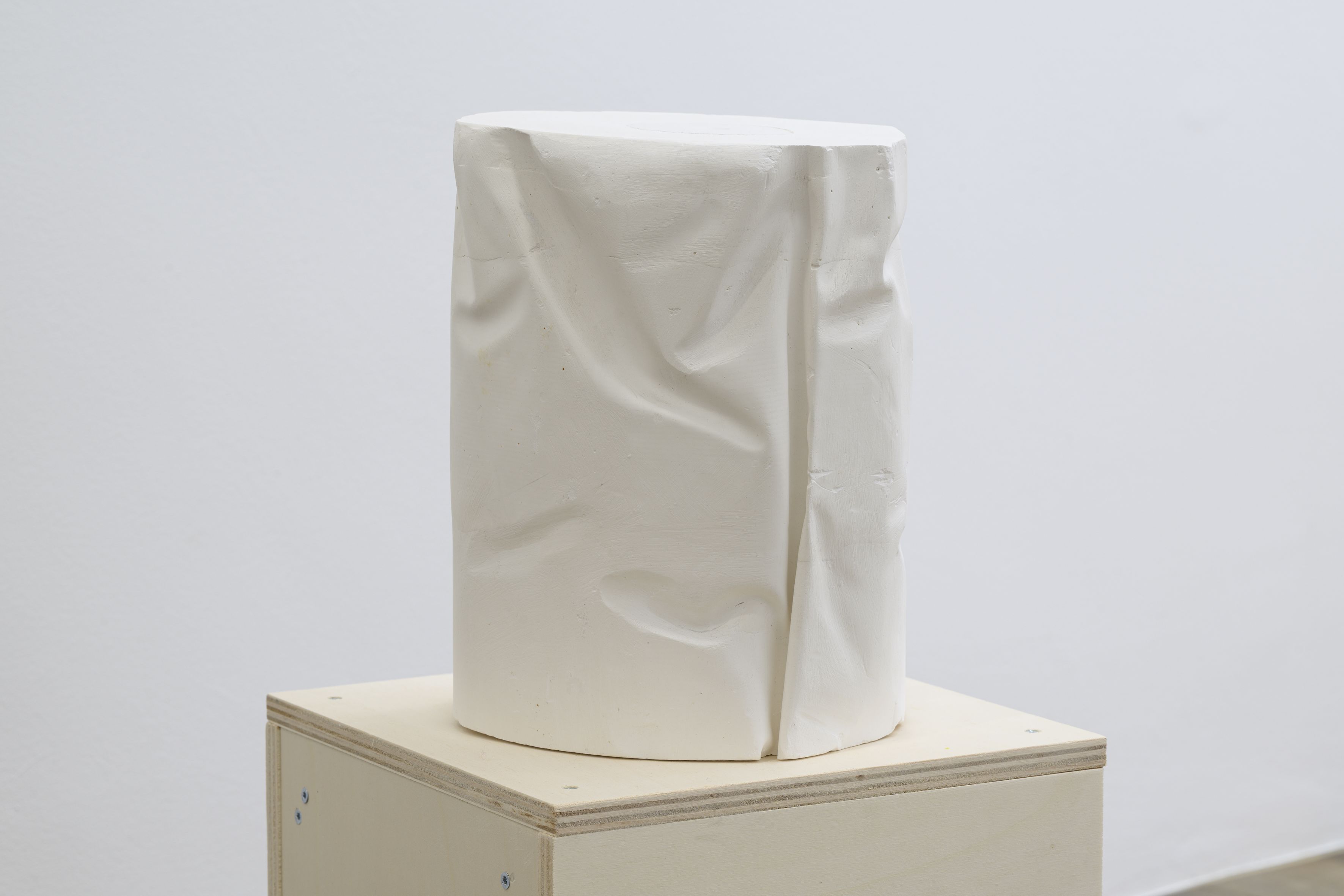
The plaster sculptures in this exhibition feature asymmetrical curves that recall bone structures, rock formations, shells or corals. Colton reinforces the plaster with materials such as steel or jute. While his sculptures are not explicitly figurative, they seem to subtly allude to the body. They carry a certain ambiguity: they appear both heavy and weightless, opaque and transparent, rational and intuitive. The materials seem almost to negotiate their own weight and volume. It's a tension that runs throughout Colton’s work.
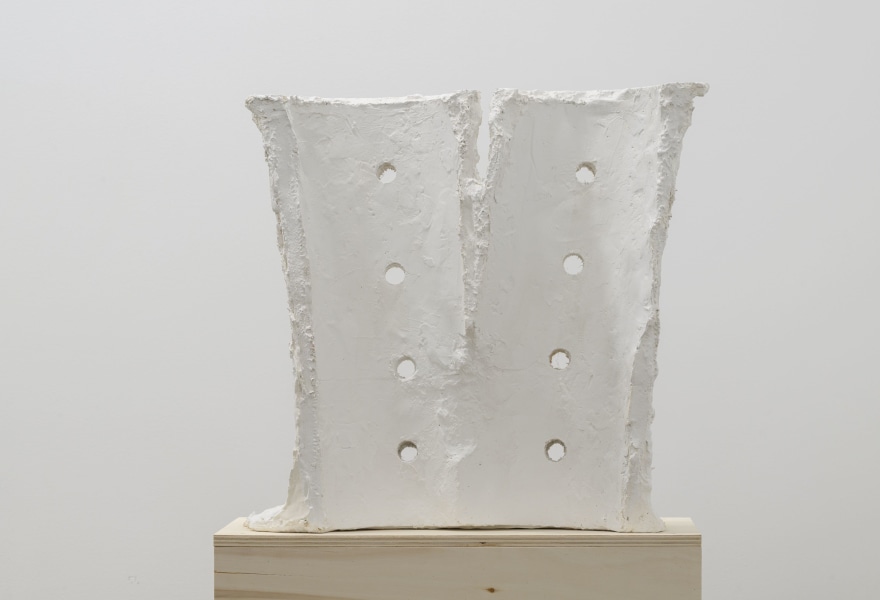
Some sculptures appear smooth and solid, such as "Smooth Space", "River of Space" and "Baroque Space". Others, like "Shining Through I" and "II", are porous and fragile. With "Wall", Colton presents a curved plaster panel with frayed edges. The back almost resembles solidified foam. The porous surface, pierced by eight openings, feels delicate, as if something interior has been turned outward. The sculpture’s matte, brittle and irregular skin is accentuated by a deep crack that runs through the centre. Light seeps through the perforations. Despite its title, "Wall" appears to have more in common with a membrane than with a solid barrier.

The walls of the exhibition are lined with collages of silver paint on wood combined with iridescent paper, as well as works that consist of silver paint and polyurethane on paper. In pieces such as "Sea of Time II" and "Panta Rhei no. 3", Colton uses a silverpoint pen and acrylic on dark backgrounds. The fragile patterns evoke microscopic tissues, nerve pathways or rivers meandering through a landscape, yet up close they reveal a meticulously constructed universe shaped by rhythm, control and repetition, precisely the field in which Colton’s work seems to move.
