24 october 2025, Martine Bontjes
The studio of... Jeske Haak
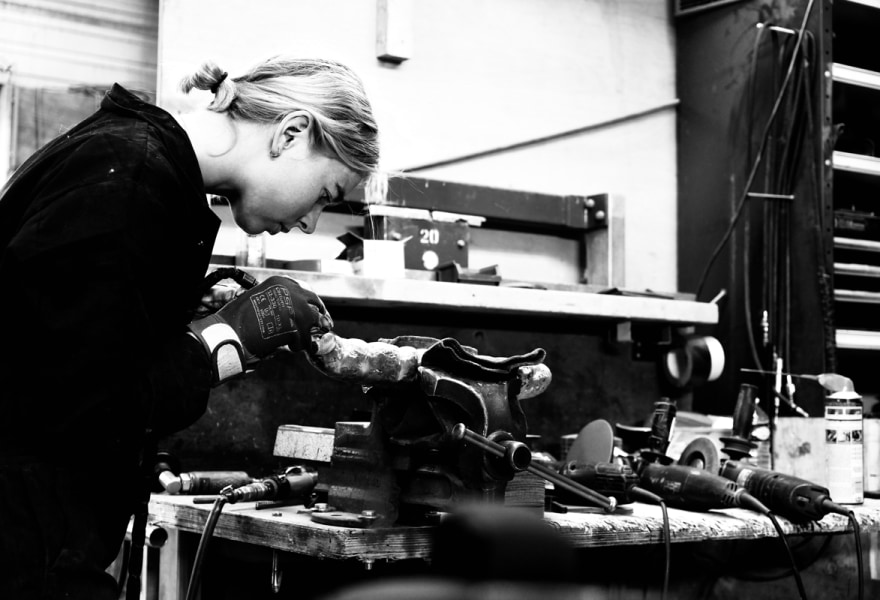
Jeske Haak divides her time between the bronze foundry in Dreumel and her studio in Rotterdam, where she works on her bronze sculptures. Haak has a keen eye for small organic structures such as root networks, tiny insects, and deep-sea life. During PAN Amsterdam, Root Gallery presents, among others, her Flower series, in which Haak makes the beauty and fragility of the underwater world tangible. She uses bronze to capture nature in a lasting form: “Just as nature leaves deep and powerful traces, I aim to create work that lasts as a tribute to the world around us.”
The 38th edition of PAN Amsterdam will take place from November 2 to 9 at RAI Amsterdam. 125 national and international participants will showcase the finest in art, antiques and design.
Where is your studio, and how would you describe this place?
My studio is located in the heart of Rotterdam. It is a spacious workspace fully arranged to support my creative process. Within the space, I have created a clear division: one area is dedicated to cleaner work such as sketches and form studies, and another area is designed for the physical work, where I shape the sculptures. The rest of the production process takes place at bronze foundry Atelier 80 in Dreumel, with whom I collaborate closely. There the work takes its final form in bronze.
What does a typical weekday in your studio look like? And can you describe the steps you go through when creating a bronze sculpture?
Every day is different depending on the stage of a piece. I usually start with research and form studies. I am inspired by nature, browse books, gather images online and make numerous sketches. Then I experiment with forms that appeal to me. The story of the work emerges gradually as it grows with the form. In the phase I call ‘shaping,’ I begin making the base model of the sculpture before it goes to the foundry. I work with materials such as foam, clay, plaster or wax to build and refine the form. Once the base model is ready, I continue at the foundry, where molds are made, wax models cast, and finally the sculpture is cast in bronze. Bronze casting is an intensive process involving molten metal over a thousand degrees. Afterward comes the finishing: sawing, sanding, polishing and patinating. It is a lengthy and precise process, but thanks to close collaboration with Atelier 80 I can realize the work exactly as I envision it.
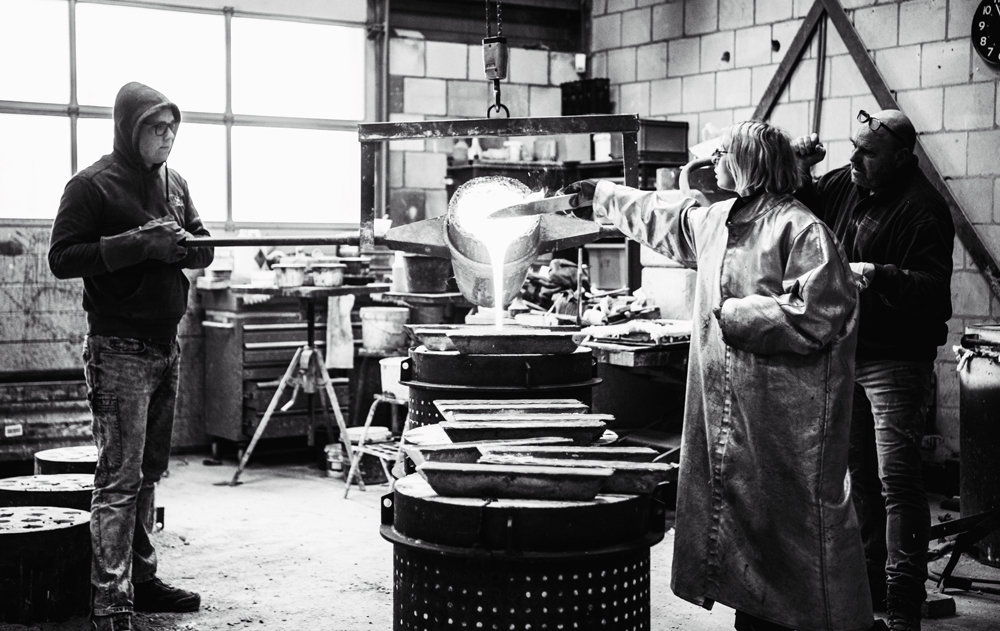
Jeske Haak in the bronze foundry, photo by Helga Bonet
You work in large and small formats. Do you usually focus on one sculpture at a time or work on several projects simultaneously?
I almost always work on multiple sculptures at once. Large pieces take a lot of time, and I enjoy taking on smaller projects in between. These smaller sculptures often serve as form studies and experiments, allowing me to quickly discover what works and what does not. This generates new ideas and techniques that I can apply to larger works. This approach gives me creative freedom and keeps my practice evolving.
In your work you explore hidden aspects of nature. How do you choose which natural organisms to translate into sculpture?
I focus on what often escapes the eye: tiny insects, root networks, deep-sea life and much more. By gathering images and creating form studies, I try to understand and translate these hidden worlds. I choose forms that visually appeal to me and tell a story about the vulnerability and strength of nature. My work gives these elements a platform, making them visible and inviting people to look closer. Bronze ensures that my work endures, allowing me to honor nature in a meaningful way.

Jeske Haak, Flying Flower, 2024, Root Gallery
During PAN Amsterdam you are showing three works around the themes of water, land and air. How did this idea come about?
The Flower series consists of three works I am showing at PAN. They represent a kind of transition or transformation from the deep water to the earth and finally to the air. They are form studies in which I transform the layers and interconnectedness of these beings into new lives. With this series I aim to show how everything in nature is intertwined. The series originated from my research into the underwater world during my graduation and later evolved as I increasingly saw the connections between all life above and below the surface.
What is the story behind your series Bad Dreams, and which bad dreams does it refer to?
Bad Dreams reflects the vulnerability of the ocean and its inhabitants. The work exposes the damage nature suffers from pollution, climate change, overfishing and other human impacts. The depicted creatures are beautiful in form, yet the work also tells the story of the threats they face. It is a call to awareness and action. The aim is to prompt reflection on the impact of our actions on nature and to recognize the beauty of these fragile organisms.

Jeske Haak, Bad Dream 02, 2023, Root Gallery
You graduated in 2022. How did you experience the transition from the academy to working as an independent artist?
The transition was exciting but also challenging. At the academy I had the freedom to experiment without immediate pressure. After graduating I suddenly had to make choices: what do I want to create, how do I present myself, how do I build a practice? I gave myself time to develop a personal collection. That allowed me to cultivate my artistic voice and gain confidence in my work. Now, three years later, I feel much more developed as an artist, though I continue to grow and learn. Being an artist is a continuous process and that is part of its beauty.
You’ve developed such a distinct visual language in just a few years. How did this signature take shape?
At the academy I learned how to construct a concept and connect a meaningful narrative to a piece. During my internship at Studio Job I focused on the technical side, learning shaping techniques that form the basis of my approach. At the foundry I gained extensive knowledge of the material and processes involved in making a bronze sculpture. This knowledge enabled me to execute my ideas precisely and skillfully. Through research, trial and error, I developed my own visual language: abstract organic forms that tell their own story. Bronze proved to be the perfect medium, allowing me to realize my forms exactly as I envision them with textures, sheen, details or simplicity. My visual language has grown into a signature where nature, material, form and emotion converge.

Jeske Haak, Crown Of The Sea, 2022, Root Gallery
You primarily work with bronze. What makes it such a satisfying material?
Bronze offers endless possibilities to bring my ideas to life. It is solid yet refined. I can create smooth reflective surfaces as well as rough organic textures. This versatility is essential to my work. What makes bronze especially remarkable is the time and attention it demands. Each sculpture goes through a long process from mold making to casting and finishing. Often weeks, months, sometimes years of work go into a single piece. This intensive process creates a strong bond with the material and the work itself. Bronze also carries a certain immortality. It allows my sculptures to endure beyond our time. Just as nature leaves deep and powerful traces, I aim to create work that lasts as a tribute to the world around us.
Looking ahead, what would you most like to create or explore over the next ten years?
My greatest dream is to create a monumental work of four meters or taller, placed in a public space where people can marvel and be inspired by often overlooked aspects of nature. I am also working on a new collection in which insects are elevated to gods. I draw inspiration from ancient Egypt and the symbolism insects carried there. In this series I aim to show how essential and remarkable these often neglected creatures are, both ecologically and aesthetically. Over the next ten years I hope to continue discovering the wonders of the world and to infuse my work with new layers of meaning and beauty. Every sculpture has its own story and strength, and I hope my work continues to inspire people to look closer at the nature that surrounds us.
