10 october 2025, Flor Linckens
Last chance: Bobbi Essers captures the intimacy of trust
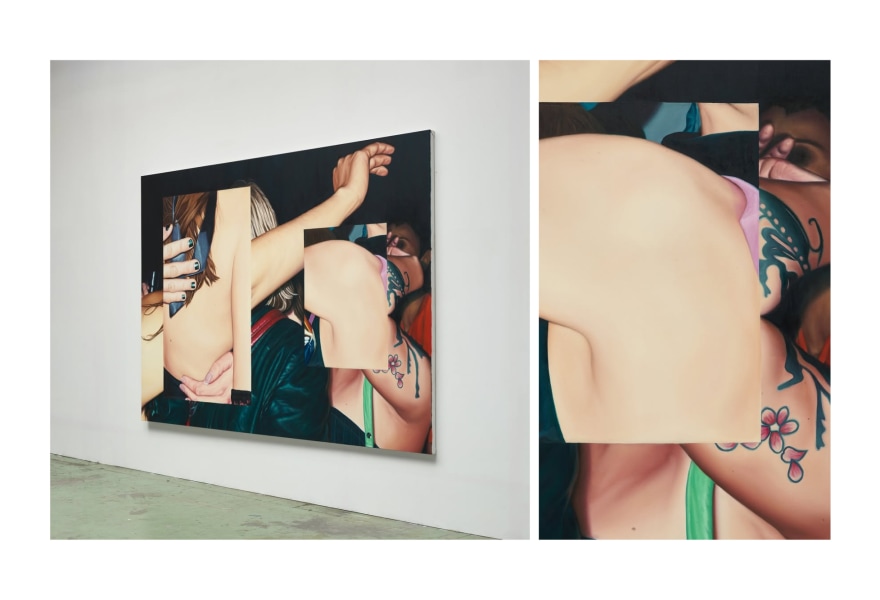
How do you give friendship, closeness and memory a lasting form? Painter Bobbi Essers explores this question in ‘Love Ridden (I’ve looked at you)’, her first solo exhibition at Stigter Van Doesburg in Amsterdam. In large, layered canvases, she depicts moments of togetherness within her circle of friends. The result is a series of cinematic scenes that feel personal, yet also recognisable and universal. Her work encapsulates how memories unfold in real life: fragmented, layered and constantly in motion. The exhibition reveals the rhythm and zeitgeist of a generation and shows how Essers captures intimacy, trust and identity in paint. Her work breathes the freedom of a community in which gender, sexuality and identity are fluid, without the need to explicitly state it. Its strength lies in the quiet ease that makes this diversity feel lived and embodied.
Where many expressions of art center romantic love, Essers focuses on platonic love instead, particularly within a (predominantly) queer bubble. At a time when more people are single and friendships are becoming increasingly important, especially within women’s and queer communities, personal bonds sometimes function as a chosen family: the result of genuine care and the quiet work of attention and emotional commitment, of something that you built together. A sharp contrast with the much-discussed ‘male loneliness epidemic’. Essers turns her gaze toward a form of intimacy that arises when shame, masks and social expectations fall away. Within that openness lies a raw kind of honesty and a sense of freedom.

Essers: “This exhibition presents a series of paintings that capture a year of celebration. A year filled with birthdays, countless exhibition openings (including each other’s), ringing in the new year, and—above all—celebrating friendship itself. What sets this body of work apart is its more luxurious tone: hair carefully styled, jewelry gleaming, clothing deliberately chosen for the occasion, and countless glasses raised in joy. These paintings not only reflect moments of festivity, but also the beauty of togetherness, intimacy, and the rituals of celebration.”
At the same time, individual identity, normally such a defining factor within social groups, plays a minor role here. It dissolves into the fragmentary nature of her compositions. Essers deliberately focuses on details rather than faces, leaving ambiguous to whom those details belong: a glint of hair, fingers resting on a shoulder, the fold of a trouser. Skin, fabric and jewellery are rendered with remarkable precision, yet they remain part of a larger whole. By rarely showing faces, Essers shifts attention to body language, gesture and touch, where emotions reveal themselves far more subtly than in a smile. She conveys the natural intimacy between people who fully trust one another. For a short moment, the viewer becomes a part of this network of friendship and connection. Her canvases show how identity and physicality resist being confined to a single form or label, just like people.
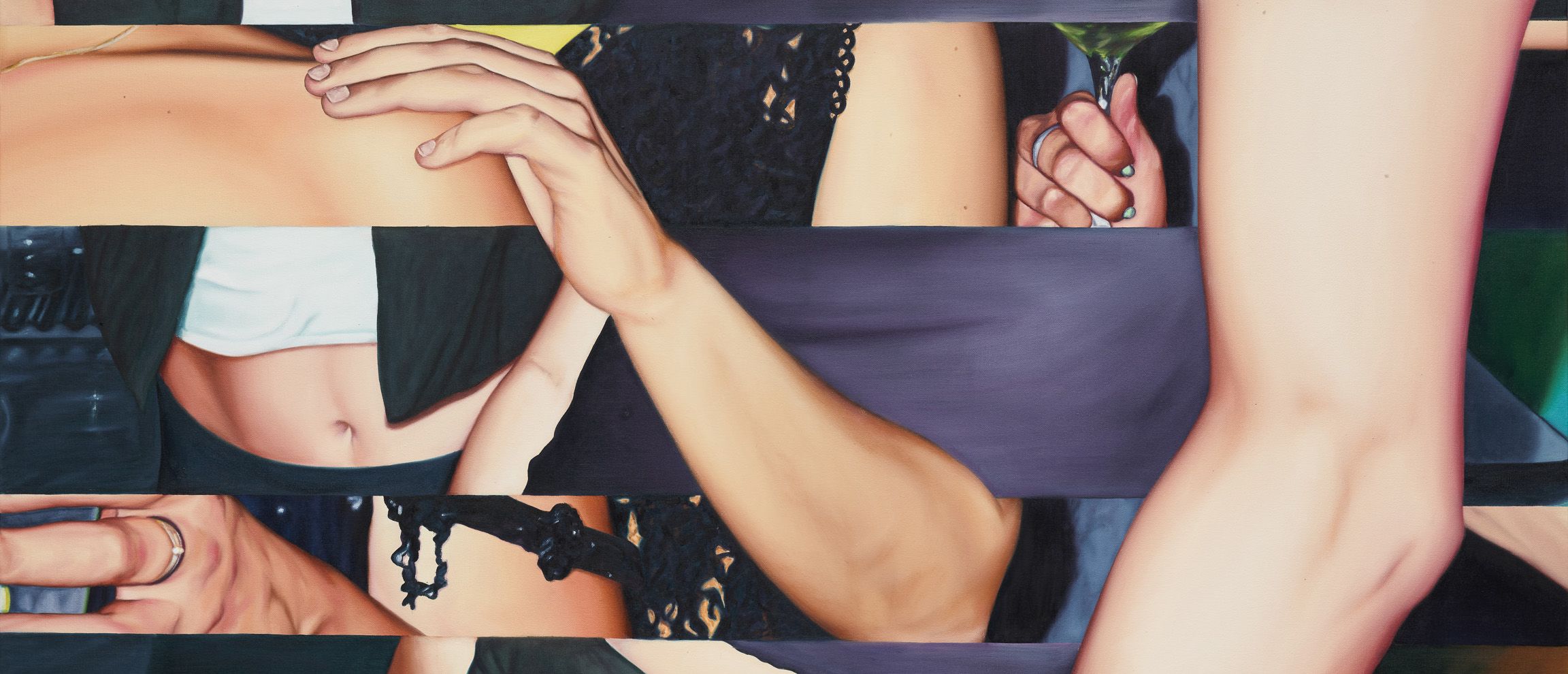
The starting point for her often large-scale works are unpolished analogue snapshots, frequently taken with flash. True to analogue photography, the image is only revealed after development. These photos are therefore less staged, less self-aware. Sometimes she takes them at parties, other times during holidays or everyday moments. In a later stage, she combines them into collages. This process mirrors the way memory functions: never linear, but built from overlapping images and sensations. In her paintings, bodies, gestures and fabrics slide across one another, allowing time and perspective to merge. What stands out is her meticulous attention to material: the gleam of a ring, the soft gradient of skin, the texture of a cardigan. Within that tangible treatment of paint lies a deep empathy for the people she portrays.
Although Essers paints in a realistic style, she seeks, within that language, a tension that extends beyond mere recognisability. Her paintings do not tell linear stories but unfold in fragments, like a film in split screen, in which overlapping shots convey atmosphere rather than information. She builds her compositions from fragments that evoke an emotional memory. By stacking moments, she transforms the everyday into something timeless, as if preserving memory itself in paint.
Visually, her works also recall the jump cuts of nouvelle vague directors such as Jean-Luc Godard and Agnès Varda. In their films, the rhythm of editing was deliberately broken: scenes no longer flowed seamlessly into one another but were presented in fragments. Moments were skipped, sentences abruptly cut off, images suddenly interrupted, like watching memories return in pieces. That approach creates a sense of spontaneity and realism, yet also of disorientation: the viewer becomes aware of time, of absence, of that what remains unseen.
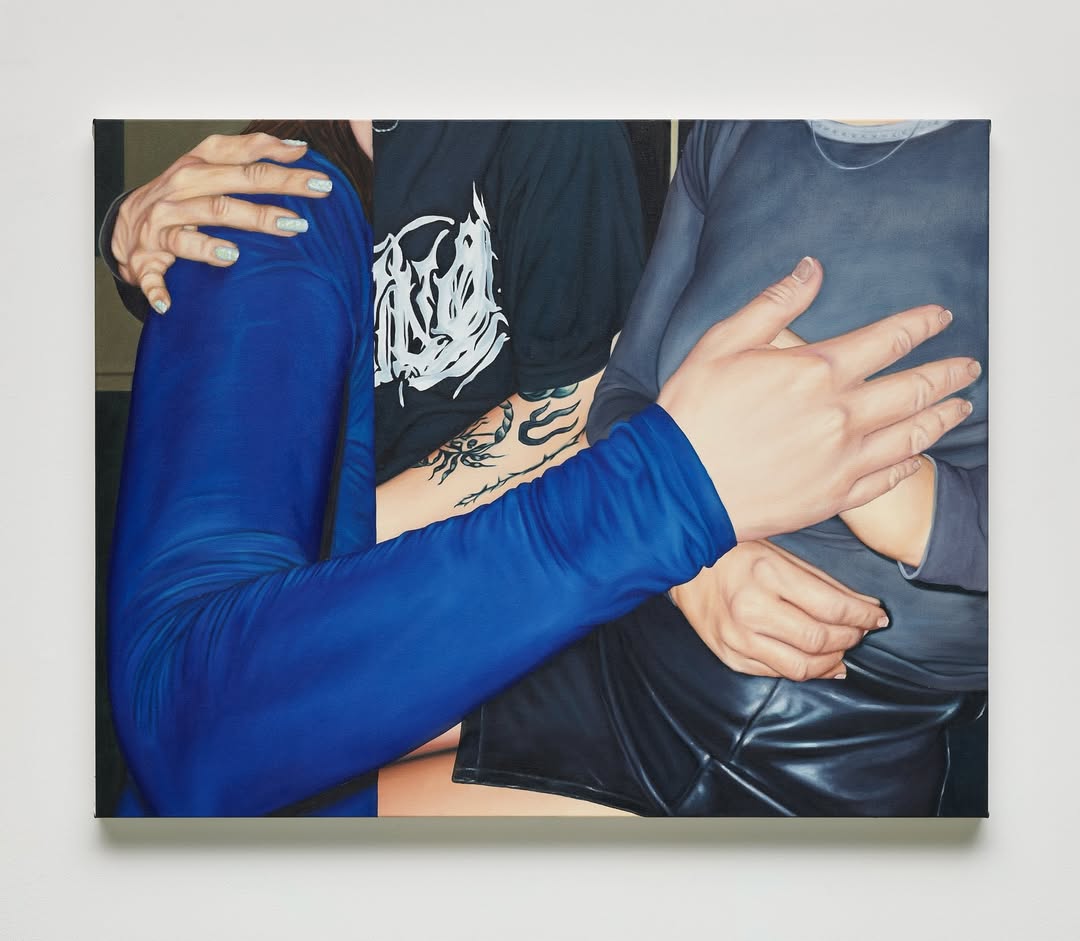
Bobbi Essers was born in Enschede in 2000. She graduated from the HKU in 2022, the same year she won the Buning Brongers Prize and the Audience Award of ‘The Best of Graduates’ at Galerie Ron Mandos. A year later, she received the Royal Award for Modern Painting and was listed as an FD Talent of 2023. That same year, Artsy included her in their selection of ‘10 Emerging Painters Born in the 2000s to Watch Now’. Her work has been shown at the Royal Palace in Amsterdam, the Centraal Museum, Melkweg Expo, Museum MORE, Unit in London and the Corridor Foundation in Shenzhen. Her work is currently on view in the group exhibition ‘Blue Zone’ at Kunsthal Rotterdam and from 21 November, it will be presented at Saatchi Gallery in London, in collaboration with the V&A Museum, the Dutch Embassy in London and artist Louise te Poele.
