30 september 2025, Flor Linckens
The hybrid realities of Kévin Bray
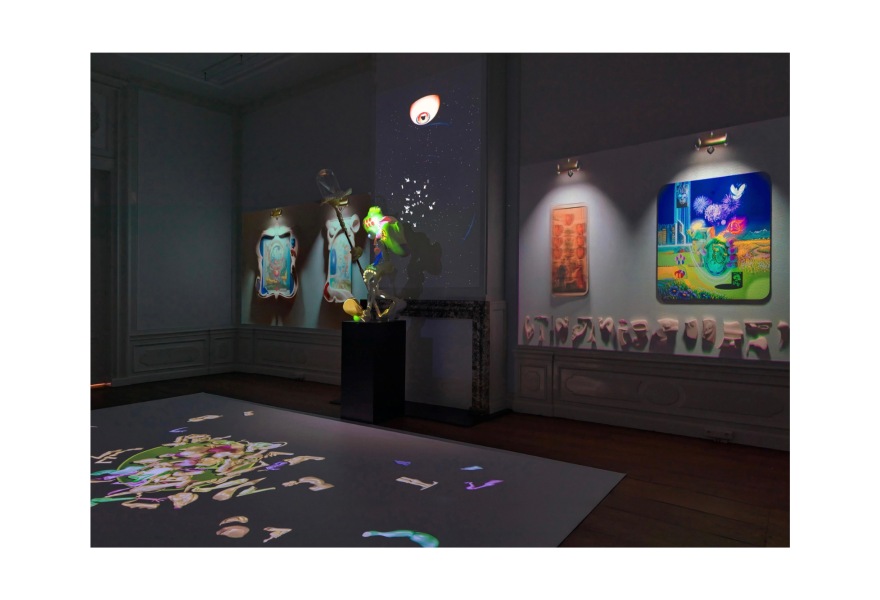
Until 18 October, Kévin Bray presents his solo exhibition ‘The Interfaced and The Compass: Playing Realities’ at Upstream Gallery in Amsterdam. In this exhibition, the French artist explores the ways in which digital and physical realities continuously influence one another.
Bray is known for his multidisciplinary practice and hybrid visual language that spans video, (digital) painting, computer graphics, animation, sculpture and sound design. Experiment, research and technical inquiry are an inherent part of his practice. With a background in graphic design, he began to investigate how images are constructed and how the language of different software and techniques intersect. How do these images function and, perhaps more crucially, how do they shape our reality? His practice draws on art history as well as apocalyptic and dystopian narratives, science fiction and fiction as construct: the way stories emerge and acquire meaning. He dissects the form and language of a medium in order to translate those codes into another. His practice could be considered as a continuous exercise in media literacy, in which techniques from different disciplines merge into a new and distinctive visual language.
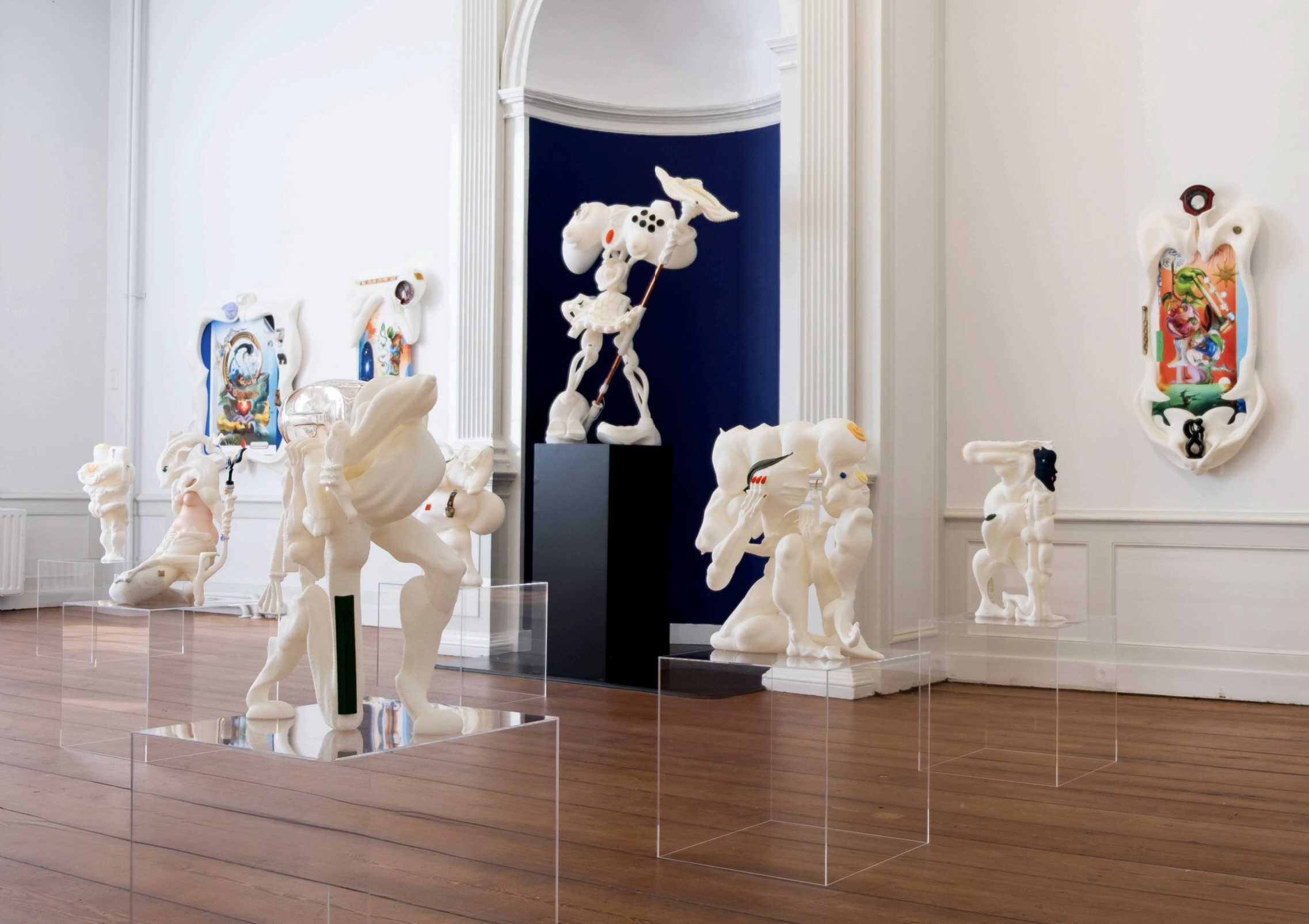
Bray’s method is characterised by this merging of techniques and mediums. He combines digital paintings with 3D-printed sculptures that incorporate glass, metal, cables and found objects. The result is a series of hybrid forms that follow the internal logic of games and interfaces, yet at the same time refer to art historical motifs and classical sculpture. What connects these works is the fact that Bray often keeps the construction visible. They result in works in which fiction and matter carry equal weight, and he demonstrates how porous the boundary between fiction and reality truly is.
His exhibition at Upstream Gallery spans two spaces that mirror one another: one presents digital versions, the other their physical, material counterparts. Together they reveal four simultaneously existing layers: the digital and the physical, the pre-idea and the post-idea. The exhibition, his second with the gallery, is conceived as a game inventory. In gaming, the inventory is a subspace where players can store items: from weapons and armour to magical potions and building materials. It enables players to make strategic choices within the game. In this exhibition, the inventory is interpreted more broadly: as a collection of objects, symbols and relational artefacts, a personal archive in which digital and physical worlds effectively intertwine.
For this concept Bray draws inspiration from the ‘Carrier Bag Theory of Fiction’ by the renowned American science fiction author Ursula K. Le Guin. She suggested that the first human tool was probably not a weapon, but a container for gathering food and objects. She used this image as a metaphor for storytelling: not a heroic battle, but a space where experiences, voices and relationships are brought together. She advocates an alternative way of storytelling, centred on care, connection and shared existence rather than domination. The Japanese writer Kōbō Abe is also an important reference for Bray. Abe juxtaposed the image of a rope and a stick: the stick symbolises aggression, power and exclusion, while the rope is about connection, bringing together and creating meaning. He stressed that human culture has been shaped not only by conflict and domination, but also by our ability to weave relationships. Bray continues along this line of thought: what if our digital avatars are not warriors, but carriers? Not instruments of exploitation, but marked by reciprocity?
At the heart of the exhibition is the character Oan, who moves between different layers of reality. A magical door grants him access to new identities and worlds, but also makes clear that choices in the fictional space inevitably become part of reality. It serves as a parable for the fragile boundary between fiction and real life, and shows how digital worlds do not escape reality but reshape it: ‘online’ or ‘imagined’ elements filter into our bodies, habits and infrastructures. Oan experiences adventures so absorbing that everyday life pales in comparison. He sees real-life friendships fade and is weighed down by guilt. Gradually it becomes clear that more of his fellow villagers have similar magical doors, and that what happens behind them is inextricably bound to who someone truly is. Oan finds relief when he discovers that both worlds can coexist, that there is a way to share these adventures and that the physical world can remain an anchor. At the same time, he realises that everyone experiences these worlds in their own way, through their own eyes, meaning they never quite form a shared reality. Bray suggests that we must take responsibility in both domains. Oan carries objects and companions back into his inventory and decides to embrace both worlds at once: to visit, but not vanish. The inventory is not presented as spoils or conquest, but as a bag filled with relationships, memories and meanings, where connection matters more than victory.

With this exhibition, Bray raises questions about the ways digital platforms and game mechanics guide our behaviour: from how we vote and date to how we learn languages, perceive the world, work or absorb (fake) news. As in games or on social media, the rules are not always clear or visible, yet their effects on our bodies and habits are concrete and tangible.
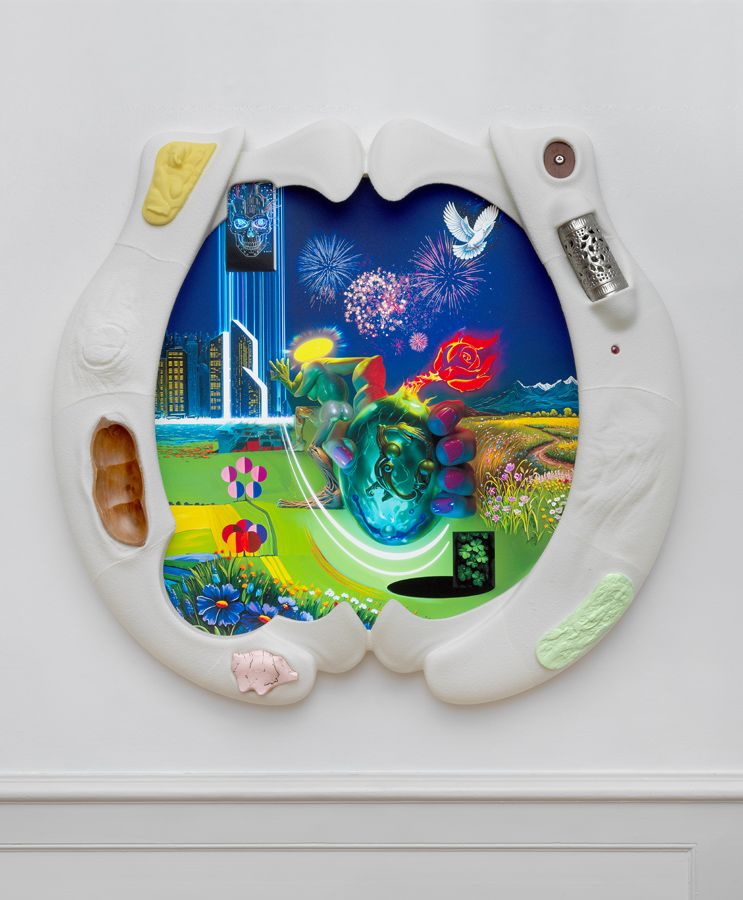
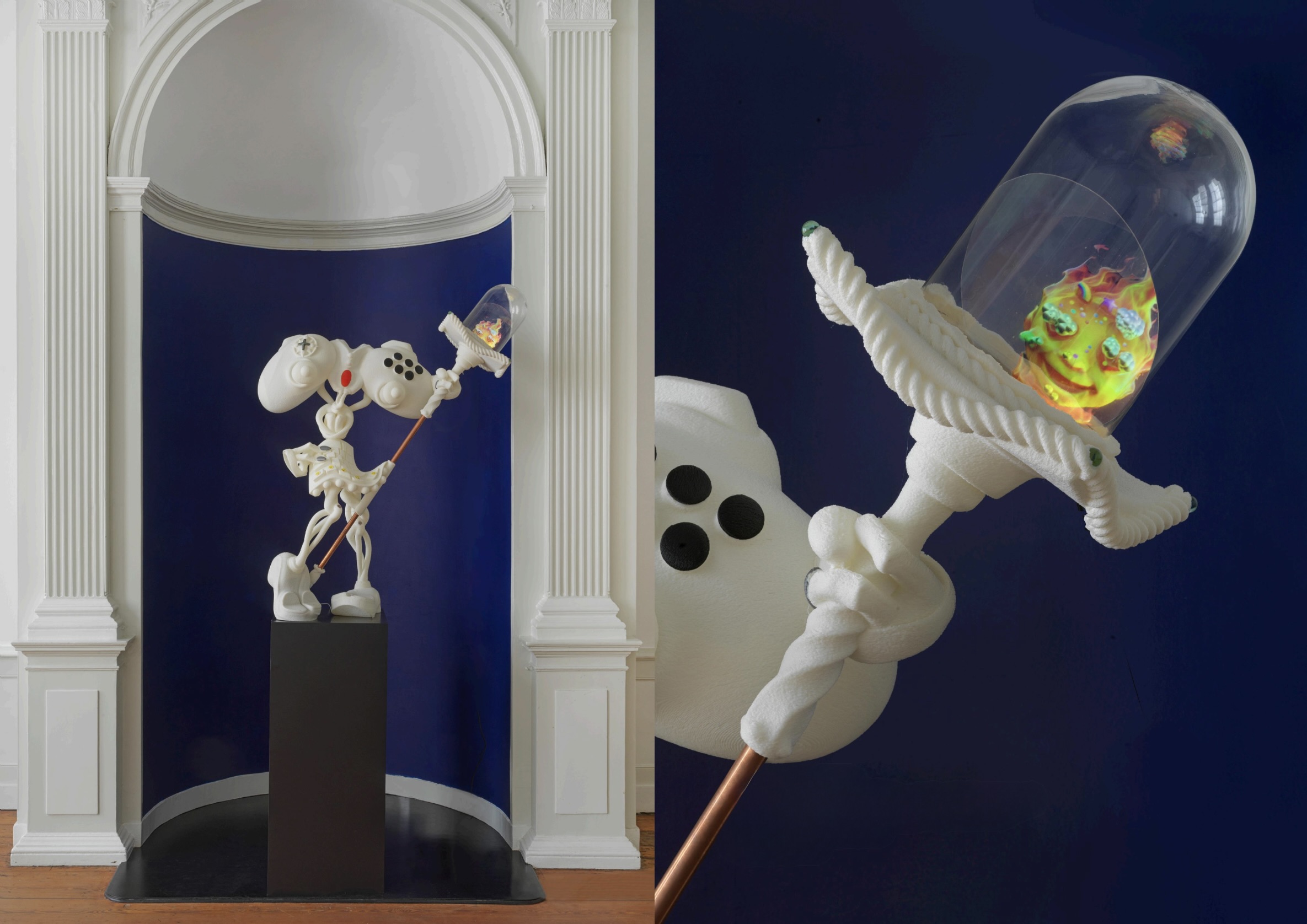
In the first gallery, visitors encounter a variety of white sculptures, produced with 3D printers. These works merge organic shapes with glass, cables and found objects. Works such as "Sirens Want Peace" or "It Is Disappearing Because of the Fearful" balance between the archaic and the futuristic, evoking both recognition and estrangement. These surreal figures seem composed of multiple entities: amalgamated bodies with unusual buttons, capsules and cavities. Another work, "Pre-Exobody", presents a hybrid creature with a torso resembling a game controller. The figure holds a staff, crowned with a glass dome, containing a glowing digital entity. On the walls, you see digitally created paintings, framed by sculptural borders that enclose small, tangible found objects such as a porcelain vase, fragments of metal and a miniature elephant. That way, the virtual world is literally anchored in material reality. In the second space, visitors are immersed in a video-mapping installation. Digital forms move across walls and floor, corresponding with their physical counterparts on pedestals. A grid on the floor acts simultaneously as interface, map and memory, guiding visitors as players through an environment without a predetermined outcome.
Kévin Bray was born in 1989 in Corbie, northern France. He studied graphic design at L'École Supérieure d'Arts Appliqués de Bourgogne, continued his studies at the Sandberg Institute and was a resident at the Rijksakademie van Beeldende Kunsten in Amsterdam, where he still lives and works. His work has been shown at Stedelijk Museum Amsterdam, Palais De Tokyo in Paris, Kunstinstituut Melly, Foam Amsterdam, Het HEM, the Max Ernst Museum in Brühl, The Hole in New York, Schiphol, De Appel, Het Nieuwe Instituut and the Dordrechts Museum. It is part of the collections of the AkzoNobel Art Foundation, ING and the Ministry of Foreign Affairs. Bray currently teaches at the Royal Academy of Art in The Hague.
