19 september 2025, Wouter van den Eijkel
The studio of… Steven Antonio Manes
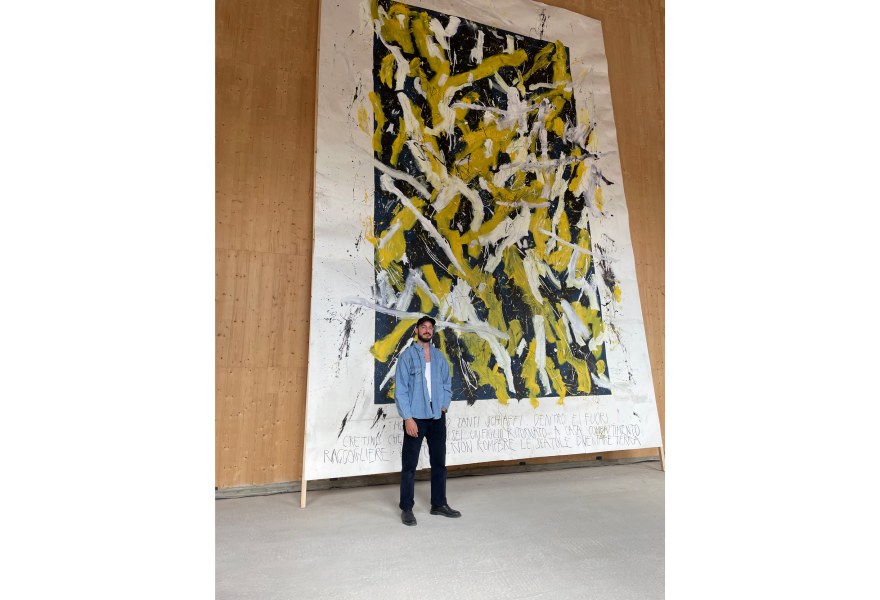
Silent Earthquake is the title of the first solo exhibition in the Netherlands featuring work by Belgian sculptor Steven Antonio Manes. Alongside a number of sculptures, works on paper are also on display at Studio Seine. The title refers to Manes’ character, which can best be described as ‘still waters run deep’.
“I am introverted, grounded, intrinsically motivated, yet often in conflict.” Silent Earthquake refers to the inner tension between silence and eruption, calmness and turbulence.
Manes describes his working method as intuitive, akin to Sturm und Drang. He usually works on several pieces at the same time, which sometimes results in unexpected cross-connections between them. His bold palette is infused with energy. “Because my process is so intuitive, there is a directness in my use of materials. I want to apply them as purely as possible, unmixed and honest.”
We spoke with Steven Antonio Manes about Silent Earthquake, his approach and his plans for the future.
Where is your studio located and how would you describe it?
My studio is located near Maastricht on the Belgian-Dutch border. A few years ago, I deliberately chose to leave Ghent behind and settle in Limburg, where there is space, silence and nature. Here I find the peace I need to be creative. The studio itself consists of two different zones. Firstly, there is a space that is primarily intended for research, where I read, draw and design. It’s where ideas grow. The other zone is a more representative space, where I create sculptural work and translate my sketches and ideas into physical form. Here I take the work to a more advanced stage and also think about how it can ultimately be shown within an exhibition context.

‘Silent Earthquake’ Studio Seine, Rotterdam
You’re trained as a sculptor, but you also create works on paper. What makes a good studio for you? What does your space absolutely require?
For me, a studio must not only be big enough, but also provide enough mental stimulation. I need a large floor area because I often literally work on the ground. It’s important that I can move freely around my work and approach it from different angles and viewpoints. The space is therefore divided into different working zones: a quiet area where I can sketch, draw, read and research without disturbance on one side and on the other, a workshop-like area where I can hammer, grind and scratch without interruption. Large windows provide natural light and a direct connection with the nature outside.
The studio has to accommodate creation in multiple disciplines, as well as the storage of tools, materials and existing work. Because my work grows like a visual diary, I organise my drawings and sculptures by the year. This results in series and chapters, making my studio not just a workspace, but also a living archive.
How would you describe your working method? Do you plan everything out in advance and then develop it in detail or do you work more intuitively? Do you focus on one sculpture at a time or several?
My approach is strongly intuitive, akin to Sturm und Drang. That’s why I work on different projects at the same time, so that unexpected connections can arise. My work contains both an emotional and a physical layering; while one work is waiting for the next step, I shift my focus to another. I don’t really have a fixed routine. The mood and my state of mind at the moment determine whether I approach the day in a more exploratory way or work more forcefully. That’s precisely why it’s important for me to work on several pieces at once—so that I can spontaneously choose where to focus my attention and energy.

‘Silent Earthquake’ Studio Seine, on show until 1 November
Congratulations on Silent Earthquake, your first solo exhibition in the Netherlands. Can you explain the title?
The title stems from the elements, primarily the earthly. I am introverted, grounded, intrinsically motivated, yet often in conflict. Silent Earthquake refers to that inner tension: silence and explosion, calmness and turbulence. These seismic shifts live within every human being and are not always visible on the surface, but resonate deeply. They are linked to origin, family, traumas and personal history. I believe art can be a way to make those hidden movements palpable, without literally expressing them.

‘Terremoto Silenzioso’, 2025, Studio Seine
One thing that stands out is the Italian words in your drawings. You grew up in Belgium as the son of Italian parents. Why did you choose to use Italian in your work? Is that your first language?
Through this language and history, I can often grasp situations more clearly. My dual background automatically creates an area of tension, which is why I often refer to Italian words. In that language, I can better capture nuances and feelings because the language is connected to my family history and youth. It’s a carrier of meaning.

‘Non è Ancora Finito’, 2024 (Image by © vandenbussche-vandenbossche) ‘Stare Zitto’, 2025
The words appear written in a way that feels desperate. Is that my interpretation or is it intentional?
That’s not specifically the intention—that’s the freedom of the writing, which is placed intuitively. The act of scratching has something obsessive about it, which I gladly allow to be reflected in my work.
Another thing that stands out is your use of a bright colour palette. How did that come about?
By using intense colours against certain backgrounds, I can highlight expressions and repetition. Because my working method is so intuitive, there is also a directness in my use of materials. I want to apply them as purely as possible, unmixed and honest.

‘Silent Earthquake’, Conversazioni Difficili (Hard Talks), 2025
You’re now in your early 30s and your career is just beginning. What do you hope to create in the next five years?
Haha, thanks for the reassurance. As an artist, it can sometimes feel like you’re always short on time. I want to continue pushing my work into different directions, combining two- and three-dimensional forms. More specifically, I want to focus on scenography and sculptural work in which both worlds reinforce each other. I want to further refine the physical tension in my work.
What are you currently working on?
I recently returned from a trip through Morocco with a few fellow artists. Such experiences are incredibly important to me. I strongly believe in the importance of community, of having people around you who inspire, challenge and support you. Over the years, I’ve built a close circle of artists and friends, and I consider this an essential part of my practice.
Residencies also play a huge role in that. To me, they’re not only an opportunity to work in a new environment, but also to meet new people. Often, it’s the people you meet along the way who unexpectedly nudge your work in a new direction.

‘Calcestruzzo Disegno Uno’, 2024 (Image by © vandenbussche-vandenbossche) ‘Grattare’, 2023 (Image by © vandenbussche-vandenbossche)
