16 september 2025, Wouter van den Eijkel
Seeing what the house sees – Vincent Zanni’s Impressions of Home
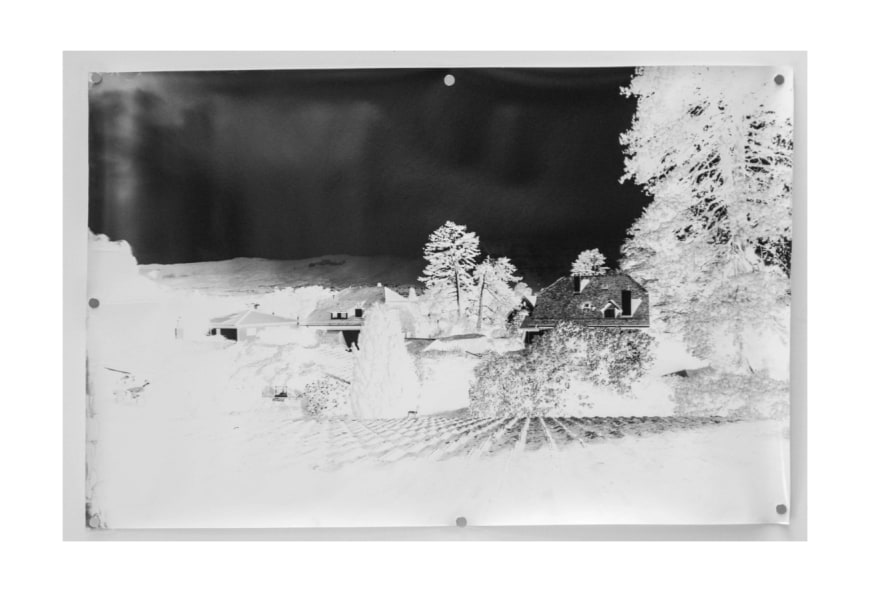
With Impressions of Home Swiss photographer Vincent Zanni is paying a final tribute to a family member who could not speak, but could see: his family home with a large blue cedar at the edge of Geneva. Using blackout material, Zanni transformed the house into a camera obscura, the oldest photographic technique. “I wanted to show what the house sees.” It signifies the next step in a body of work in which personal history and the universality of memory are combined using old techniques.
Ask a random person how to preserve a memory and chances are they’ll mention photography. For many, it is the ultimate carrier of memories. Today, it is easier than ever to capture moments forever. Simply reach into your pocket and you hold a camera more advanced than almost any of its predecessors. But photographs are not the only vessels of memory; places and houses also carry that gift.
Vincent Zanni (Switzerland, 1995) was in his third year at the Willem de Kooning Academy when his grandmother passed away. She was the last resident of the family home, located on a large plot at the edge of Geneva. His grandmother, the house and the blue cedar in the garden hold a special place in Zanni’s life and memories. It was the setting for family gatherings, birthdays and celebrations, a place where cherished memories were made.
Realising that the house would be sold and likely demolished, he decided to dedicate his graduation project to the fading memories of the family home—something deeply connected to the medium of photography. “Keeping a memory alive is what photography is all about,” Zanni says, as if speaking about a family member.
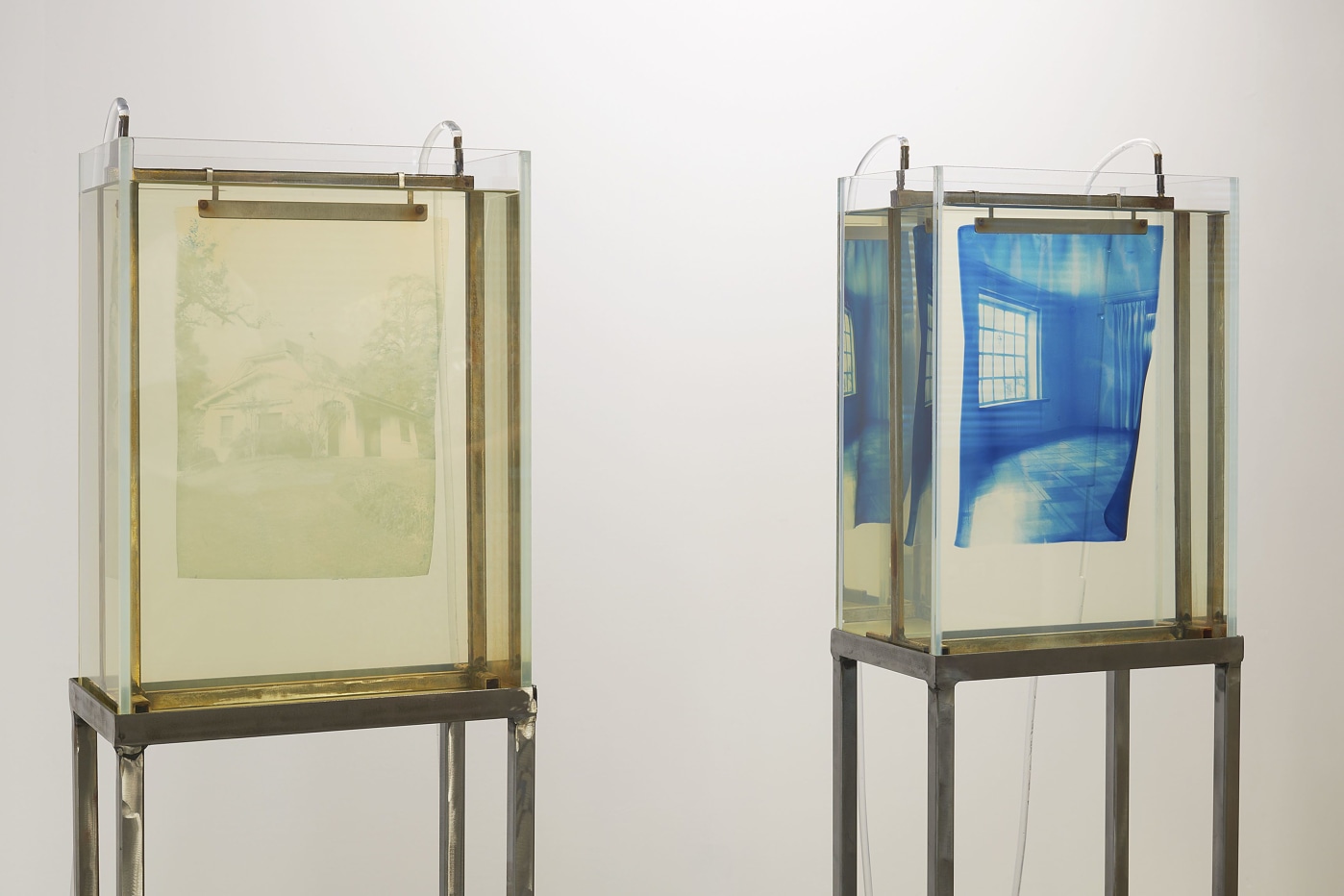
Vincent Zanni, La Maison #4, 2023, Frank Taal Galerie
For his graduation project, he created several tanks filled with water in which cyanotypes slowly dissolved, like a memory gradually disappearing into the mist of time. The ambitious project drew attention and was selected for the Best of Graduates exhibition of 2023. “Because I already knew in my third year what my graduation project would be about, I could invest a lot of time in it, like experimenting with water temperature and the rate at which the gelatin dissolved.”
Even during his commercial photography studies in Vevey, Switzerland, Zanni was interested in archaic printing and photographic techniques. On a mountain hike with his programme, he began making cyanotypes, some of which still hang in his studio. At the Willem de Kooning Academy, he experimented with wet plates, another 19th-century method. “When people see the portraits I made with this technique, they’re always amazed at the image quality, but that’s not where the difference lies—the difference is in the process.”

Vincent Zanni, Climbing, 2024, Frank Taal Galerie
Blue Cedar
The garden of the family home—and especially the enormous blue cedar—takes centre stage in the series Blue Cedar (2024). Zanni’s great-grandfather planted the tree a century ago, when cuttings of the species first arrived in Switzerland. The tree is easily 20 meters tall and inseparably tied to the place.
For this series, Zanni made the pigment for the photographs of the tree from its own branches. It was quite a journey, he explains in his Amsterdam studio. To turn the branches into charcoal, he had to burn them in a vacuum. Then came the challenge of grinding the charred branches finely enough. A regular mortar and coffee grinder were too coarse. Only when he ground them with marbles did he achieve pigment that was fine enough.
Impressions of Home
When the decision was made to sell the house, Zanni saw the opportunity to do one last project, a final ode to the silent family member. He transformed each room of the house into a camera obscura. What would you see if you let the house itself photograph its view? Zanni wondered. It might sound strange, but it isn’t. Camera obscura (darkened room) is a technique in which the role of the photographer is quite minor. There is no lens, no shutter speed and no need to focus—the space (the camera) does the recording.
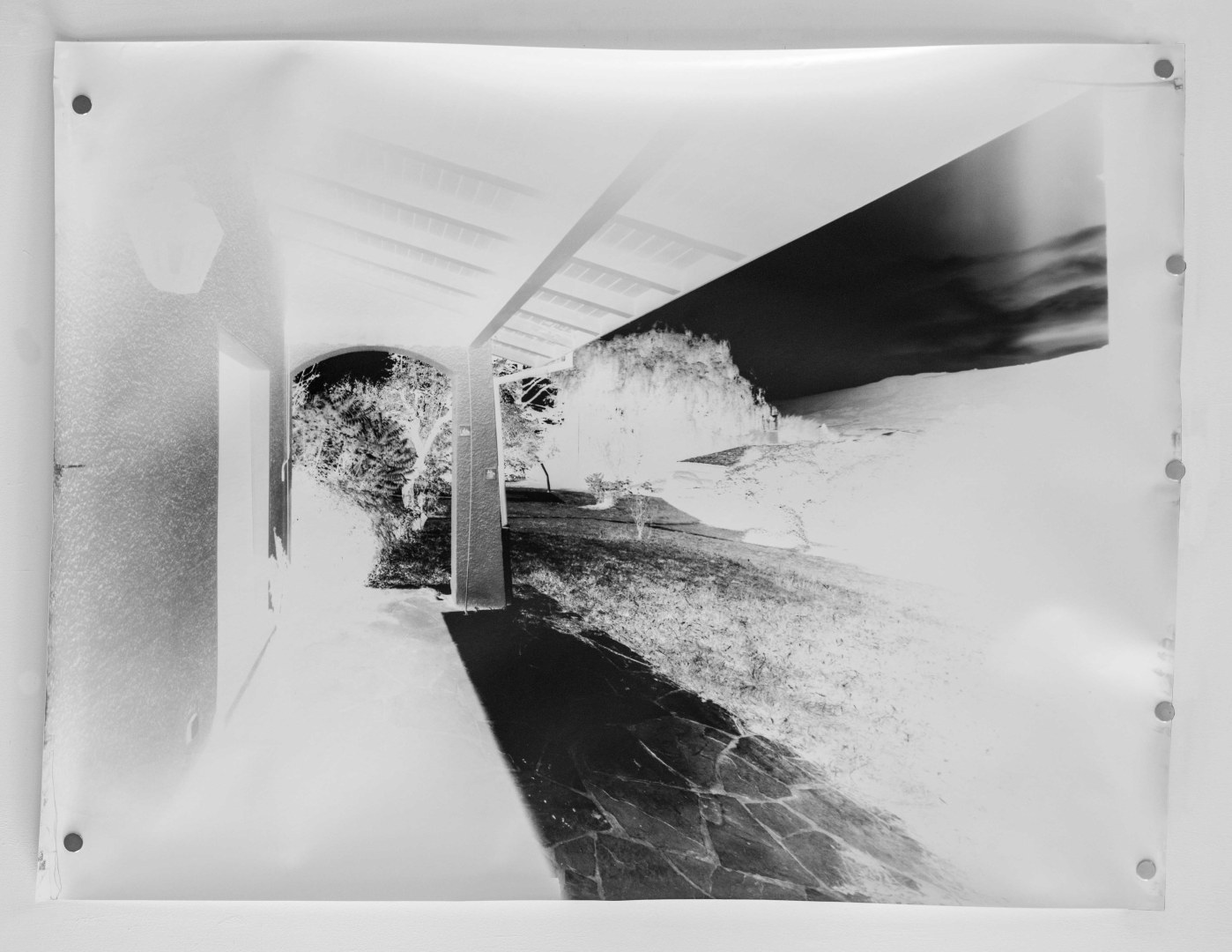
Vincent Zanni, Porch View 2, 2025, Frank Taal Galerie
Zanni blacked out the rooms with construction plastic, turned the kitchen into a darkroom and the bathroom into a developing room. Through a tiny pinhole, light entered each room and fell onto a large sheet of light-sensitive paper. The exposure time depended on the weather: about 20 minutes on clear days, while it could take hours with shifting clouds. The result was large negative images of the garden, the surroundings and occasionally a fragment of a wall.
The project was technically challenging yet deeply personal. Working inside the darkened house, Zanni experienced the rooms as if they had fallen out of time. Understandable for a place that, for a hundred years, served as the setting of every family gathering. The photogra
Impressions of Home by Vincent Zanni is on display until 1 November at the Frank Taal Gallery in Rotterdam together with the exhibition Just Flowers by Gerben Mulder.

Vincent Zanni, Dining room View, Self-portrait under the Blue Cedar, 2025, Frank Taal Galerie
