02 september 2025, Yves Joris
René Heyvaert (1929-1984) enters into dialogue with Carmine Antonio Iacolare (1998) at Settantotto Art Gallery
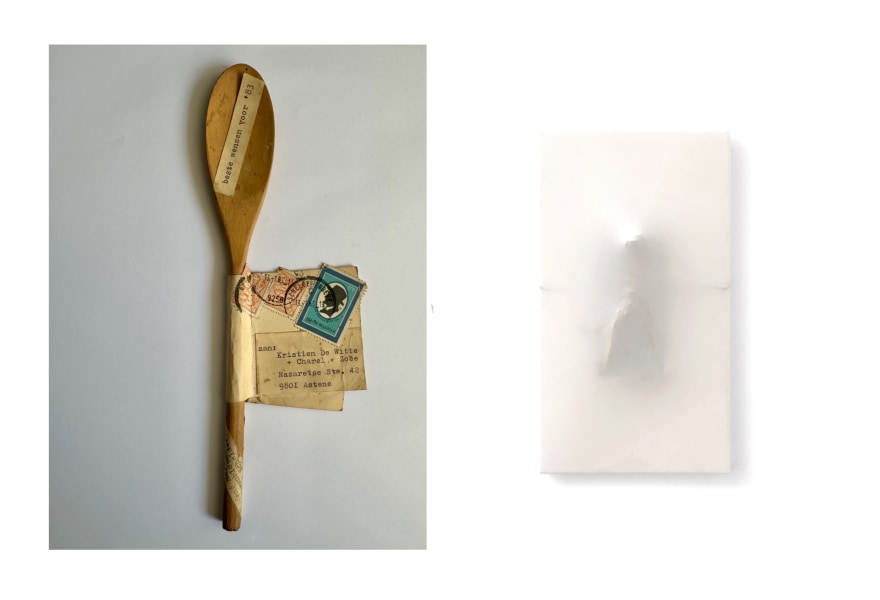
Inside the Settantotto Art Gallery, an echo whispers. It is the voice of René Heyvaert (1929–1984) who, decades ago, spoke the winged words that characterise his artistry: I am establishing a kingdom. Not a kingdom of power, not a palace of stone, but a domain of silence and precision. His world was built from the small, the everyday, the casually found object that in his hands became a symbol of attention. Wooden spoons, scraps of cardboard, a square leading nowhere yet containing everything. These were the building blocks of an invisible architecture, a realm that only came to life in the gaze of the viewer.
The silent realm of René Heyvaert
During this exhibition, he enters into dialogue with Heimat aus der Ferne by Carmine Antonio Iacolare (°1998), an artist with German roots who currently lives in Antwerp. His work moves between skins, bones and membranes and exudes the fragility of a freshly healed wound. He uses calfskin, deer antler, horsehair and oil. Not to conjure up a morbid world, but to reveal the vulnerability of existence, the origin that is both soft and resistant. In his hands, the remains of an animal or skin of calf do not become a trophy, but a bearer of meaning, a place where pain and healing converge. Whereas Heyvaert whispers that he is establishing a kingdom, Iacolare seems to respond by covering the walls of that realm with skin and bone. Whereas Heyvaert worked with cardboard and postcards, with spoons and small constructions that can hardly be called sculptures, Iacolare emphasises the emotional world. He shows how truth and tenderness are concealed in the vulnerability we so often conceal. It is as if he is opening a chapel in the heart of Heyvaert’s kingdom, a place where suffering is not pushed away, but embraced.
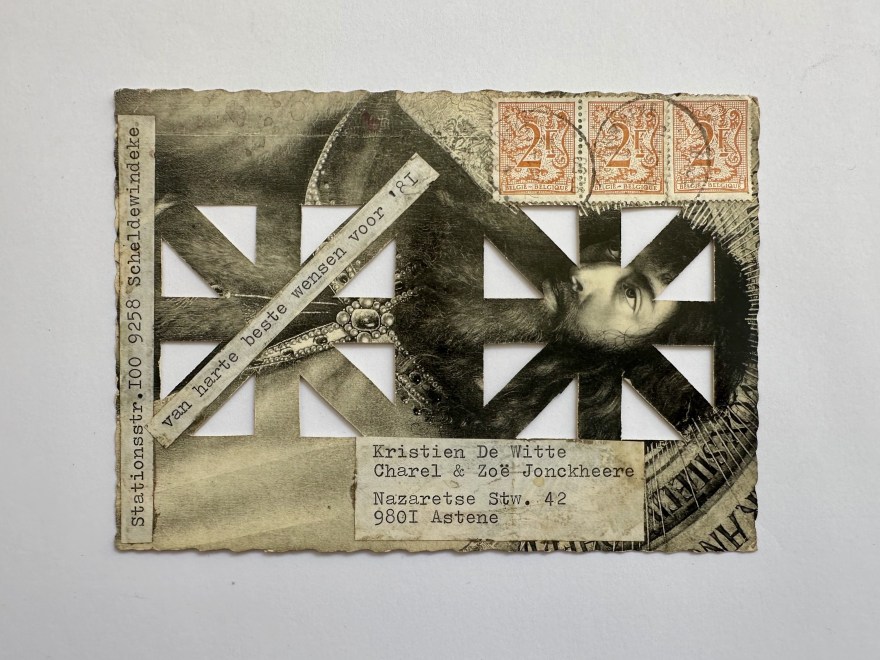
René Heyvaert, untitled (mail art), 1981, Settantotto Art Gallery
The healing skins of Carmine Antonio Iacolare
Heyvaert’s work still carries the scent of architecture. He began as a designer of buildings and his art always kept searching for a precise proportion of material, space and form. Even when he added a nut to a simple wooden beam or glued a spoon into a new construction, it resonated with a longing for order and silence. He demanded little, only that we bowed our heads to look, that we attempted to understand the gravity of the small.
Whereas Heyvaert sought architecture in wood, cardboard and silence, Iacolare seeks it in the body itself. The title Heimat aus der Ferne carries tension within it: a home that always remains at a distance. To him, home is not a fixed place, but a skin that is carried along—sometimes supple, sometimes taut. The artist asks the viewer to turn inward, to feel his or her own skin while looking at his work: a piece of deer antler piercing a rubber membrane, a thin layer of calfskin stretched into a fragile wall, a flattened goatskin clinging to wood and metal. These works of art are not quiet whispers, but bounded breaths, rhythms of a body showing itself in all its vulnerability. His images seem to ask: where is your scar, how do you carry your pain and why do you hide it?
And yet, there is no opposition, only an unexpected harmony between the two artists. Heyvaert sought the silent gesture, Iacolare seeks the silent wound. Both construct a space in which the viewer’s gaze can slow down. Heyvaert’s postcard with a short sentence or a small cardboard square reflects the same as Iacolare’s skins and bones: it is about the attentiveness with which we learn to see what seems too small or too fragile to be art
A kingdom of silence and skin
In the gallery, both artists are given their own space. These are, after all, two solo exhibitions. Their work does not hang together, but the echo of their choice of materials travels through the walls. In one room lies a wooden beam by Heyvaert, simple and clear, a gesture of silence and precision. In the other room, Iacolare shows a work made of calfskin, oil and antler—an object that breathes and wavers like a living body. Although separated in space, one object seems to be a note and the other an echo. Together they form a chord that resounds beyond the time that separates them. It is as if Heyvaert is gently nodding to the young artist, inviting him to continue building the kingdom that will never be completed.
What makes this dialogue so unique is that it is not hierarchical. The elder master does not dictate and the younger artist does not imitate. It is merely a whisper between generations. Heyvaert shows Iacolare that simplicity and precision can open the way to a universal language. Iacolare shows Heyvaert that the way to truth also runs through the wound, that the architecture of art can consist not only of wood and cardboard, but also of flesh, skin and scars.
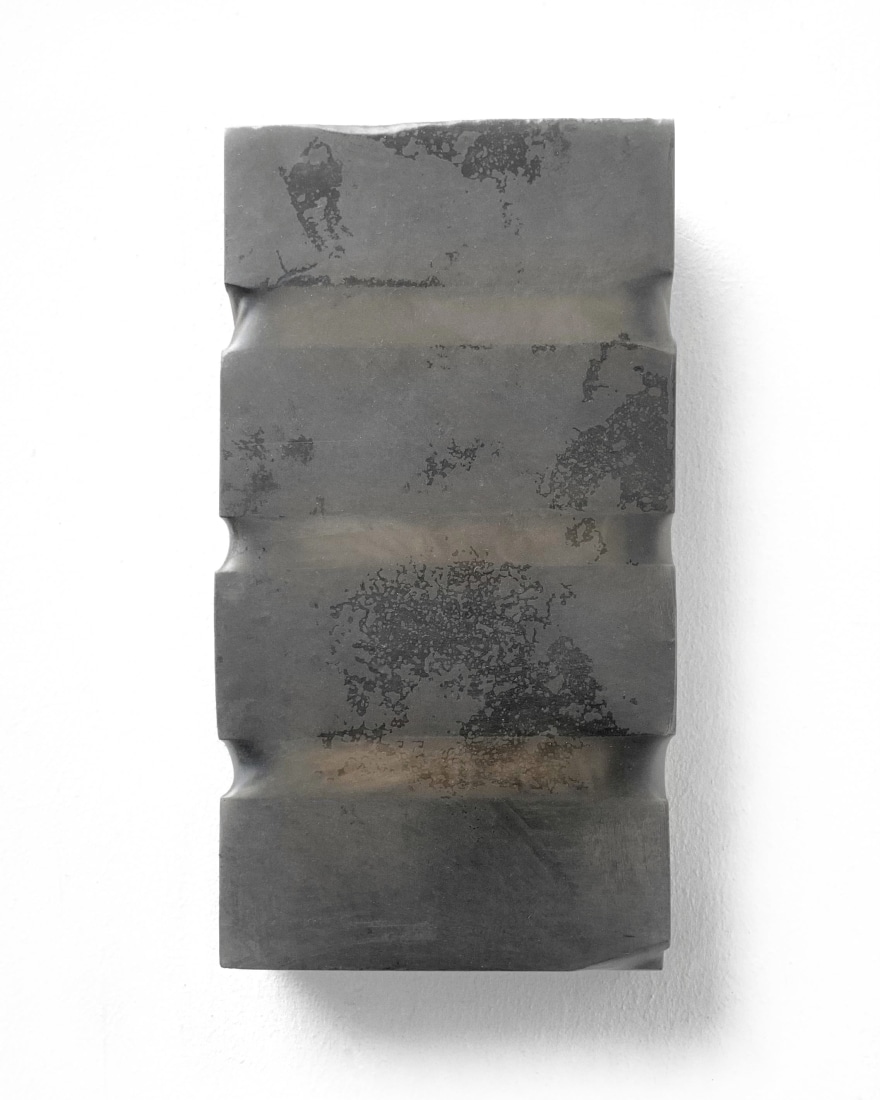
Carmine Antonio Iacolare, untitled, 2025, Settantotto Art Gallery
For the visitor, this means that you are not entering a palace, but a realm of silence, a kingdom where materials speak with a voice that is both old and new. Heyvaert’s spoons, cardboard forms and mail art repeat their gentle irony. Iacolare’s skins, bones and membranes add a raw intensity. Together they say that art is never a closed territory, but an open field where the most fragile materials turn out to be the strongest foundations.
As I leave the exhibition, the sentence lingers: I am establishing a kingdom. It is not a promise of power or possession, but an invitation to rethink our own realm. Not in stones or walls, but in attentiveness, in silence, in the ability to see what normally escapes us. Heyvaert laid the foundation and Iacolare has raised the walls from skin and bone. We, as visitors, become part of this realm each time we sharpen our gaze, each time we learn to see that beauty does not reside in brilliance or monumentality, but in the small gestures that carry life.
