01 september 2025, Martine Bontjes
The studio of... Andreas Senoner
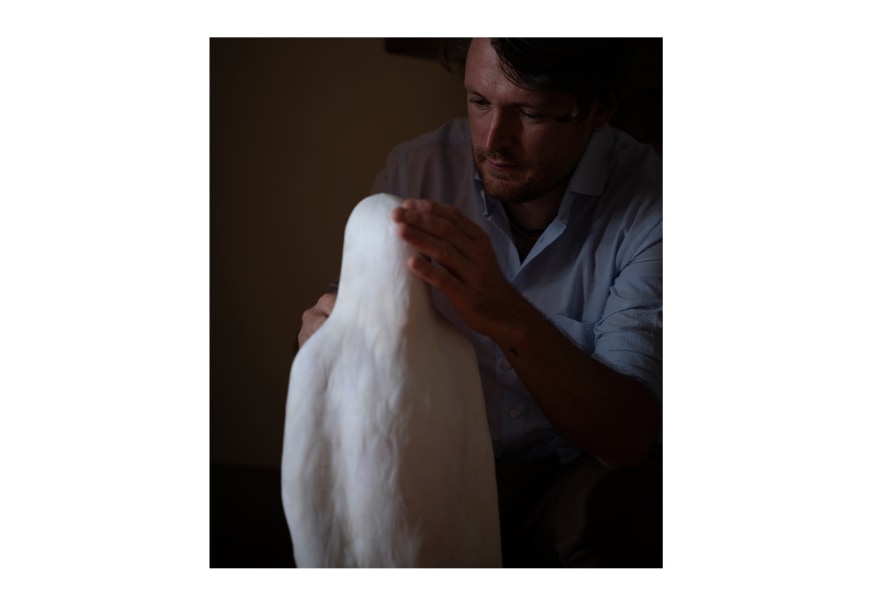
Before the streets of Florence awaken to tourists, Andreas Senoner is already making his way to his studio in a renaissance building at the heart of the city. Inside, he works in quiet isolation on his wooden sculptures. Senoner uses natural materials such as wood, lichens, feathers and beeswax. According to the artist, these materials demand special attention: "They carry their own voice and require attentiveness in order to be understood." Senoner's sculptures carry traces of time and memories from the past, they reflect the life that resides within the material.
On Sunday 7 September the exhibition "In Dialogue" will open at Galerie Wilms in Venlo. Senoner's sculptures engage in conversation with the work of five other artists: Brooke DiDonato, Suzanne Jongmans, Sandra Kruisbrink, Magdalena Lamri and Julie van der Vaart. Together they explore themes such as corporeality, impermanence and nature.
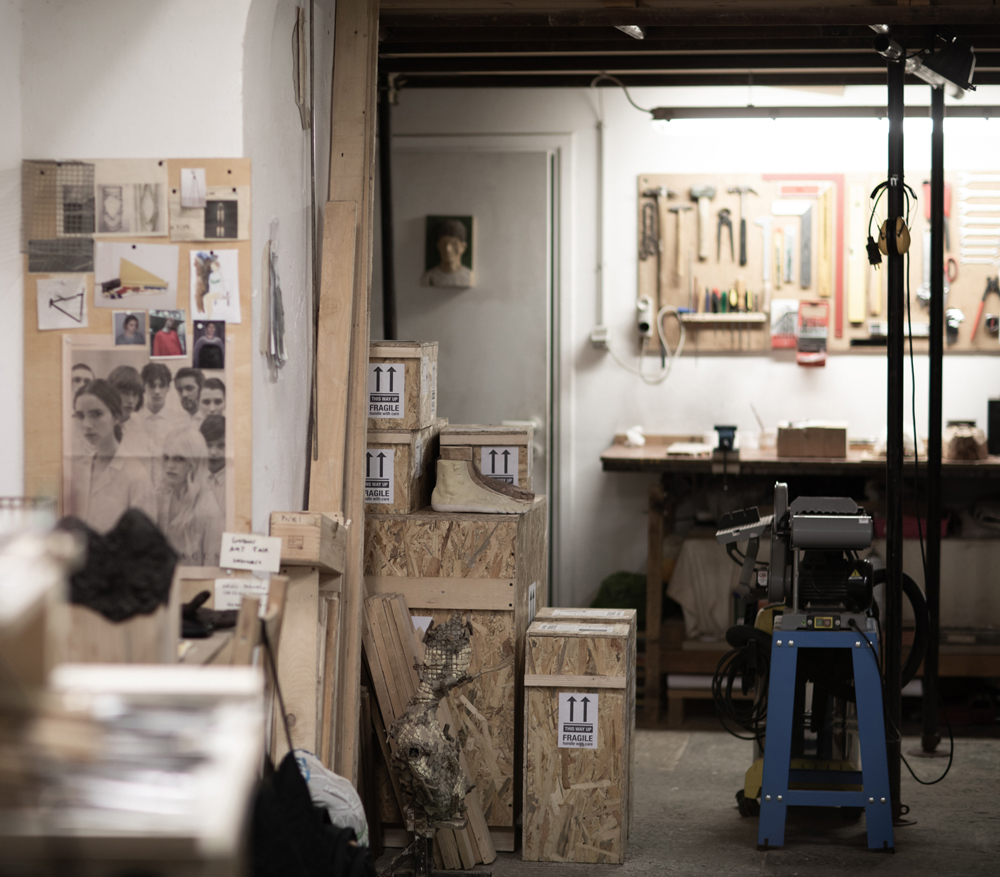
Studio Andreas Senoner. Photo by Alessandro Moggi.
Where is your studio, and how would you describe this place?
I live and work in Florence, and my studio is located in the historic center, inside a Renaissance building. It is a functional space that I have refined over the years, designed to allow me to work and complete the projects I intend to develop. I need a flexible environment that enables me to work on multiple pieces simultaneously, to experiment with different materials, and to carry out the entire creative process—from conception, realization, and finally shipping. Wood sculpture, which is at the core of my artistic practice, requires a great deal of equipment, space, and suitable structures. Over the years, I have tailored the studio to my needs so that I can work dynamically.
Do you ever invite other fellow sculptors or artists from other disciplines into your studio? Or is your studio a place of solitude?
I consider my studio a personal space, where everything has its place and function, and where the environment itself is designed to foster ideas and the creative process. I like to think of it as a space that is truly mine, one that I can control and adapt according to my needs. Although it is located in the heart of the historic center, the structure of the studio isolates it from the outside world, both visually and acoustically. It can be visited by appointment and is regularly frequented by collectors, artists, and gallerists who are in town. Conversations and projects often emerge from these encounters, and at times, I have found such strong connections that some artists have stayed to work and develop their projects in the studio for months, even years. This exchange makes the studio not only a workplace but also a fertile ground for relationships and new ideas.

Andreas Senoner, Cage, 2025, Galerie Wilms
Could you describe a standard workday in your studio? Which tasks take up most of your time? Is there a specific way in which you start or end your workday?
My day begins with a walk through the still-quiet streets of Florence, before the arrival of the tourists. I stop for breakfast at a café, a small ritual that helps me prepare for the focus required in the studio.
I usually spend around eight hours a day there. I always work on several pieces at once because this allows the works to enter into dialogue with one another. Taking a break from a sculpture for a few hours often helps me to see it from a fresh perspective.
I alternate the creation of new works with exhibition planning, residency applications, and studio visits.
I like to think of my practice as a dynamic activity, where every task contributes to the development of my research path.

Andreas Senoner, Absence, 2025, Galerie Wilms
You describe sculpture as a form of listening. What do you mean by that?
On a creative level, the traditional working method of wood sculpture as well as the use of lichens or feathers, are processes that require a great deal of time and involve countless stylistic choices, which ultimately shape the finished work and the message it conveys. For me, sculpture is a form of listening—both for myself as the maker, who must channel the idea of the work and respond to the demands of the material, and for the viewer, who is invited to listen to the silent message it transmits. Wood, feathers, and lichens are all natural materials without a uniform structure; they carry their own voice and require attentiveness in order to be understood.
Your choice of materials, such as lichens and beeswax, are quite unusual. What draws you to these materials and what do they allow you to express?
For several years, I have focused my artistic research on themes related to nature and its evolutionary processes. Through this, I have developed a visual language that allows me to investigate the human condition today. For this reason, I work with specific natural materials—wood, lichens, feathers, fabrics, wax—always considering their history and their processes of creation and transformation, while giving value to these factors.
Sourcing the materials is often part of the creative process itself. I personally collect the lichens, select them carefully, and treat them for use in my works.
Do you treat these materials to preserve them, or is decay and transformation part of the work?
Yes, I treat all the materials I use to ensure they remain stable over time. I am very selective in my choice of materials—especially with wood, where the species, grain, and color are crucial factors that significantly influence the final aesthetic of the piece.

Andreas Senoner, Mask, 2025, Galerie Wilms
Feathers are a recurring element in your sculptures. What do they symbolize for you and do they have a specific origin?
Feathers carry powerful symbolism and play a key role in rituals and celebrations across many cultures, often representing lightness and freedom. I use them to build layers—an intangible, delicate skin or shell that can still protect the individual portrayed from the outside world. This creates a striking contrast: a fragile yet protective surface that speaks to both vulnerability and resilience. In contemporary sculpture, a thoughtful and intentional approach to materials—whatever they may be—is essential to the creative process.
In your work Fragment (witness) we see a contrast between dark and light wood. What story does this work convey?
Fragment (witness) is part of a broader research on the theme of the fragment in archaeology, understood as a container of stories and meanings from the past, from its very existence. Human history is made of traces and fragments that testify to its passage, enabling those who study them to reconstruct events and distant stories.
I used different types of wood in various stages of preservation to suggest a kind of reconstruction of the fragment—one that partially restores its original form and function. In this way, the fragment becomes not only a witness to the past but also an invitation to reflect on the present and the continuity of memory.

Andreas Senoner, Fragment (witness), 2024, Galerie Wilms
In September your new work will be part of the ‘In Dialogue’ exhibition at Galerie Wilms. Were there any surprising or inspiring connections between your work and one of the other artists?
All the works I am presenting at Galerie Wilms were created specifically for the exhibition. The participating artists were selected to encourage dialogue among different approaches, and I find it fascinating to see how diverse techniques and processes converge on shared themes. Contemporary artists are increasingly expected to engage in cross-disciplinary dialogue, and I believe this exhibition shows how different creative approaches can come together to create a shared energy.
What are you currently working on?
In recent months, I have been working on a series of new pieces for upcoming exhibitions and art fairs that will take place this fall.
This winter, I will leave Europe for a few months to take part in a residency in the Philippines, where I will dedicate myself to researching and exploring new expressive languages, drawing inspiration from the socio-cultural and natural context in which I will live. During my time living and working on a small island, I plan to begin a new cycle of work inspired by nature, which will be presented in Manila at the end of the residency. In my practice, I often work with techniques such as wood sculpture, which have very ancient origins. It is, therefore, extremely interesting for me to observe and study how these same practices are used in cultures different from my own. What I find most compelling is how materials and techniques carry knowledge across time, and how, through sculpture, they can continue to evolve and find new meaning.

Andreas Senoner, Origins, 2025, Galerie Wilms
