18 august 2025, Flor Linckens
A sculptural canoe and a magical fountain: Kokmeijer & Feigl during SAIL 2025
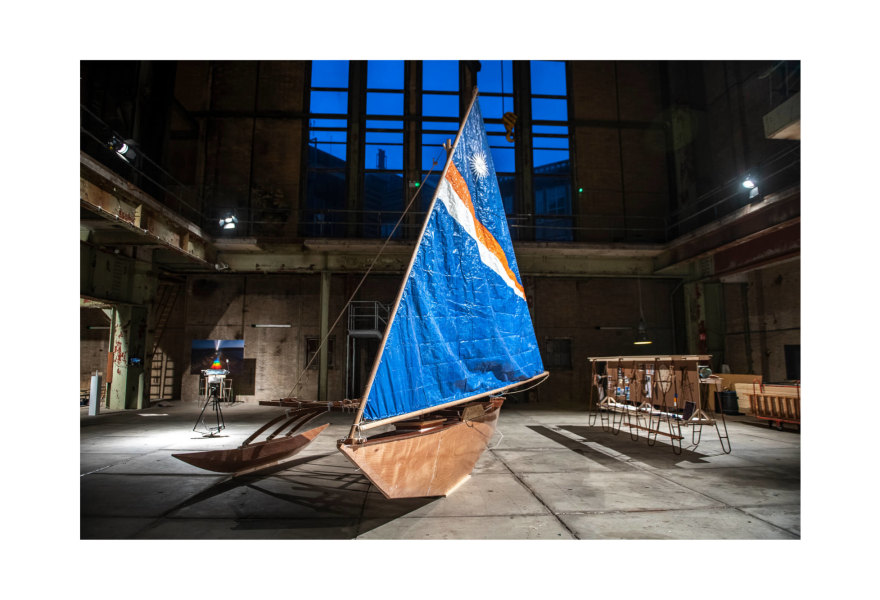
From 20 to 24 August, SAIL 2025 will set the stage for an encounter between two artists who each engage with nature in their own way. Esther Kokmeijer and Zoro Feigl will present their work at Galerie Vriend van Bavink, and in the gallery’s impressive new project space around the corner at Oosterdokskade 161 in Amsterdam, which will officially open in November. SAIL offers visitors a sneak preview. Where Kokmeijer explores the ocean and its cultural significance, Feigl reveals the beauty of natural forces in motion.
Esther Kokmeijer was born in Brantgum in Friesland in 1977. She studied visual art and graphic design at the Constantijn Huygens Academie (now ArtEZ) and later pursued the minor Arctic and Antarctic Studies at the University of Groningen. Since 2008 she has worked as an independent artist. Her work has been exhibited internationally and she has published several books and editions of her own projects. Her work has been included in various collections, including those of the CBK, Europas Parkas and the Verbeke Foundation. Travel plays a central role in her practice: she has visited 85 countries and taken part in residency programmes in Indonesia, South Korea, Greenland, Antarctica, Spitsbergen, Mongolia and China. She is particularly interested in places where human life and nature intersect directly, from the polar regions to the Marshall Islands. Kokmeijer: "In my work and projects as an artist I mainly focus on the ‘Global Commons’. The high oceans, the atmosphere, outer space and Antarctica."
In her ongoing project "Deep Meaning of Voyaging – My Sea Is Your Sea", Kokmeijer explores a nearly lost navigation method in which seafarers read the patterns of waves to detect the presence of land. This knowledge, passed down orally for centuries on the Marshall Islands, is at risk of disappearing due to climate change and forced migration. Together with Isocker Anwell, one of the last traditional canoe builders, and marine engineer Henrik Richter, Kokmeijer reconstructed a traditional outrigger canoe, based on historical models. During SAIL, the canoe will join the parade, after which it will be dismantled and suspended inside the project space as a sculptural installation, accompanied by film projections and sound. In doing so, Kokmeijer brings the ocean experience into the heart of the city.
Alongside her artistic practice, Kokmeijer works as an expedition photographer and polar guide. For her, travel is not merely a source of inspiration but an integral part of her work. Her installations merge scientific research and artistic imagination, drawing attention to ancient systems of indigenous knowledge and the question of how they might contribute to a more sustainable relationship with our environment. She deliberately seeks dialogue between science and art, where mysticism and empirical observation do not exclude, but enrich one another.
Zoro Feigl, born in Amsterdam in 1983, studied at the Hogeschool voor de Kunsten Utrecht, the Gerrit Rietveld Academie and the Higher Institute for Fine Arts (HISK) in Ghent. He is known for his kinetic works in which materials appear to have a will of their own. Using minimal means, often of an industrial nature, he creates installations that dance, swirl or pulsate. He frequently collaborates with engineers and scientists and in 2018, he received the Witteveen+Bos Art+Technology Prize. During SAIL, Feigl presents his latest installation "Magical Fountain", which has not been shown before. In a circular basin more than three metres wide, the water surface is set into motion by invisible forces. Variations in frequency generate ever-changing patterns that vanish as suddenly as they emerge. The result is a hypnotic play of form and movement. Where Kokmeijer approaches the sea as a vessel of stories and knowledge, Feigl uses material behaviour and motion to remind us of the unpredictability of natural forces.
Feigl has presented his work internationally, from the Mori Art Museum in Tokyo to the National Art Museum of China. In the Netherlands his work was shown at Museum Voorlinden, Stedelijk Museum Schiedam and Museum Kranenburgh. His installations are part of collections including Museum Voorlinden, the Stedelijk Museum Schiedam, the Verbeke Foundation, AkzoNobel and NN Group. He has also created several public commissions, such as the work "ECHO" for the Ministry building in The Hague, visible to anyone walking towards Central Station who remembers to look up.
