29 july 2025, Martine Bontjes
The studio of... Chantal Elisabeth Ariëns
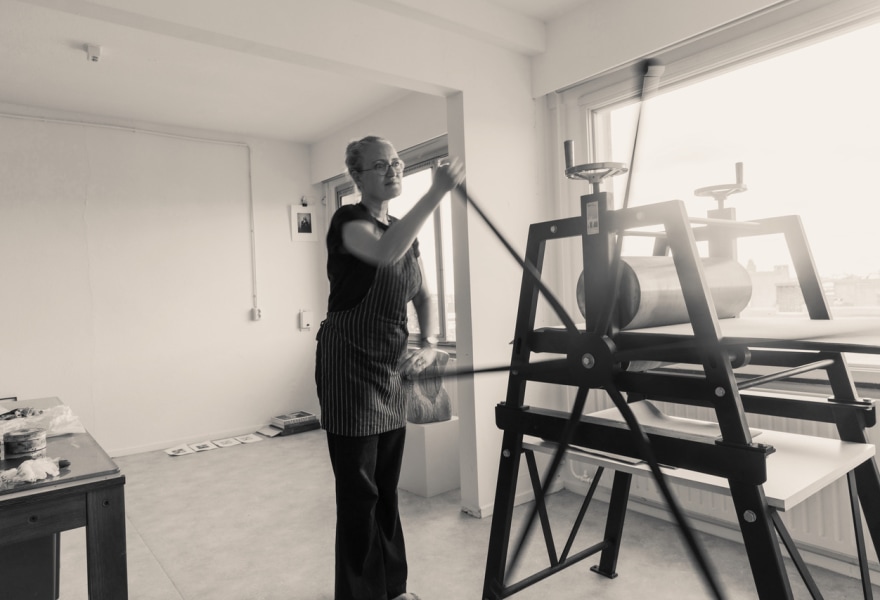
After years of commuting between various printmaking studios, Chantal Elisabeth Ariëns recently found her own studio at Surinameplein in Amsterdam. She no longer has to travel back and forth with her fragile photopolymer plates. In this new place, she slowly builds her dream studio, complete with darkroom, exposure equipment and a cherished acquisition: a printing press for her photogravures.
From a young age, dance was a way for Ariëns to express emotion. “In movement, you can release yours thoughts, it brings you closer to the core,” she explains. That approach is reflected in her photography, where the body often serves as an expressive instrument. Movement and stillness meet in her carefully composed images, where photography and printmaking are interwoven. Her work is on view until 30 August in the group exhibition "Premiers" at Bildhalle in Amsterdam. See the gallery’s website for adjusted summer opening hours.
Where is your studio, and how would you describe this place?
I managed to secure a studio at the creative hub "Sup" on Surinameplein in Amsterdam, a place focused on craft and experimentation. My studio is on the top floor, with windows stretching across the entire width. I look out over the city and even on the darkest days it is full of light. Until now, I worked at the Amsterdams Grafisch Atelier and (because of the limited opening hours, artists are not finished at 4.15pm), at the Grafisch Atelier in Hilversum. I used to travel between these places carrying fragile photopolymer plates, transparencies and paper. That is why I now feel incredibly fortunate to have a space of my own where I can work day and night, be in silence, reflect and experiment.
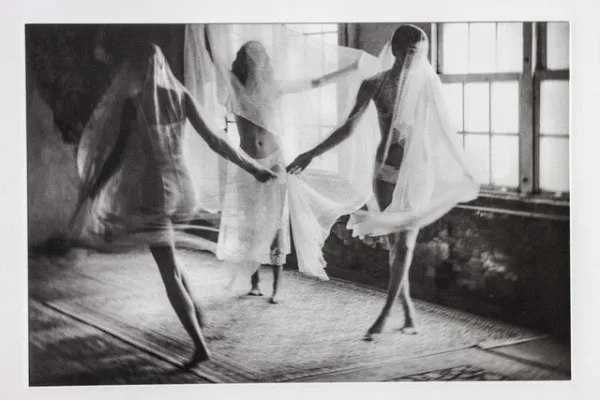
Chantal Elisabeth Ariëns, Nymphes #29, 2024, Bildhalle
What are the essentials in your studio. Are there specific objects or light you need in your studio?
I am still in the process of setting up my studio. I have a darkroom, a UV exposure unit and a fantastic printing press, by far the most essential tool for me as a printmaker. I was able to acquire it from a remarkable 80-year-old artist. The studio feels like a safe haven to me. It is important to be able to work freely, to follow impulses in solitude in order to reach a deeper layer, sometimes quite literally but certainly also figuratively.
You started your career as a dancer and model. How have these experiences shaped your perspective as a visual artist?
From a young age, dance was a way for me to express myself and process emotion. I invite the models I photograph to stay in motion, to let go of posing. In movement, you can release your thoughts, it brings you closer to the core, to emotion, and that is where things become interesting. I did not pursue the dance career I had envisioned, but I also worked as a model, which taught me a lot about photography, composition, light and shadow, and what it feels like to be on the other side of the camera. Those experiences continue to influence my work. I am always searching for movement and for ways to translate movement and emotion into images that not only speak visually but also resonate emotionally.
When did photography become a fully autonomous and professional form of expression for you?
I felt the urge to create personal work, letting go of fixed concepts and allowing myself to arrive intuitively at my own themes. Gradually, I found myself on an autonomous path. The photopolymer etching technique I came to master aligned perfectly with this intuitive approach and strengthened my artistic search within the realm of printmaking as well.
Your work is often described as poetic and cinematic. Are there specific poets, writers or filmmakers who inspire you?
I am drawn to works, whether written, filmed or expressed in other ways, that carry a sense of melancholy. A few names that come to mind are Pablo Neruda, Chekhov and Parajanov.
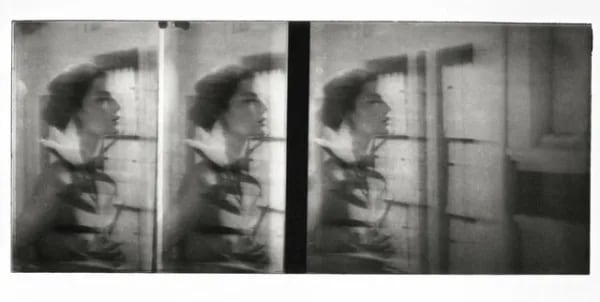
Chantal Elisabeth Ariëns, Nymphes/Unfinished #1, 2024, Bildhalle
Your images feature special fabrics and couture. What fascinates you about textiles and clothing, and how do you decide what remains visible?
I am not interested in clothing in itself, but I am fascinated by couture, exceptional designs and fabrics that evoke a certain feeling. I enjoy working with them. I never determine in advance what an image will look like. I let it emerge intuitively.
You work with photopolymer photogravures. What drew you to this traditional printing technique, and how did you discover this technique?
I once saw a photopolymer print in a gallery. The tactility, the imperfect character, the visible craftsmanship, it fascinated me. I love the texture, the subtle tonal range, the deep blacks and the layering that make the print so special and unique.
You’ve mentioned that you were drawn to a technique that allowed for a physical, hands-on approach to image-making. Were there other methods you explored before discovering photopolymer printing?
This is the technique I started with, but I have made it my own so I can give my images a signature of their own. It also led me to traditional copperplate engraving and other graphic techniques I would like to explore further in relation to my imagery.
What are you currently working on? Or what are you most looking forward to in the near future?
I am currently working on a book based on the images I created using designs by Olivier Theyskens, not so much a fashion book but rather a world of its own coming into expression.
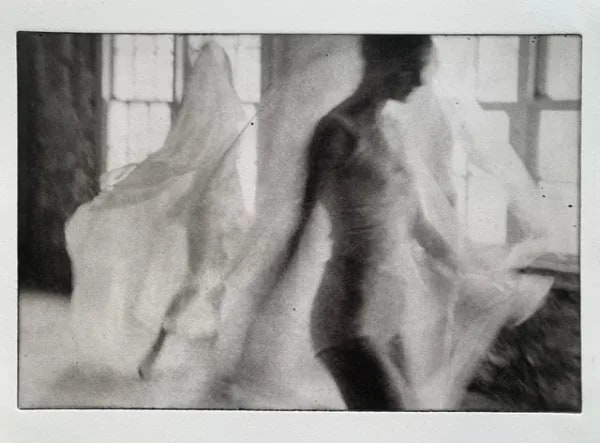
Chantal Elisabeth Ariëns, Nymphes #31, 2024, Bildhalle
