23 april 2025, Wouter van den Eijkel
The studio of... Marjolein Rothman
'Penumbra' is the title of painter Marjolein Rothman's first solo exhibition at galerie dudokdegroot. It refers to the space between light and dark — a zone that is neither fully illuminated nor completely obscured. Her fascination with this in-between gap stems from the magic she experienced in the darkroom during her studies. Throughout her career, Rothman has continually sought new ways to capture the intangible.
For 'Penumbra', she worked on aluminium, a reference to analogue photography. This surface also changes the viewer’s perception of the work—she describes it as more dynamic and unstable than canvas — and requires a different technique. Aluminium is a surface that must be worked on in one go. “It has to be right the first time. If I’m not happy with a detail, I wipe the paint off the panel and start over again—and again and again—until it’s right.”
The exhibition 'Penumbra' can be seen at galerie dudokdegroot in Amsterdam through 17 May 2025.
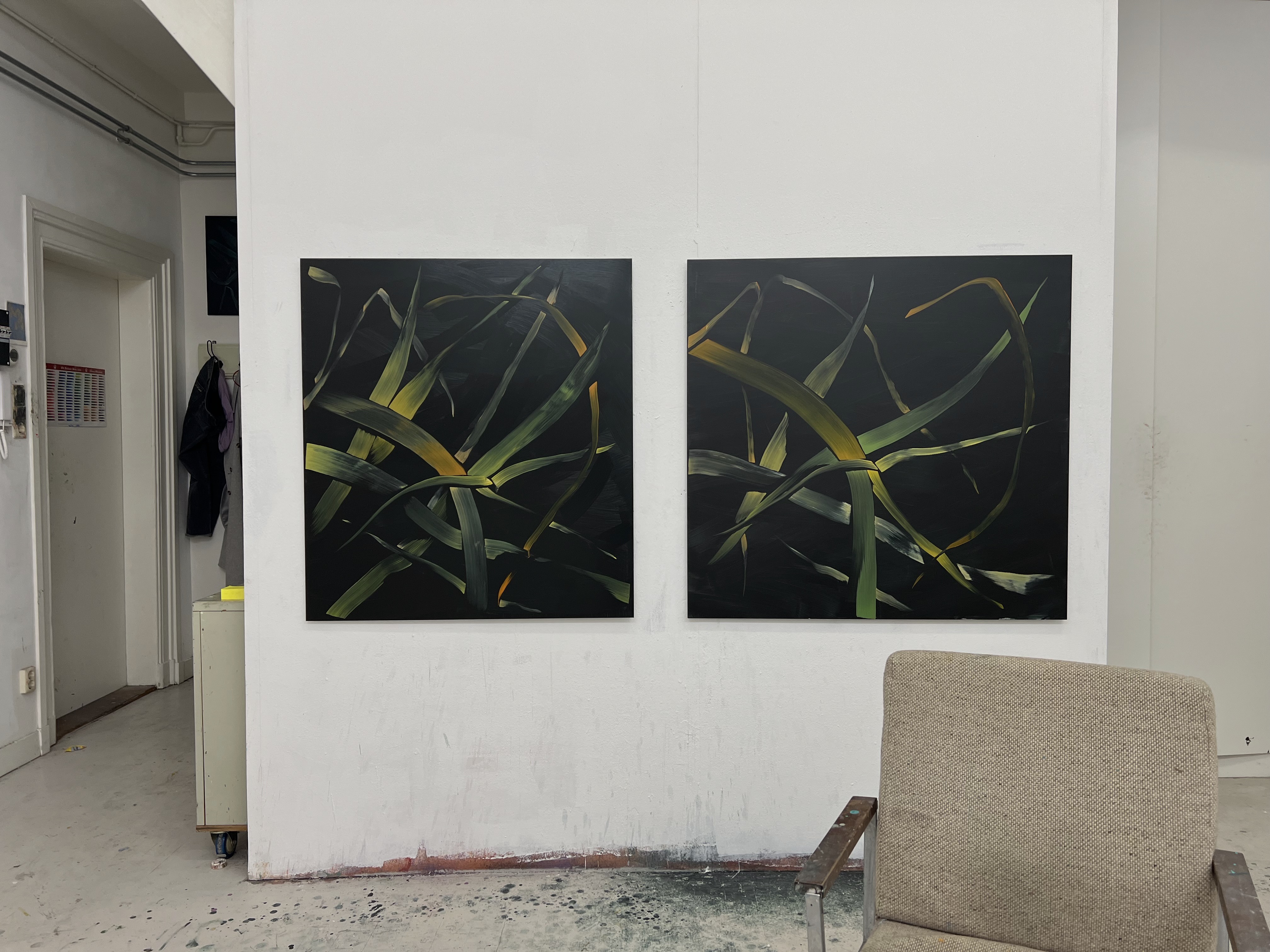
Penumbra I, 2024 | Penumbra II, 2024
Where is your studio and how would you describe it?
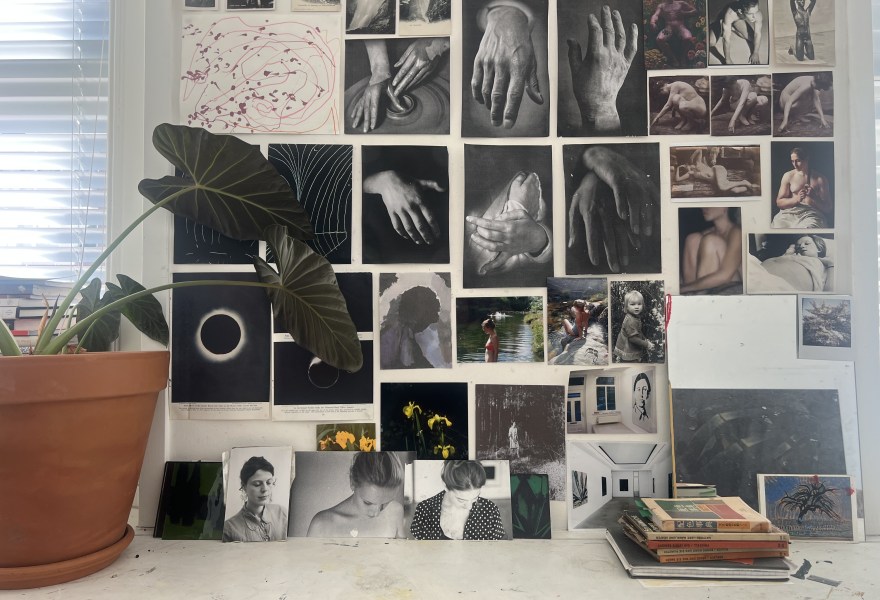
My studio is located in an old school building on the Palmgracht in Amsterdam. It’s a classroom of around 60 square metres with tall windows. The light is softened by blinds. I’ve painted the wooden floor a neutral grey and kept the space fairly empty. There’s one wall covered with photos: portraits, anatomical images, plants, trees and a series of eclipse images. In front of the wall is a drawer unit with paints sorted by colour. When I work, I use a mobile palette: a cart with a glass plate on top. A mezzanine takes up around a third of the studio, which is the ‘clean area’. There you’ll find a desk, a bookshelf, a large flat file and a daybed. Below the mezzanine are storage cabinets for paintings and a small kitchen. There are quite a few plants in the studio, especially upstairs.
You’re a painter who also studied photography and your work partly explores light and how it falls. I imagine natural light is very important to you. What makes a good studio space for you?
Yes, I studied photography for a while at the academy. That experience still influences how I approach painting. In my paintings, I explore how light — through low or high contrast — can evoke an image that exists in a sort of transitional phase: emerging but not yet fully formed. Daylight isn’t essential; in my studio, the lighting is a combination of cool and warm artificial light combined with subdued daylight. The work is often not shown in natural light either, though I do appreciate the predominantly natural light at galerie dudokdegroot, where my work is now on display. My workspace needs to at least be large enough to work, preferably with high ceilings, and have plenty of wall space.
How do you view your studio: is it a special place or mainly a functional one?
Both. It’s functional because it meets the requirements for working effectively — size, height, layout, lighting. But it’s a special place because I’m always alone there and in a certain state of focus. That’s what the space radiates: calm, space and concentration. The studio isn’t far from my home and I enjoy walking there, often in the evening, just to spend time there and observe. Walking through the city helps me concentrate when working, just like certain rituals in the studio: looking, arranging, mixing and so on. I always feel a certain excitement or tension when I go there. I consider my studio a space that offers room and possibilities, also mentally.
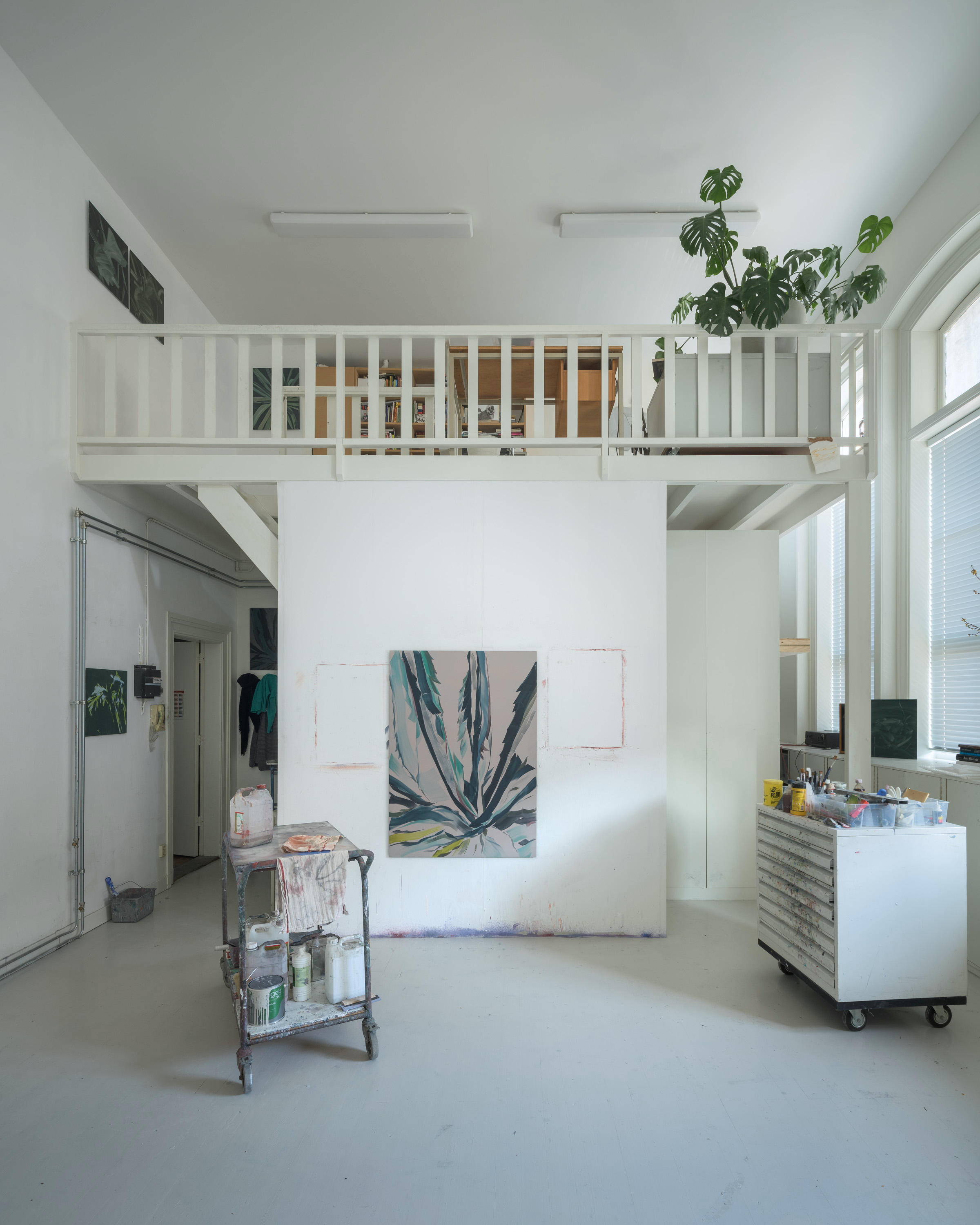
Studio of Marjolein Rothman in 2022. Work on the wall muur: Agave VIII, 2019. Photo: Ralph Kamena
What does an average day in the studio look like?
I don’t have a strict routine, but I prefer to work in the afternoon and evening. The day starts with looking: moving paintings around, seeing how they relate to one another. I often work in series and try to figure out what’s missing or just starting to appear. That leads to new ideas, which in turn lead to me painting.
First, I mix black, then different colours. In this series, I started by applying black over the dry red underlayer. I then added brushstrokes in lighter tones, which gradually shaped the image.
Each painting takes a total of around half an hour, but it must be completed in a single session. Every action remains visible; correcting is not an option. It has to be right the first time. If I’m not satisfied with a detail, I wipe the paint off the panel and start over again — and again and again — until it’s right. My workdays vary considerably. Sometimes I work two hours, sometimes eight.
Congratulations on 'Penumbra'. The title refers to the space between light and dark, a zone that is neither fully lit nor fully veiled. This isn’t the first time your work titles refer to light and its perception. I’m thinking of your previous series "Interval" and before that, "Reversed Grounds"; "False Color". Why does this theme fascinate you?
It comes from my fascination with photography and the magic I experienced in the darkroom, when an image would slowly emerge in the developing tray. I often fixed the image before the scene was fully formed — it was in that in-between phase that I found meaning. "Penumbra", like "Interval", refers to that intermediate space: the moment when light brings something into being—that can just as quickly vanish again. But it also refers to the spatial in-between areas in the composition, which are just as important in evoking that liminal space. The paintings in "Reversed Grounds", for example, are made up of two tones so close in value that the planes seem to shift in relation to each other — coming forward and receding. The image presents itself and simultaneously withdraws.
So, I’m always looking for a way to capture the elusive, a moment that inevitably passes. Whereas photography fixes time, painting can stretch and transform that moment — both through the use of light.
In 'Penumbra', we see the leaves of agave plants, I think, in semi-darkness. The work balances between abstraction and figuration. Why this subject?
"Penumbra" was preceded by a series of works featuring flowers and plants, including agaves. I started that series — unconsciously — eight years ago after my mother passed away. Flowers and plants are symbols of transience, but the theme also lends itself well to exploring abstraction. I did that within series of paintings based on a single specific photo. Through repetition, I let the image slowly tilt, distort, shift.
The paintings in 'Penumbra' no longer start from a fixed image. The composition is created while painting: brushstrokes become leaves and then brushstrokes again. The image remains in flux, as shapes emerge during viewing and simultaneously dissolve back into gestures and paint.
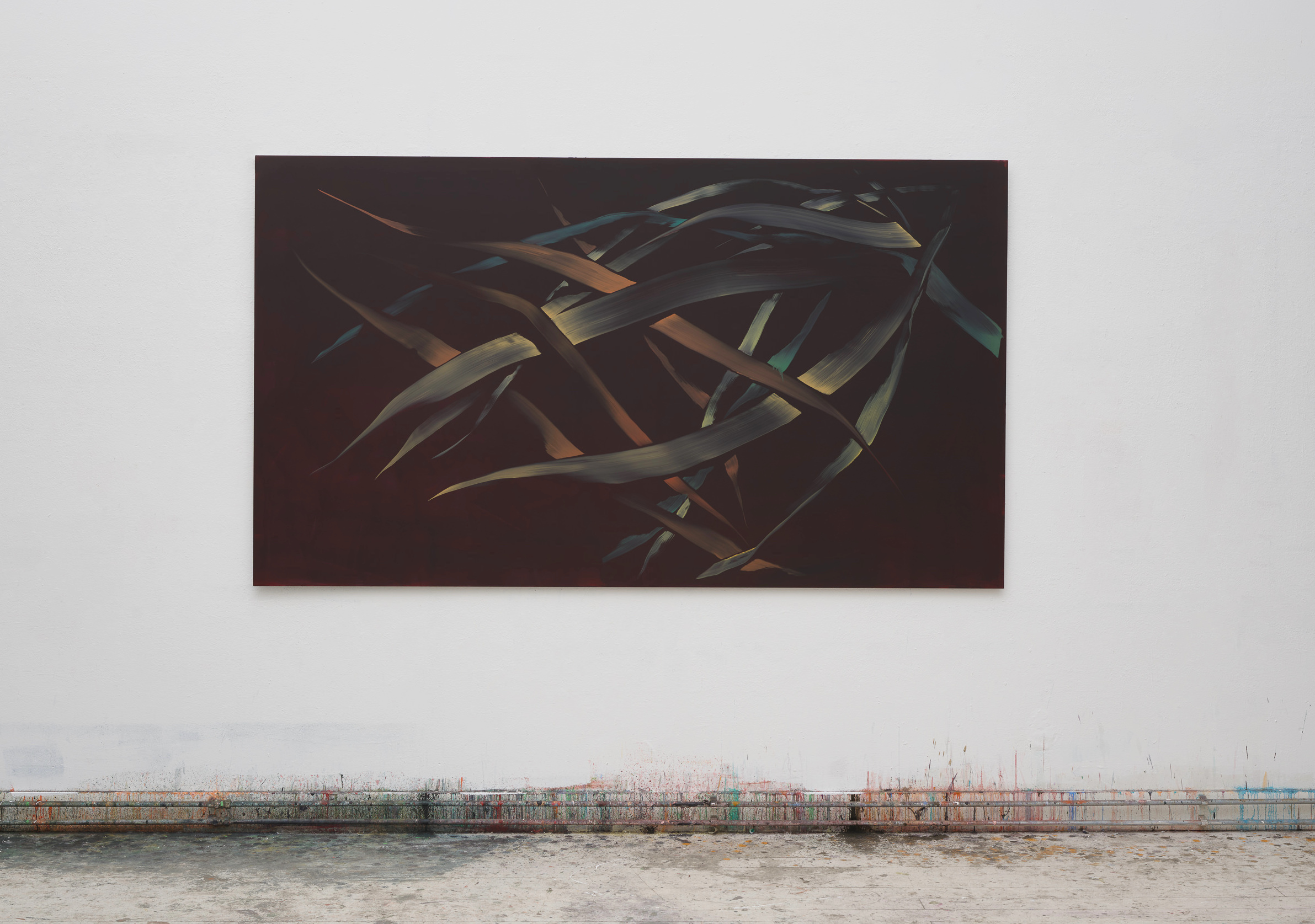
Studio in 2025. Work: Foliage V, 2025. Photo: Jonathan de Waart
You paint on aluminium and the surface is composed of red and black, resulting in an earthy brown tone. Because of this surface, you have to apply the composition in one go. You have to see what emerges and respond to it. That seems quite challenging. When did you develop this technique?
Yes, it’s a very direct way of painting in which I constantly respond to what’s happening at the moment. This method gradually evolved over the years, but accelerated in recent months. A few months ago, I decided to revisit an older, darker painting with leaves. I still had a panel with a dark red underlayer and applied a thin black layer over it. Unlike before, I now painted directly onto that wet black layer and let the image develop from there. That moment turned out to be a turning point: a whole series of dark paintings followed that seemed to come into being almost effortlessly. In the meantime, I had gained freedom and technique.
Can you tell us more about the choice of aluminium as a surface?
My choice of aluminium is partly conceptual, partly practical. The material references analogue photography, an underlying motif in my work. That association becomes even stronger when I leave parts of the aluminium exposed, allowing the surface to remain visible.
Aluminium reflects light differently than canvas. As you move past the work, the image changes, appearing in new ways each time. Compared to canvas, the image on aluminium is more fluid, less fixed, you might say. That instability of perception is something I want to emphasise in my work.
Aluminium also allows you to completely erase an image and start over. Or to wipe away parts and let the light reemerge.
If you hadn’t become an artist, what path do you think you would’ve followed?
I studied sociology at the University of Amsterdam for a year, which I found interesting, but I always wanted to go to art school. That same year, I applied to AKI and was accepted. Since then, I’ve never doubted that decision, which makes it hard to imagine doing something else. I also teach at the academy now, which could be seen as an alternative path, but it’s completely intertwined with my artistic practice.
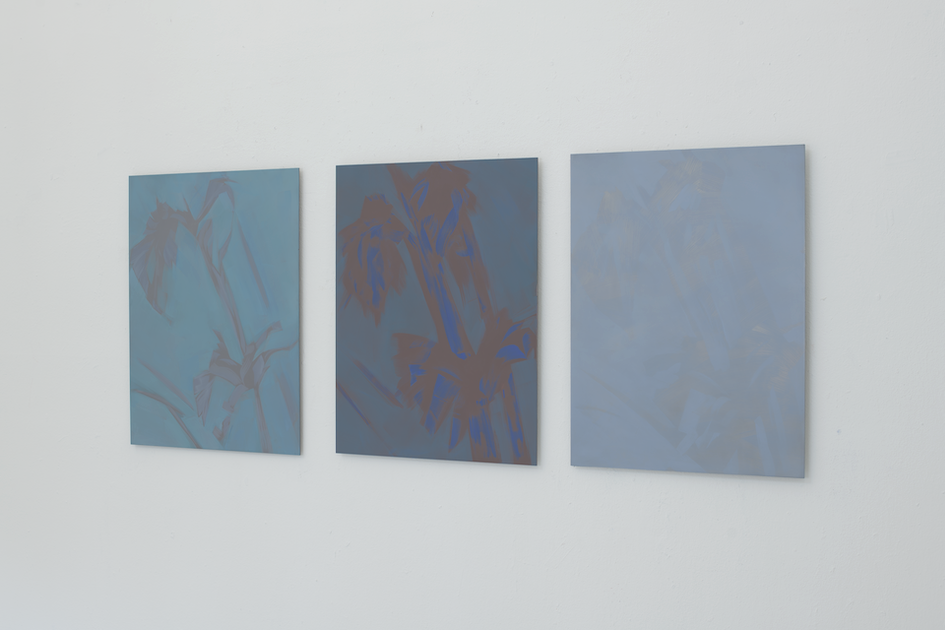
Studio in 2022. Serie 'Iris'
Suppose I gave you carte blanche and time and money were no object. What project would you like to start and why?
That’s something I occasionally ask myself — and I’m happy to say I wouldn’t do anything other than what I’m doing right now. My work doesn’t lend itself to large-scale or spectacular projects; it mainly requires time and dedication. So, what I would do is buy a live-in studio, so I could devote myself even more fully to my work without any distractions.
What are you currently working on?
I currently have a solo exhibition at galerie dudokdegroot, a new collaboration I’m very excited about. At the same time, I’m preparing for a solo presentation at Art Brussels with my Swedish gallery, Wetterling Gallery. I’ll be showing eight works from this series in combination with a self-portrait. That combination excites me — the portrait casts a new light on the more abstract, darker paintings, allowing them to be read more as mental landscapes. That tension is something I want to continue exploring in the future.
