14 october 2024, Wouter van den Eijkel
The studio of... Hemaseh Manawi Rad
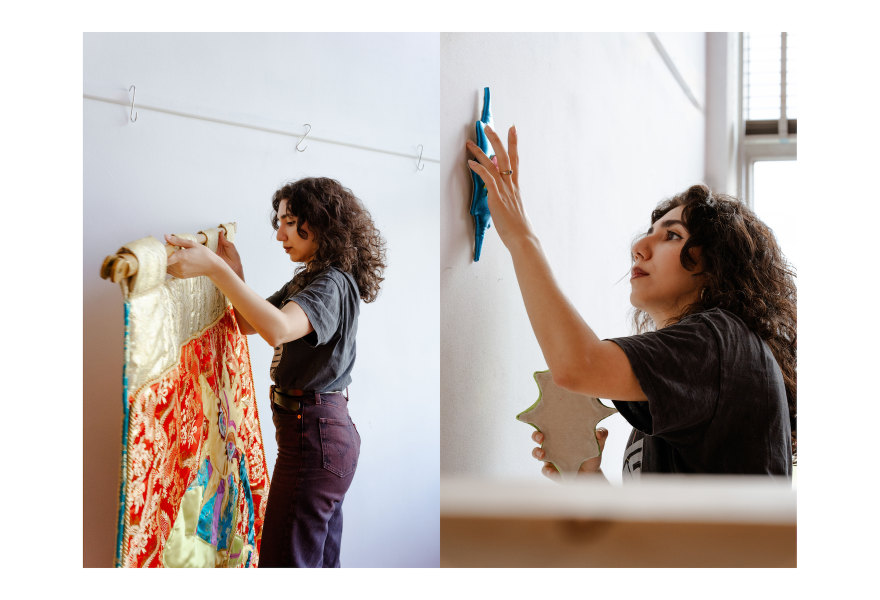
Heard it through the grapevine is the title of Hemaseh Manawi Rad's first solo exhibition. The phrase is not only the title of a hit song by Marvin Gaye, but also a typical opening line for a story. And storytelling is precisely what the work of this Eindhoven-based artist with Iranian roots is all about.
Manawi Rad (1995) creates textile art in the form of tapestries, giving them her own unique twist. You won’t find floral motifs or geometric patterns here, but tapestries stuffed with pillow filling, featuring bold colours, quirky patterns and textures. The stories she tells through her work are partly drawn from her personal life and partly inspired by Persian fables.
As someone who grew up between two cultures, she wanted to find a form that does justice to both cultural traditions: the Persian and the Western. “Images go beyond language and bridge cultures,” says Manawi Rad. “When you live between two cultures, it can sometimes feel like no-man's land. You're neither fully one nor the other, and because these are deeply personal experiences, it's hard to find recognition.” Her work hovers between two cultures, brightly coloured messages from no-man's land.
Heard it through the grapevine by Hemaseh Manawi Rad can be seen at Galerie Bart until 19 October.

Where is your studio and what does it look like?
My studio is located in Plan-B in Eindhoven. It’s an old Philips industrial building that now houses a lot of creative enterprises. My space is four metres high and has plenty of natural light coming in through a large window. My father, who is very handy, built a mezzanine floor that I use to store my work. This leaves me with a lot of room downstairs to create large pieces, for example.
You create textile art. What makes a good studio for you?
I imagine my needs are different from, say, a sculptor's. I work with various tools, including a sewing machine and tufting machine. So, it's important that these have a good location in my studio. My worktable with the sewing machine is near the window. Under the mezzanine, I have cabinets full of fabric and wool.
One of my favourite parts of my studio is my large mobile tufting frame. When I'm tufting, it stands opposite the window so I have lots of light and it can be rolled away when I’m not using it, creating more floor space. I’ve painted one of my walls bright pink because I like to see my work against a colourful background. I also have a white wall for documenting my pieces.
If I were interning with you, what would a typical day in your studio look like? Do you have routines, play music or prefer to keep the door closed?
I put on music the moment I enter the studio. Without music, I think too much and don’t get much done. A sewing machine and tufting machine have their own kind of rhythmic sound. I like a bit of noise. When my music combines with the sound of my machines, it creates a wonderful atmosphere that helps me work.
The creation process starts with some simple sketches. I then make a pattern for the piece. The textiles are cut and sewn until I have the ‘base’ of the tapestry. After that, I continue with the symbols and figurative elements. I draw these to scale and cut them out to use as stencils. I place the stencils on the base of the work and move them around until I find a composition I like. I then work them out in textile and attach them to the tapestry. Sometimes, I have visitors who think along with me about the next steps in my process. I like being able to bounce ideas off others from time to time. Often, just saying something aloud is enough to find out whether it’s a good or bad idea.
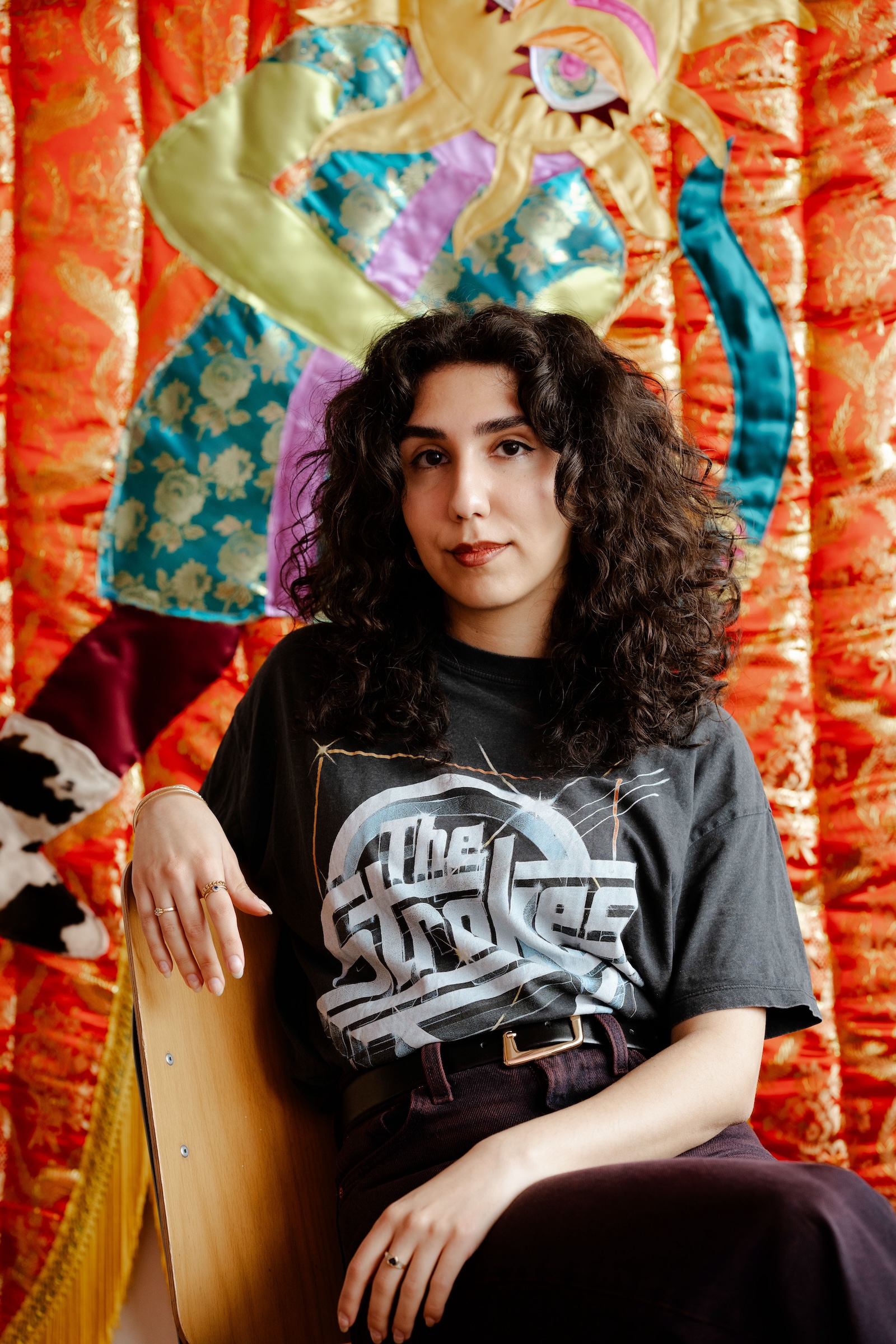
It’s a way of communicating. Images go beyond language and bridge cultures. The work I make often hovers between two cultures. I quickly noticed that it’s easy to sketch situations for others through stories, whether my own stories and experiences or those of others in similar situations. Of course, it's also a personal preference to work with stories. After all, my name means ‘epic’ in Farsi.
You have Iranian roots and live in the Netherlands/the West. With your work, you want to honour both cultural traditions. When did you realise that textiles were the best medium for this?
There are several reasons why I chose textiles. They stem from Persian carpets and I wanted to do something with them, but give them my own twist. I started doing this by stuffing the carpets with pillow filling, using bold colours, patterns and textures. These choices are strongly tied to the TV and internet culture I grew up with. I also started working with textiles because I can't always control them well. I can be a real control freak and this forces me to make different choices than I originally planned. This makes the creative process playful and brings fun surprises.
According to the press release, you focus on the no-man's land between two cultural traditions. Why is that and where do the two overlap?
When you live between two cultures, it can sometimes feel like no-man's land. You’re neither fully one nor the other, and because these are deeply personal experiences, it’s hard to find recognition. This is one of the main reasons I started making work about this.

Some people immediately recognise the Iranian elements in my works. I find that very special because the symbols I make often come from my ‘in-between culture’. But there are also many connections with people who are bicultural, like the feeling of not belonging or doubting where you fit in. I think most of us have experienced a similar search at some point in our lives. My work is about accepting the in-between space and seeing it as a fully fledged culture. When I talk about it with viewers who recognise it, there is often mutual understanding.
What’s the best reaction you’ve heard to Heard through the grapevine?
I’ve received so many great reactions that it’s hard to choose! I always find it very special when I’m told that my work moves someone. I’ve also noticed that my work invites people to share their own personal and cultural stories with me.

I definitely recognise it, but it’s not the intention at this point. I think it would be really cool to make it a tactile experience for visitors. But the work I are now making is too fragile for that. Maybe I’ll come up with something like that in the future!
You're at the start of your career. What do you hope to do in the next five years? Do you have concrete goals?
In the past few years, I’ve had the chance to do lots of exciting and varied projects. I’ve learned that with my work, and as an artist, I can claim more space. In the coming years, I hope to step into that space more often. I’m already doing this with my double-sided banners that hang in the middle of the room. But I want to develop this even further in coming years.
I’d also love to exhibit abroad. I’m curious to see what new insights that will bring from, for example, visitors who might connect with the work in different ways, depending on their own cultural background.
What are you currently working on?
Since many of my new works are on display, my studio feels quite empty. This gives me a strong urge to start creating again. Right now, I’m working on two smaller, partly tufted pieces. Once I’ve finished these, I’m excited to get started on a new large tapestry.
