08 december 2023, Yves Joris
Hans Temmerman: dialogue between marble and canvas
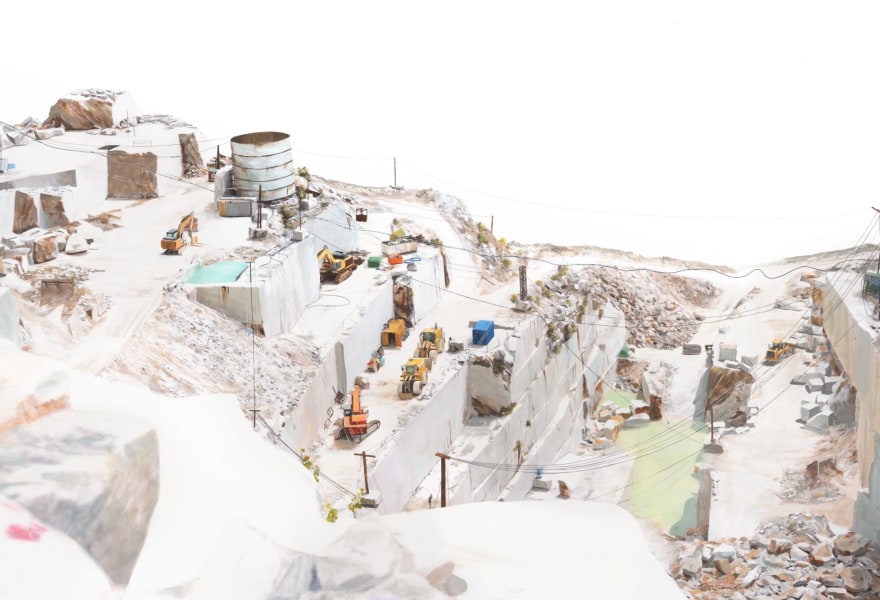
For his new exhibition Honed, which opened on 2 December at Gallery Ysebaert, Hans Temmerman journeyed to the marble quarries of Carrara together with his partner. The result is a series of almost photorealistic paintings that transport you into a total experience, where the beauty of white marble engages in dialogue with the surroundings.
When I meet the artist for the interview, preparations are still in full swing. Paintings of various sizes stand side by side, waiting patiently to storm the white walls. Temmerman lives in Aalst, where he also has his studio. But to prepare for Honed, he made his way to Sint-Martens-Latem. His oeuvre extends beyond painting, as photography is a consistent element of his artistic output. He is also a graphic designer and lecturer at the Artevelde University College in Ghent. As a self-taught artist, he took his first steps into the art world in 2008. Describing himself as someone who likes to delve into his subject matter, he emphasises his desire to forge his own path with minimal external influence. When asked whether this exhibition has resulted in changes or evolution in his work, he responds in the affirmative.

Hans Temmerman, Honed 07, 2023, Gallery Ysebaert
Distancing himself from abundance
"In the past, my paintings were much more chaotic, leaving less room for the work to ‘breathe’. The turning point came when I photographed a dock in the mist in Ghent. On translating it onto canvas later, I became intrigued by the point where the mist took over, enveloping the surroundings in a white-grey nothingness. This emptiness allows viewers to fill in the rest themselves. It felt immediately right."
The paintings in the new series endorse this. The white brilliance of the marble creates an emptiness on the canvas that the viewer needs to interpret. But this emptiness is not accentuated solely by the whiteness. In his work, Temmerman depicts the explicit absence of humans. No characters adorn his canvases, while large forklifts, trucks and heavy equipment for quarrying marble imply the presence of humans. It is as if he asked them to lay down their work and wait just beyond the edge of the canvas. "In perhaps five percent of my work, humans are present and when they are, they usually remain shrouded in anonymity," he adds.
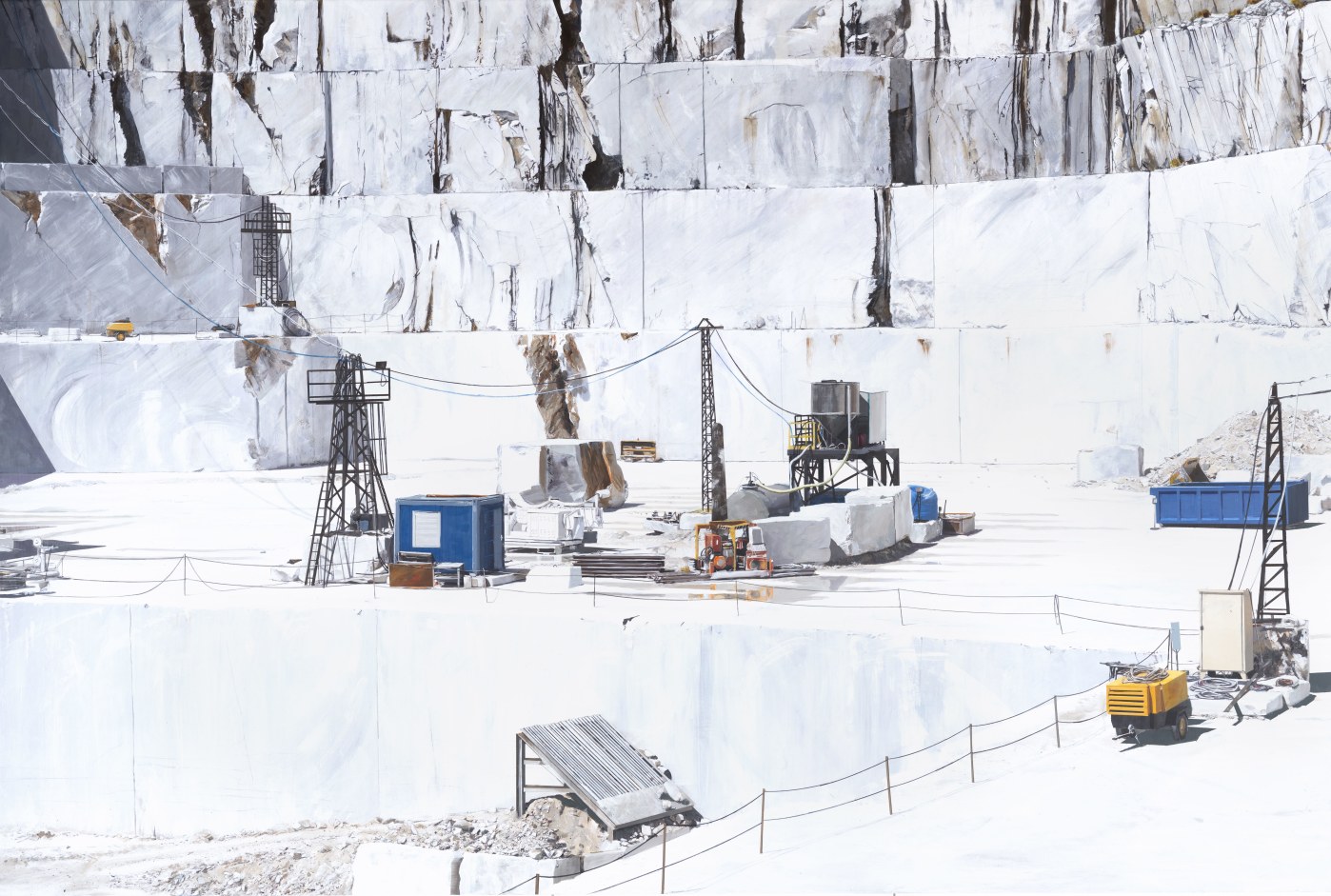
Hans Temmerman, Honed 17, 2023, Gallery Ysebaert
“It is often only much later that I understand why I painted something."
For Honed, he and his partner spent six weeks traveling across Italy. The impressive marble quarries also captivated his partner, who works in fashion photography. Why does he harbour such affection for this stone beauty? He confesses that the answer usually does not come to him until much later. "When I used to create work featuring structures that were tightly boarded up on stilts or pillars, I realised later on that this height was intended to protect me from the surroundings. It was a tough time for me and that height let me isolate and shield myself from the world. At one point, more colour crept into my work, which turned out to be the moment I fell in love with my current partner. So, if you really want to know what I mean with this series, it's probably better if we meet again in about a year or two." (laughs)
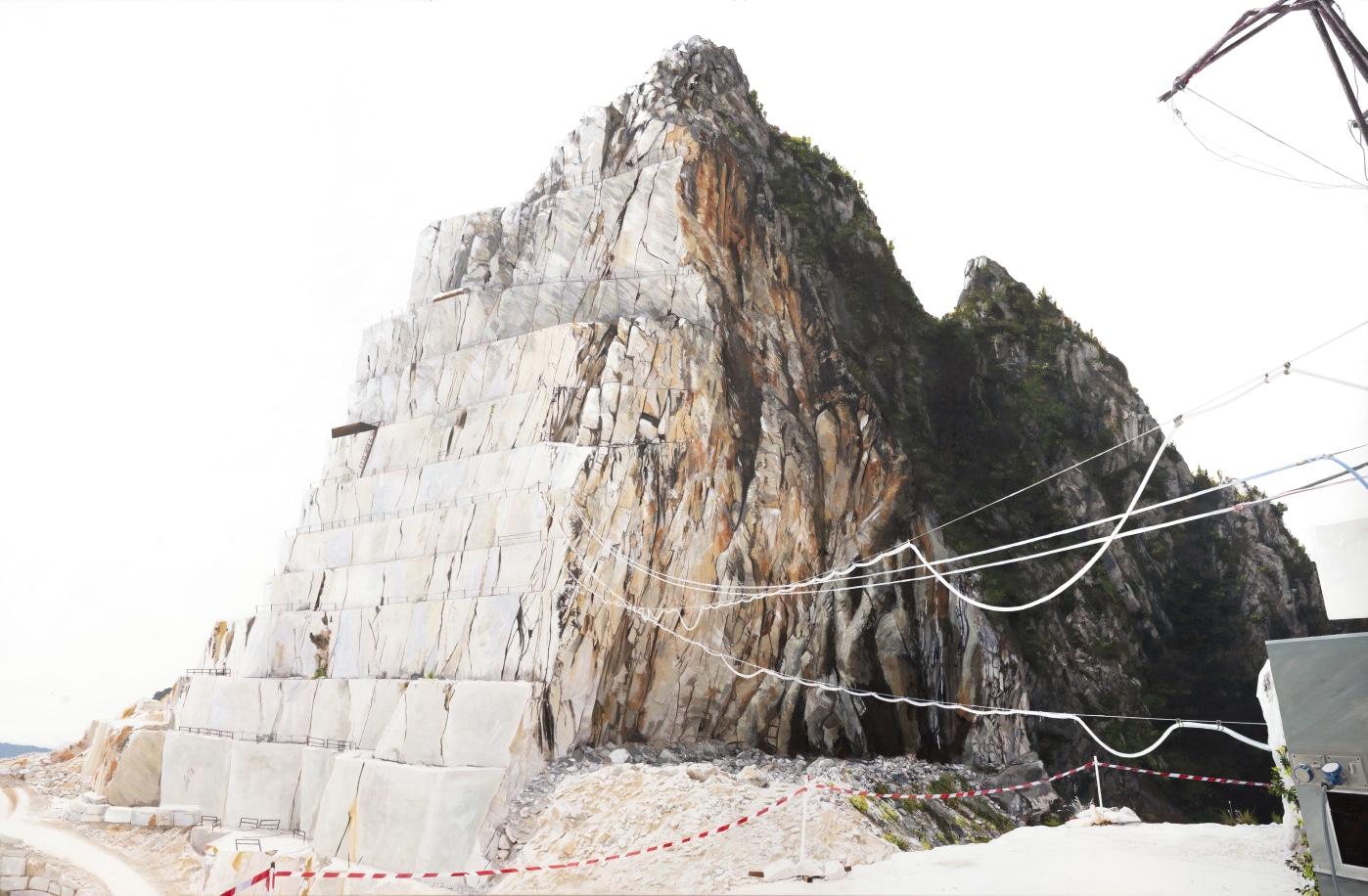
Hans Temmerman, Honed 19, 2023, Gallery Ysebaert
A photorealistic canvas
All of his work in the new exhibition has the same title followed by a number. To Temmerman, titles are too directive. We pause at the work Honed 19, where he validates this. The impressive painting, which measures 130 x 200 cm, depicts an excavated wall with clear traces of quarrying. "Suppose I were to name this work Red Ribbon. In that case, I know people would mainly focus on that and they might no longer see the grandeur of the mountain. Perhaps they would think the ribbon is a warning that rocks might roll down. Titles infer too much."
In his new work, Temmerman has also used a different technique. He usually paints with acrylic on rough canvas but realised that, for the amount of detail in these works, he also had to use a pencil and ink. "With earlier work, I usually covered the canvas with a layer of paper, making it easier to work on without losing its uniqueness. Often, you can still see the small cracks caused by the rough canvas. With this series, I applied multiple layers on top of each other to create a much smoother effect." He also points out the numerous threads and cables that feature in his work, acting as escape lines guiding the viewer's gaze. Honed also refers to the marble surface, which is not yet polished and lacks the characteristic shine of polished marble.
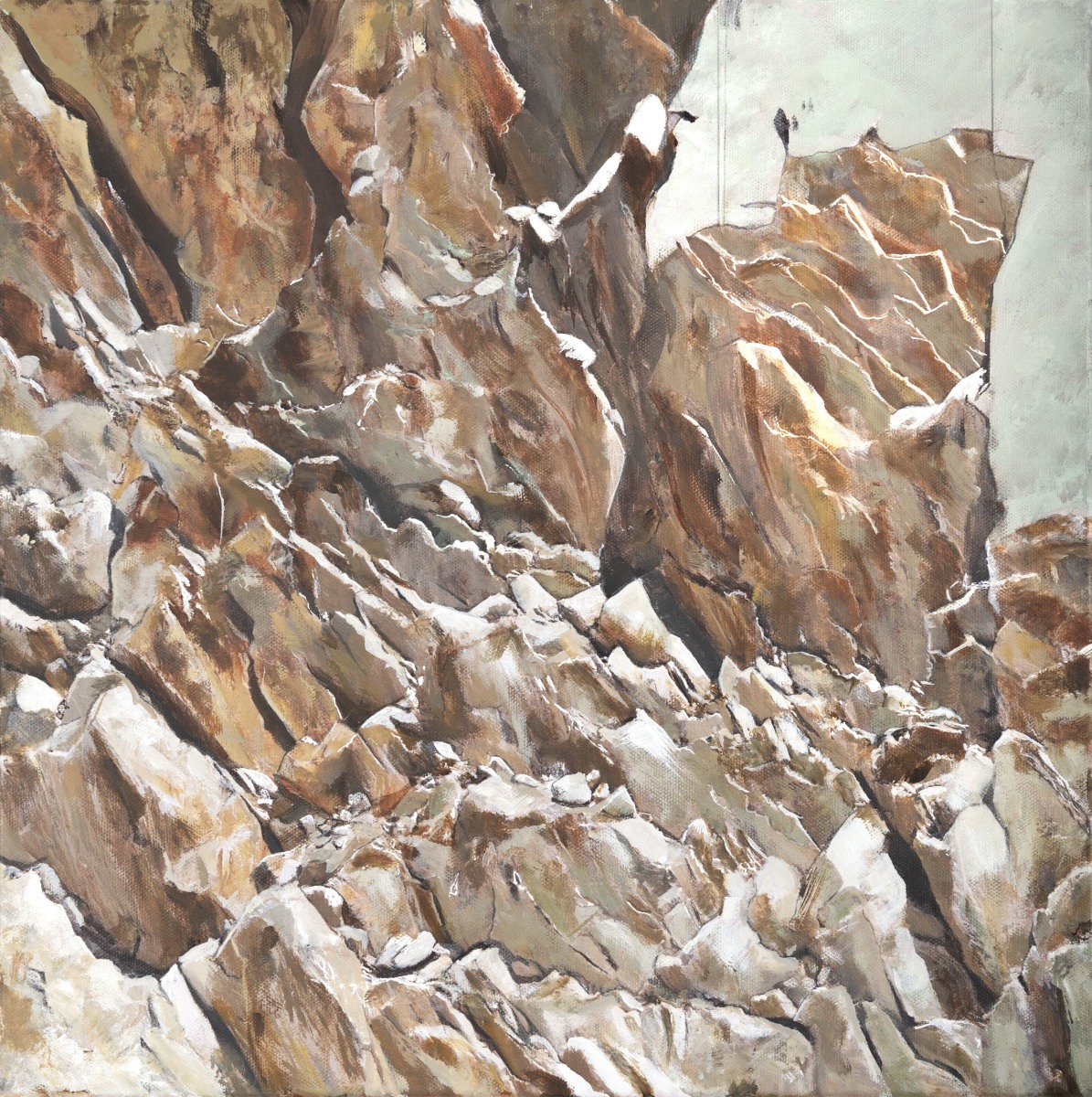
Hans Temmerman, Honed 02, 2023, Gallery Ysebaert
Limitation of a stairwell
Finally, we come to the question of whether each work demands a specific format. Laughing, he admits to having only two real limitations: the size of the stairwell in his studio and that of his car. He immediately adds that determining the format often depends on the amount of detail on the canvas. Honed 18, which depicts the mining environment in the tranquillity of a Sunday, requires a larger size due to the amount of information on the canvas. This work, which is also the campaign image for the new exhibition, shows a number of excavators and trucks that seem to be engulfed by the vast white nothingness. "It is one of the first works in which I combine realism with a blurring effect. The rock is barely visible in the foreground and even the azure blue sky in the background has to yield to the abstraction of an all-encompassing white emptiness."
During the conversation, more and more works of art are removed from the lineup and placed against the white walls. White on white, marble depicted on canvas. It is only the busyness of the final preparations that makes it difficult to immediately step into the space and enjoy the silence reflected on the canvas.
