05 december 2023, Indra Devriendt
From the outside in | Partly Cloudy – Leon Vranken explores the relationship between inside and outside
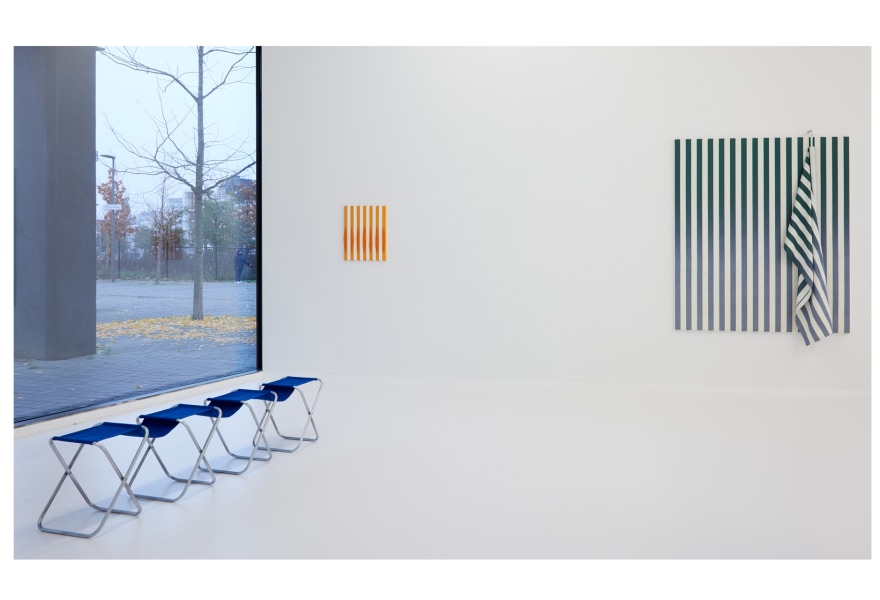
In Partly Cloudy, Leon Vranken visualises the dynamic between the external and internal. Starting with the visible, he reveals invisible processes, touching on the essence of life and human experience of thinking and feeling in polarities. Vranken seeks tranquillity and harmony, prompting the question: When is there not a cloud in the sky?
Leon Vranken showcases sun canopies, camping chairs, doormats and stones in the exhibition space, objects that are all associated with the outdoors. "I find it interesting how things from the outside come inside," he explains. "I love nature and hiking. Nature is a great source of inspiration. But even when I'm on my way to and from my studio, I often encounter interesting objects, everything from pipes and racks to gas cylinders and a hook. I bring them with me and put them in my studio and sometimes they become works of art."
His work goes beyond the material and visible or external world. It is a way of communicating about the invisible or tangible from the outside in. Vranken delves into the essence of life, emphasising how opposites continually trigger one another. The connection between the inside and outside is inseparable. When striving for perfection, irregularities emerge. Vranken displays tightly painted orange bands on a canvas disrupted by orange onion nets, creating a distortion of the image. Similar to the exhibition's title, which refers to a cloud causing an obstruction when partially obscuring the sun. Vranken also presents a striped canvas on which a hanging piece of fabric disrupts the rhythm of the stripes. His work appears minimal and simple, yet is calculated, thoughtful and complex to create. “For Some stones are rocks and some rocks are clouds,” Vranken says, “I used bristles from doormats and what remained of the mats as a grid to weave stones into.”
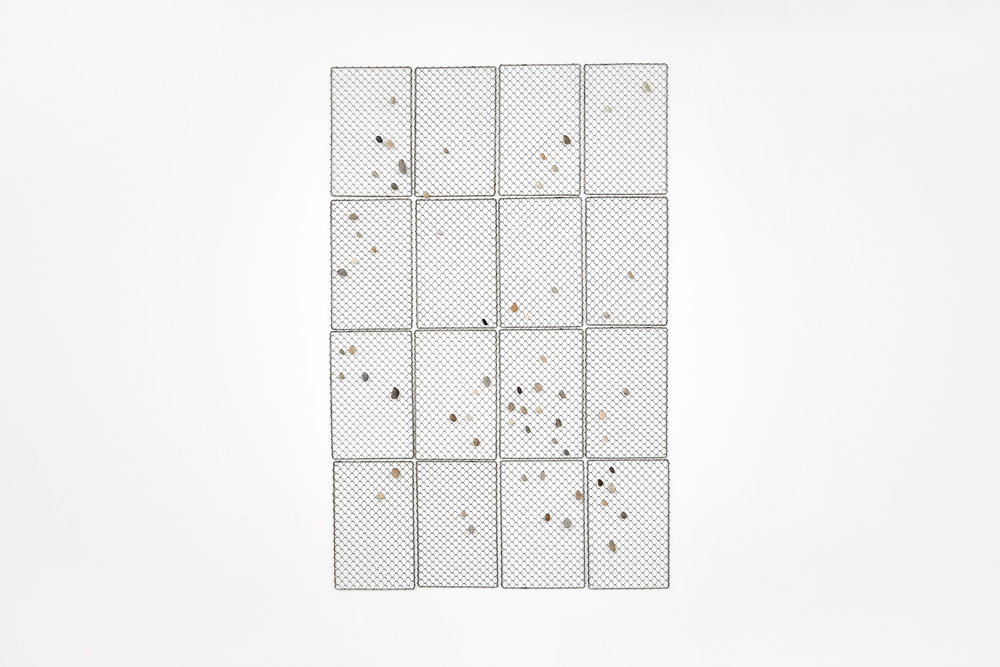
‘Some stones are rocks and some rocks are clouds’, 2023, courtesy of the artist and Gallery Sofie Van de Velde. Image: Michaël Smits
Vranken utilises functional objects from daily life, placing them – altered or unaltered – in a new context. "I like to start with something mass-produced industrially," he explains. "I do something with it to give it a homely touch." The industrial often undergoes manual manipulation. For instance, he weaves remnants of roofing into a rectangular frame, placing a wooden bowl within. "The rubber is elastic and easy to stretch," says Vranken. "I explore, combine and enjoy experimenting with materials. Much of my work is the result of such experimentation. I love to be amazed and hope to surprise viewers."
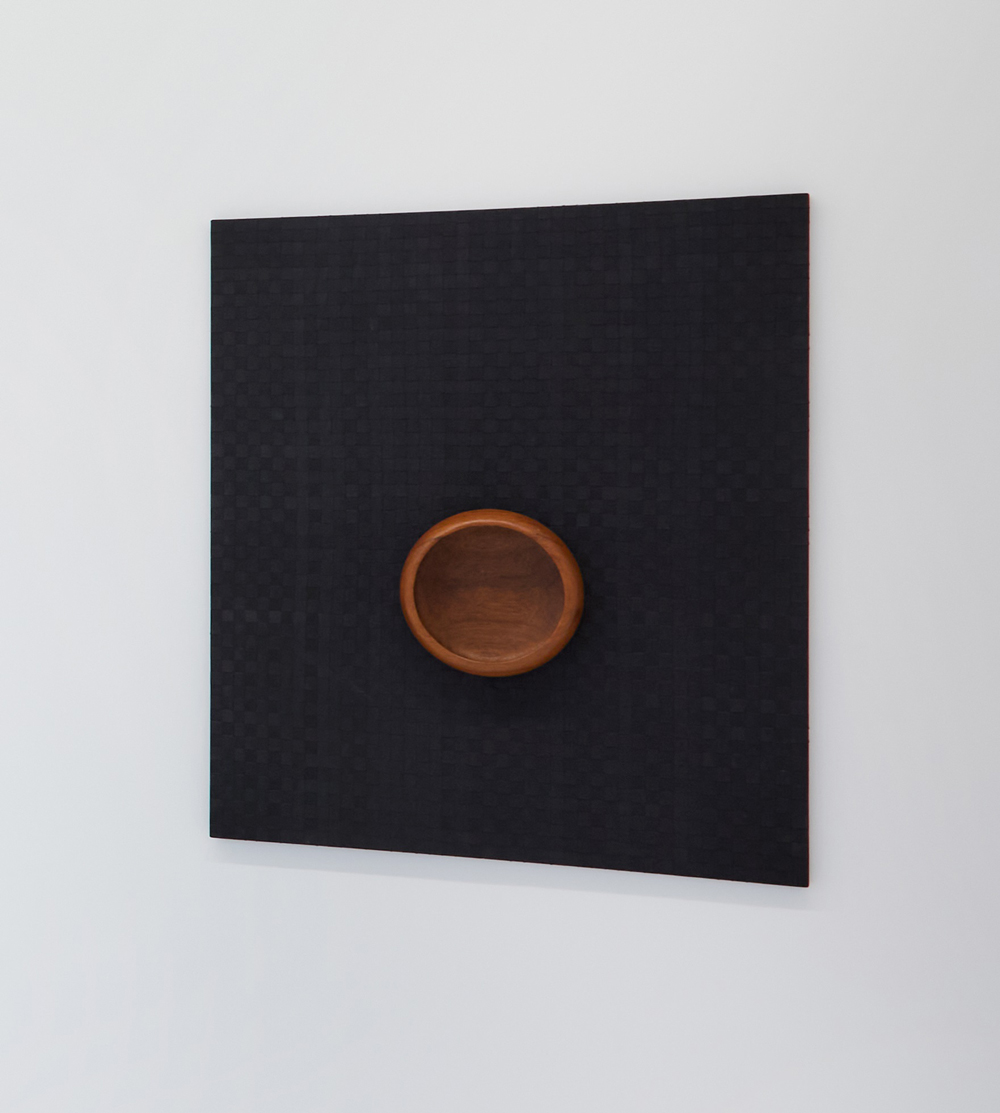
‘Gum (I)’, 2022, courtesy of the artist and Gallery Sofie Van de Velde. Image: Michaël Smits
He opts for familiar objects, providing easy access to his work. But the alterations or new compositions have an unsettling effect before long. Recognising a beaded cushion meant for a car seat, Vranken has reknotted it to serve as a cover for a pedestal. The pedestal has a suspension system with a hook, supporting an object as weight, making it open to interpretation. "I want to inspire questions," he says. "I hope people reflect on the origin or meaning of what they see." He succeeds in doing just that, but also leads us astray. We doubt the authenticity of materials and feel inclined to touch them. Or we want to lift a work to check if it is light or heavy. "I created the stone using insulation foam and covered it with a saddle cover," he explains. Both stones belong to a collection of smaller objects presented on a long beam, establishing a relationship with larger works in the space. "They are not scale models," he says. "I love the confusion that can arise about what came first."
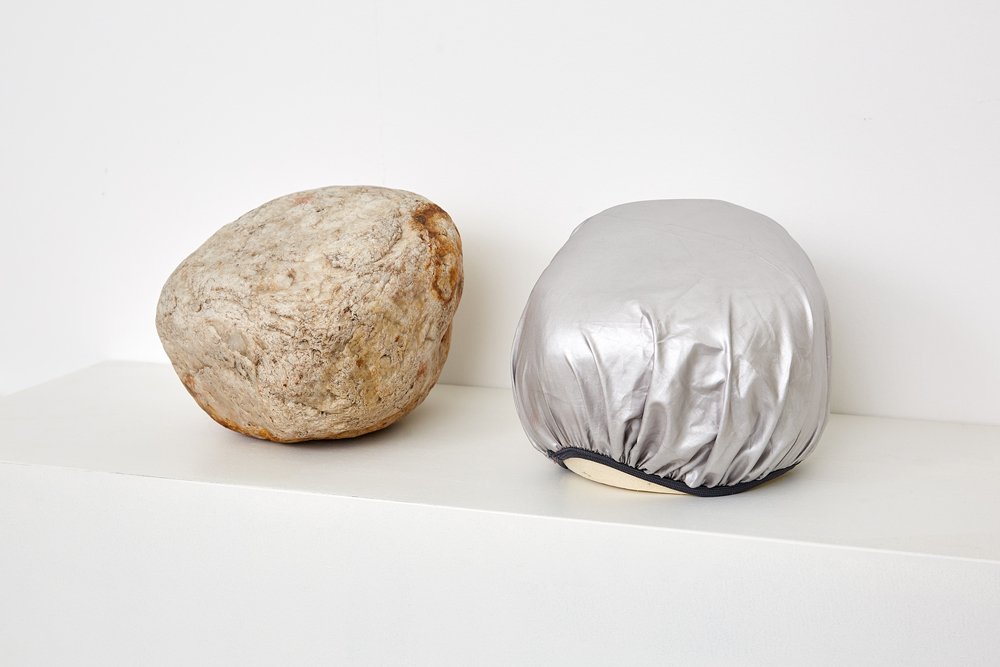
‘Doublers’, 2023, courtesy of the artist and Gallery Sofie Van de Velde. Image: Michaël Smits
His visual language highlights how we break down and interpret reality. Patterns and orders provide us with a framework to fill our lives. Vranken displays numerous repetitive patterns, grids and frames. "I love the repetitive," says Vranken. "It gives me peace of mind." We find this in the exhibited works and the process of creating his art. He opts for manual work with repetitive actions, such as knotting, weaving and threading. Vranken points out how we enjoy structuring everything, but he also undermines that notion. His work balances between sculpture and painting, creating various supports that he hangs and combines with objects. The way he uses paint, canvas and colour also has painterly qualities. Does it make sense to categorise everything?
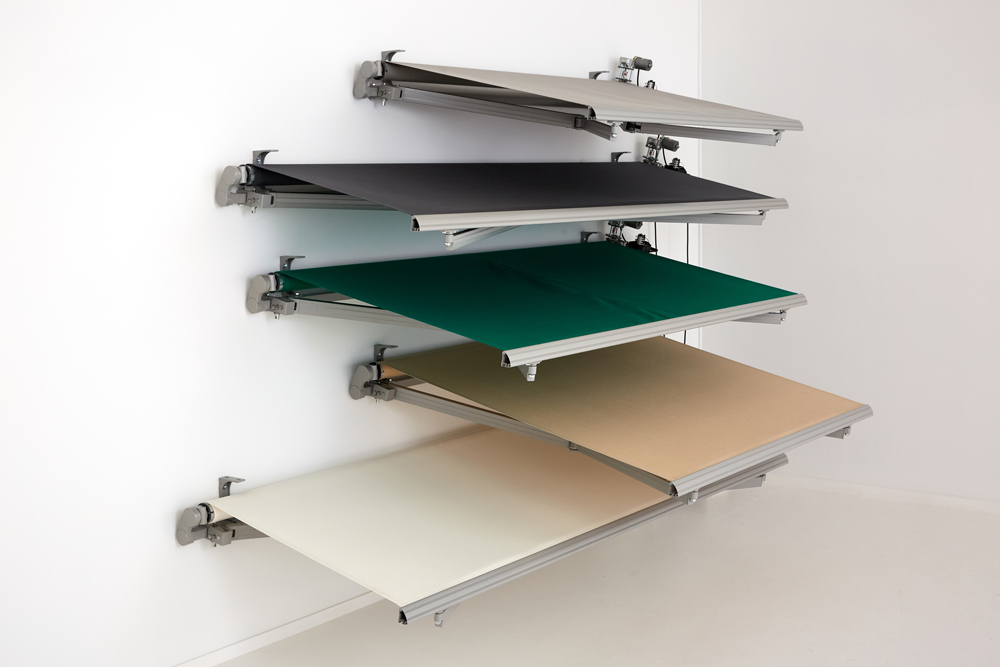
‘Sunsetter’, 2023, courtesy of the artist and Gallery Sofie Van de Velde. Image: Michaël Smits
In the transience of life, everything is in constant flux. Uncertainty and unpredictability drive us to seek safety and certainty. Routine and order provide a sense of control. Time is crucial for organising our lives. We see how time and change play a pivotal role in Partly Cloudy. Vranken takes his time determining which technique to use and the repetitive actions demand time. He also forces the visitor to pause—not only by prompting questions with his work but also to contemplate the pieces. An installation featuring moving sun canopies catches our attention. Hanging on the wall, they slowly open and close.
We see a combination of planes, preventing us from seeing everything in its entirety. This composition reveals changeability. There are also works that suggest movement, such as camping chairs that are lined up, with the blue fabric of the seats extending between them creating a wavelike rhythm, or the hanging object on a hook that looks like it is about to move at any moment.
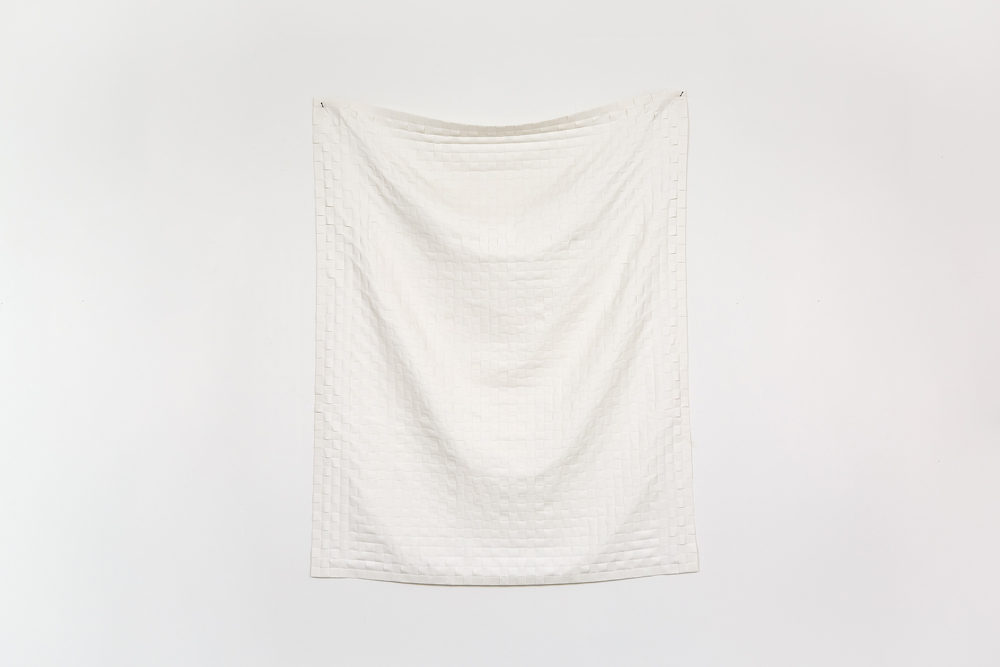
‘Untitled’, 2023, courtesy of the artist and Gallery Sofie Van de Velde. Image: Michaël Smits
Changeability is also present in how things become outdated, like scales, camping chairs, and beaded cushions. "I show things I grew up with," says Vranken. The movement of visitors through the space also plays a role. "I always start by building a model and observe how visitors move," he says. A good example of this is the white cylinder we see on entering the room. Initially, we only see an orange line, a shadow, at the edge. As we move, we realise there is a tube behind it. Light, shadow, colour and shape are decisive in his work when addressing polarities, orders and changeability. He presents strips of canvas woven into a cloth and hanging on the wall, allowing light and shadow to disturb the pattern's rhythm. This is also evident in a work with folded and painted canvas or the canvas with the discoloured fabric of sun canopies, creating a subtle colour transition. Vranken prefers geometric forms like lines, circles and cylinders. This visual language, constituting our universe and nature, symbolises harmony and tranquillity. Vranken is deeply concerned about how materials, colours and techniques come together. The care, precision and concentration with which he treats each object reflect a labour of love. The valuation he gives them reflects back to the viewer. Love, beauty, harmony and tranquillity—are we not all searching for these things?
