18 september 2023, Yves Joris
Between perception and reality: the artistic vision(s) of Griet Dobbels and Evelien Gysen
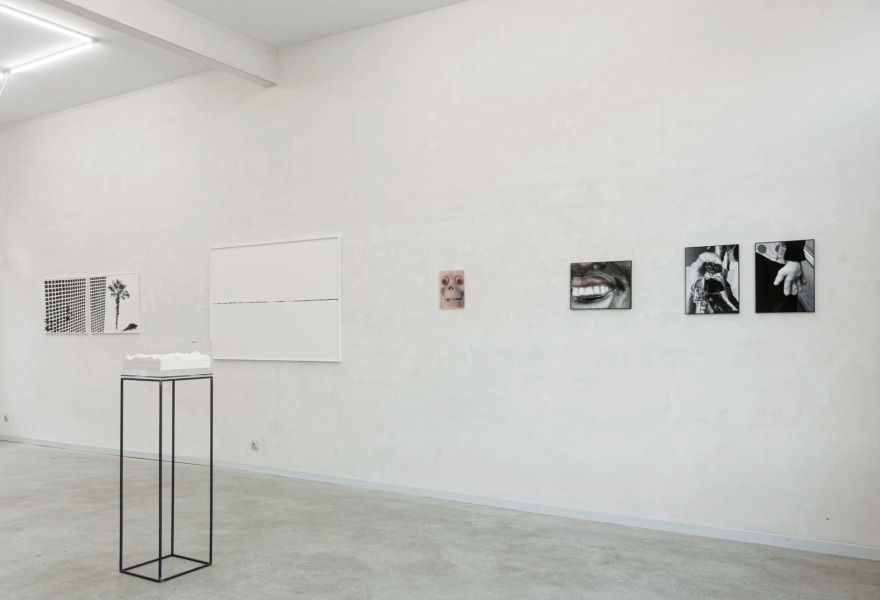
This is Griet Dobbels’ first collaboration with Shoobil Gallery, while it’s Evelien Gysen’s fourth time exhibiting at Serena Baplu's Antwerp gallery. The relationship between perception and reality, and the dialogue between nature and culture, are a common thread within the oeuvre of both artists. Both focus on the relationship between the individual and the environment in which they live, each in her own unique way. But for Gallery Viewer, I looked for the differences in their shared quest.
Baplu has opted to have both artists engage into dialogue with each other during the exhibition. After all, the two spaces that make up the gallery could easily have facilitated two separate artistic monologues. Fortunately, she did not do this and visitors can witness this conversation, because – let's be honest – both artists have her own specific perspective on the same subject.

Evelien Gysen, I walk alone, 2023, Shoobil
Evelien Gysen’s ‘eeriness’
An initial confrontation with Gysen's work may cause some confusion. Baplu describes her work as an experiment with stream-of-consciousness in which no fixed or recorded truth can be found. Art connoisseur and artistic director of WARP Stef Van Bellingen refers to the concept of 'pareidolia' in an attempt to explain her work. The term can best be described as a psychic-optical phenomenon in which the viewer perceives recognisable things in random images. Images say more than words, but I still make a brave attempt to add words to images. A good example is the work I walk alone, which evokes memories of Van Gogh's poplar avenue in Nuenen. By enlarging the footage, an increasingly coarse grain is created that blurs the result and at times even immerses it in a ghostly atmosphere. A similar image emerges in Walking 1, where Gysen points her camera at an uprooted tree, from which a forest spirit appears to be staring at us. Evelien Gysen starts from hyper-realistic photographs and manipulates them into images in which nothing is as it seems.

Evelien Gysen, Walking I, 2022, Shoobil
Griet Dobbels maps art
Griet Dobbels graduated from The Royal College of Art in London in 1986 and her artistic CV includes such exhibition locations as De Brakke Grond, Museum Dhondt-Dhaenens, Netwerk Aalst and the Fondazione Pistoletto.
The works she is exhibiting at Shoobil are primarily based on existing geographical maps that she appropriates artistically. In School Atlas (06), 2023, a Wolters school atlas from 1939 has been stripped of its maps and is painted over with a tree in sumi ink, with black branches and leaves overgrowing the original words. An interesting detail is that the trees and cards are the same age, making them 'silent witnesses' of a bygone era.

Griet Dobbels, Belgische Kongo_1919, 2023, Shoobil
Belgische Kongo_1919, 2023 shows an old didactic school map of almost 2x2 meters that once adorned many school rooms. The old geographical national and provincial borders are hidden behind an immense tree made of copper leaf, a reference to scarce raw materials and the struggle to obtain them. In addition to the visually ‘crowded’ images, Dobbels also presents almost ephemeral works in which the abundant white almost completely overshadows the image.
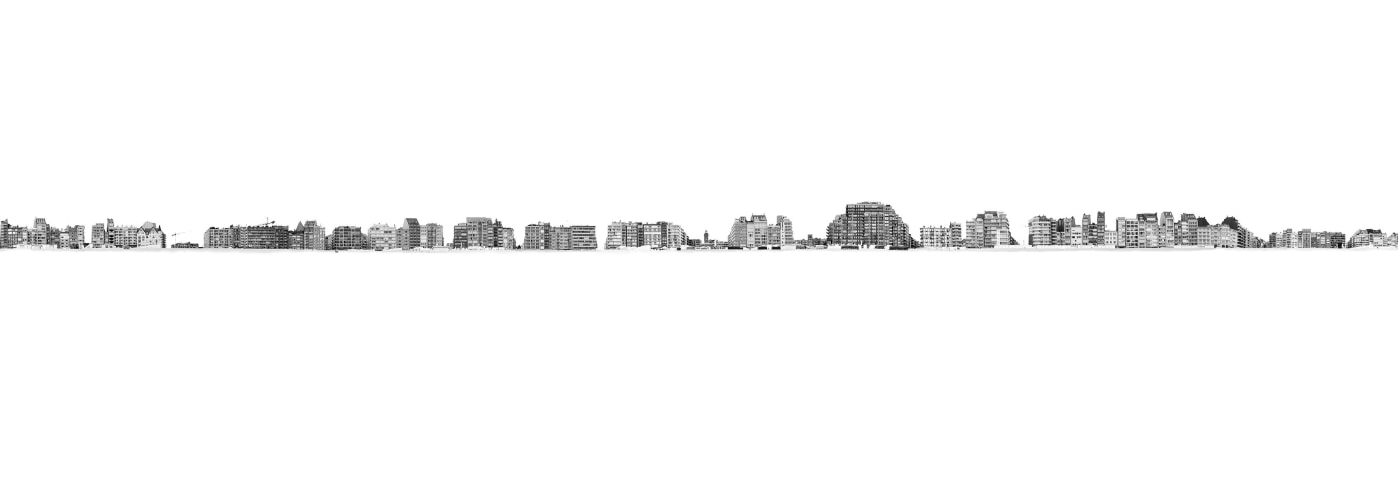
Griet Dobbels, Straight Line Attempt II (Knokke-Heist - Blankenberge), 2017, Shoobil
Straight Line Attempt II (Knokke-Heist - Blankenberge), 2017 is a unique print that is part of a series of seven different works in which Dobbels depicts the Belgian coastline. With her back facing the sea, she shows us the concrete irregularity of the apartment buildings from Knokke to De Panne. During the exhibition, she is showing the only part that has not yet found its way into a collection: part two, from Duinbergen to the fairway of Blankenberge.
Both Evelien Gysen and Griet Dobbels each has her own visual language to show what once was. For Gysen, this often leads to disturbing images and for Dobbels to an environment in which everything is in danger of becoming overgrown.
Those who would like to learn more about the work of both artists can attend an artist talk at the Shoobil Gallery on Sunday 24 September at 4 p.m.
