15 august 2023, Flor Linckens
Where art and research come together: an exhibition in COPPEJANS GALLERY
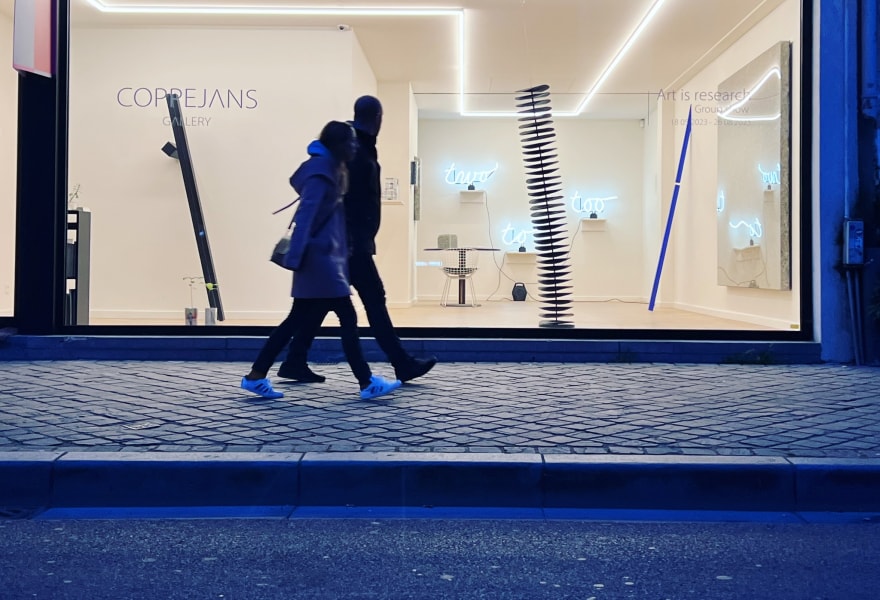
Art is often reduced to a simple question: is the work aesthetic? Not a completely irrelevant question, but in addressing just that aspect, you ignore the possible deeper layers that hide behind a work of art: the layers that can make a work of art infinitely more interesting. Until 27 August, COPPEJANS GALLERY in Antwerp presents the exhibition 'Art is Research', effectively diving below the surface. This exhibition not only celebrates the beauty of a work of art, but also the quest that precedes it. This produces art that is both relevant and resonant. In the group exhibition in COPPEJANS GALLERY you can view work by three artists: Jan Henderikse, Caroline Hofman and Hans Kooi.
Please note: The gallery will officially reopen on 24 August after a summer hiatus, but there will be a festive Friday night at the gallery on 18 August. Between 4 and 8 pm, you can view the exhibition while enjoying summer drinks in the presence of two of the exhibiting artists: Caroline Hofman and Hans Kooi.

For Dutch artist Hans Kooi, the preliminary research lies in the direction of science. From childhood he was fascinated by balance and repetitive and predictable movements in nature, such as water or the tides. During his education at the Rotterdam Academy for Visual Arts and Technical Sciences, he united scientific knowledge with a visual language. Magnets and motor skills are recurring elements in his kinetic practice, which is marked by movement. His work has been included in the collections of the Kröller-Müller Museum, the Municipality of Rotterdam, McKinsey, ABN Amro and the Arizona State University Art Museum, among others.

The German artist Caroline Hofman is known for her in-depth material research in which she explores the possibilities of paper and cardboard, resulting in three-dimensional compositions. By experimenting with seemingly simple materials, Hofman reveals their hidden potential for three-dimensionality. She uses recognisable and everyday elements and objects to emphasise their graphic qualities. The interplay of research, technique and aesthetics is also reflected in Hofman's new publication 'The Aesthetics of Silence', which was published this year by Waanders.

The Dutch artist Jan Henderikse is considered a pioneer in the art world. He was, among other things, of central importance in the establishment of the Nul movement, the Dutch branch of the ZERO movement. His research approach betrays an ongoing fascination with everyday objects, embracing elements of society that are often overlooked or discarded. Other times he destroys things that are valued. In the gallery you can see several transparent plexiglas boxes and frames with shredded dollar bills. This attention to the mundane and everyday — and the consumer culture and human habits that underlie it — turn him into a kind of artistic anthropologistm who investigates human nature and seeks poetry in the banal. Henderikse received a lot of international recognition and his work was a central part in the exhibition 'ZERO: Countdown to Tomorrow, 1950s-60s' in the Guggenheim Museum in New York in 2015.
