14 july 2023, Yves Joris
Photography in dialogue at Art Gallery De Wael 15
Images that enter into a dialogue between words and images. If a picture is worth a thousand words, how many letters will it take to produce a picture of the five photographers who each enter into a dialogue with a unique visual language? This dialogue is first and foremost with themselves and subsequently, with their colleagues and visitors to the exhibition I C / Interacting Cameras, on display until the end of July at Art Gallery De Wael 15.
In a world full of words in which meaning often teeters on the edge of obscurity, we find solace in the art of capturing moments in time. Photographer Ansel Adams, a master of visual language, understood the power of images when words fail. His profound statements resonate deeply and remind us of the deep impact a single picture can have on our souls. When words fail to convey the depth of emotion or complexity of a story, we turn to these visual masterpieces for refuge. Yet, even in the realm of images, there may come a point when they, too, prove inadequate to contain the unspeakable. In such moments, we are left with the realisation that sometimes, in the face of the inadequacy of both words and images, silence becomes our most profound language. It allows us to embrace the grandeur of the unspoken. During the expo, of which the abbreviation I C is a verbal reference to ‘I see’, five photographers take visitors on a journey in which words, images and silence come together, cross borders and open doors to undiscovered forms of expression.

Peter H. Waterschoot, Pink Moon, Nagisaya Bay, Nachikatsuura, 2016, Art Gallery De Wael 15
Hopperian melancholy
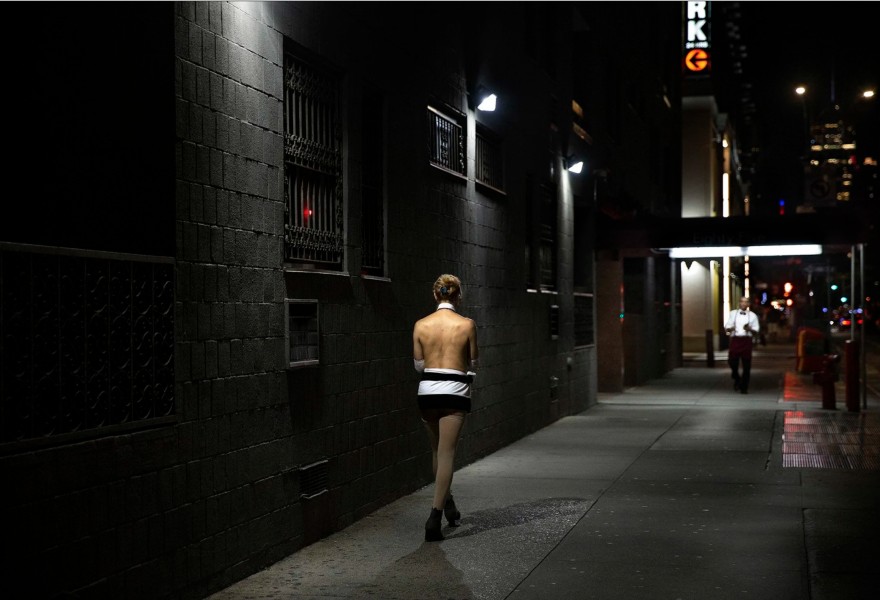
The show kicks off with Nele Van Canneyt’s dark work, which balances on the interface between the impenetrable and the unspoken. Her work is often set in the urban environment without naming it specifically and produces a Hopperian melancholy that she unleashes on viewers. Each picture is a book or film waiting to be written or shot, a mix of Raymond Carver meets David Lynch. We encounter a similar film sequence in the work of Peter H. Waterschoot, who takes viewers on a spiritual journey in pink and blue colour combinations. The colour pink entered Western art under the influence of Japonism and refers to passion and vitality, but is also a reference to the Pink Film, Japanese softcore pornography. Or to put it in the words of the artist himself, “Three Times Pink, Three Times Blue celebrates eroticism as a divine force of nature, embedded in artificiality, at a crossroads between kitsch, aesthetics and the ephemeral.” With five scenes of nature and a nude, he challenges viewers with abject, electrically charged colours, so that fiction and reality merge and even fade.

Naser Kianersi, Polaroid 1, 2023,Art Gallery De Wael 15
Curiosity about what can't be seen
That reality is much more apparent in the work of Iranian photographer Naser Kianersi, who has been working as a photographer since 2009, which was the reason he had to leave his native country for a life in exile in 2012. He works with a Polaroid, a technique that not only ensures that each work is unique, but also emphasises nostalgia for times past. The characters and locations in Naser's work are often anonymous, though clearly recognisable. They become inanimate objects without a sense of time and space, and therefore also timeless and universal. Vita (nomen est omen) Duffeleer can best be described as a young photographer with an old lens (or rather, soul). Her work shifts the gaze to what is not visible, what is deliberately kept out of the picture. In addition, cryptic titles like MRS1-2023 and LPSNTRPRD2-2022 ensure that you are given no clues about time or place. The first work shows a greyish tree landscape in which green grass tones and colourful field flowers slowly dissolve into a misty cloud cover. Buildings hidden behind the greenery are the only testament of human presence. Or absence to be more precise. Unconsciously, you ask yourself what is behind the photographer's back. That same curiosity is evoked in LPSNTRPRD2-2022, in which a shaky ladder offers the only way out of a narrow tower. What will we see when we arrive at the top? Once again, as spectators, we are triggered by this presence of the unknown.

Vita Duffeleer, SGRVNWZL1-2023, 2023, Art Gallery De Wael 15
Magi Jansen took her first photographs in her teens using a borrowed camera. Capturing sensation and emotions in images made her understand the power of photography as a medium. Her work immediately stands out due to the vague images with golden elements, a technique she borrows from kintsugi, an important part of wabi-sabi, the art of imperfection.
Bringing together five photographers, each with their own unique style, requires rigorous choreography. Gallery owner Rik Rosseels has pulled this off perfectly. The works flow into each other without your gaze faltering, and yet the photographers are given sufficient space to preserve their individuality. Reason enough to visit this exhibition.

Magi Jansen, Golden Leafs, 2023, Art Gallery De Wael 15
