25 april 2023, Pienk de Gaay Fortman
The surreal universe of Johanna Bath and Shimon Kamada
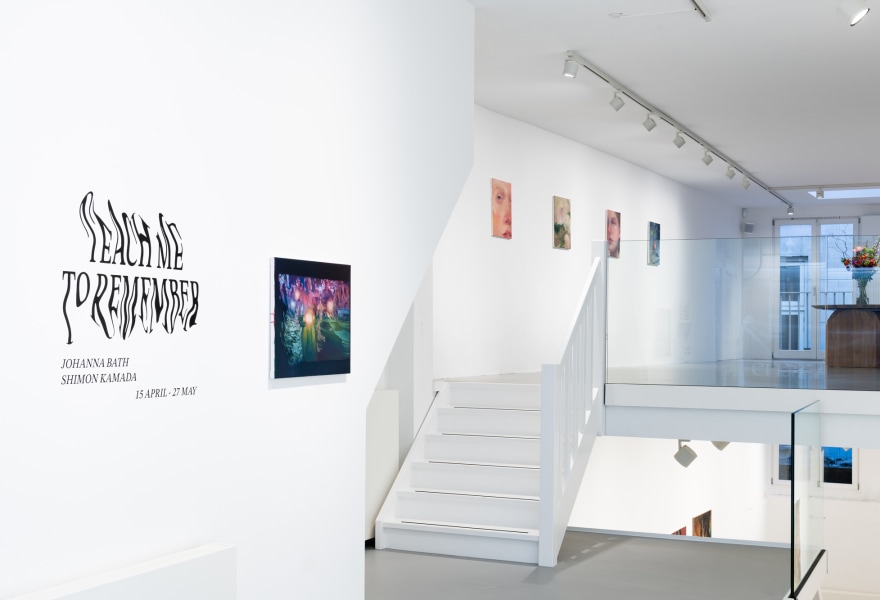
In the brand-new Enari Gallery on Utrechtsestraat, a magical universe of two artists in the prime of their careers unfolds. Johanna Bath and Shimon Kamada take the viewer into imaginative paintings that express their mostly subconscious thoughts and feelings. Despite addressing common themes such as transience, intimacy and memories, each artist have his or her own signature style.
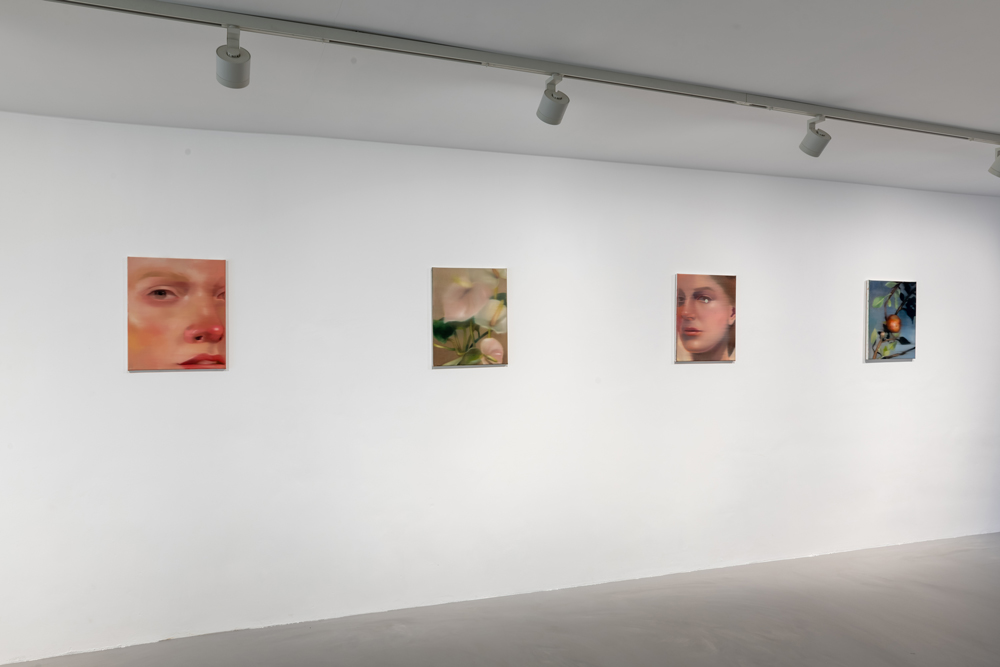
Johanna Bath, ‘the freeze’ (2022) ‘anthurium’ (2023) ‘looking at me/looking at you’ (2023) en ‘moody apple’ (2022), Enari Gallery
Bath is showing her most recent work at the exhibition at Enari Gallery. A series of four paintings that have been carefully curated immediately catch the eye. The freeze (2022) anthurium (2023) looking at me/looking at you (2023) and moody apple (2022) present the viewer with a combination of zoomed-in portraits and still lifes. This balance between the human and the natural reflects a sense of tranquillity through the refined painting style. According to the artist, they are all connected in one large circle. An interesting aspect of the creative process is that Bath lets go of her perfectionism. “My brain switches off completely while painting. The result doesn't matter to me. When the oil is still wet, I run the brush through it and lose control over it. There is a 50% chance it will be successful.” Similar to how the artist is absorbed in the moment of painting, the result is a fragment of time. Not surprisingly, Bath makes flowers her subject. Since the 17th century, still lifes have been known for their time-freezing capacity. By adding a hazy film to her paintings, she transforms the brushstroke into the passage of time.
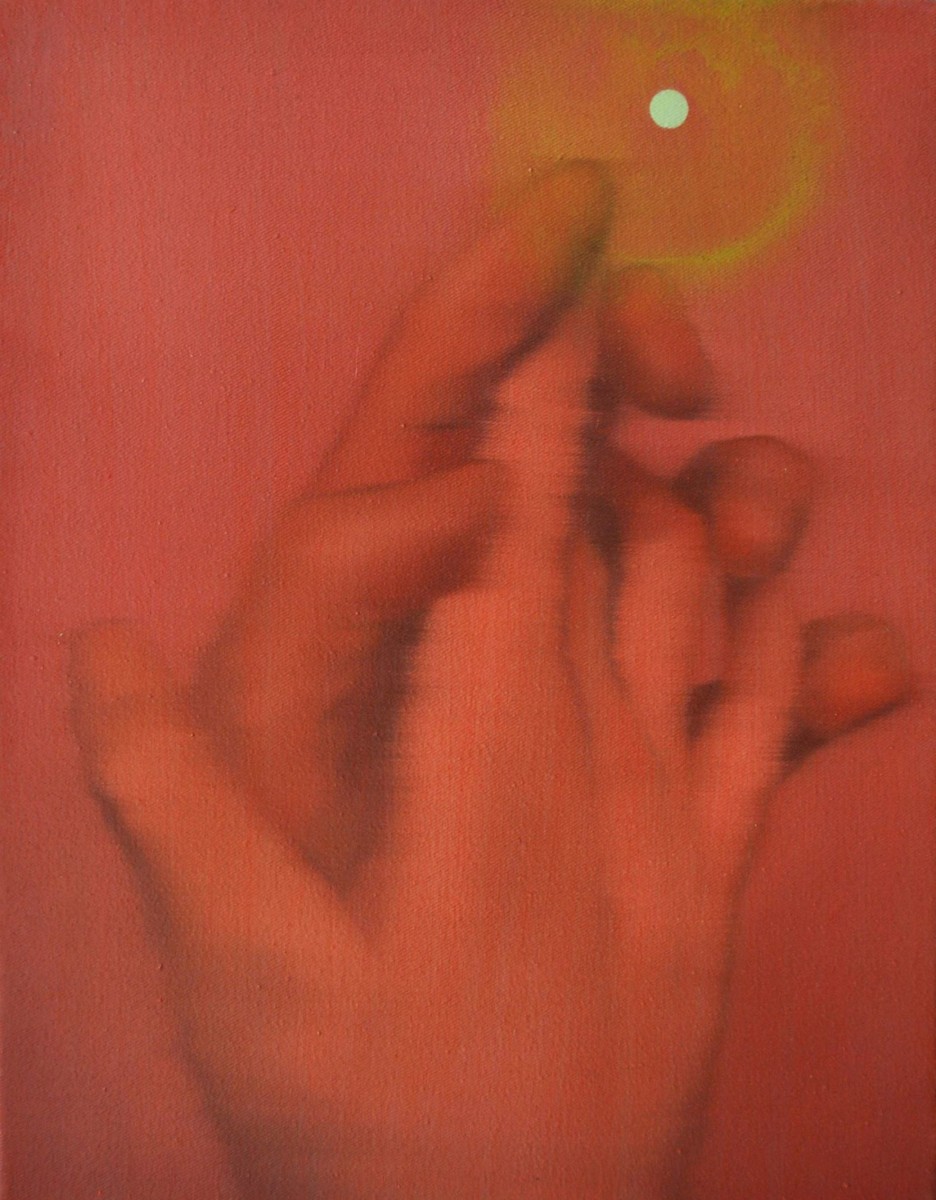
Johanna Bath, essence, (2023), Enari Gallery
In addition to oils, Bath also uses spray cans. This creates an exciting focus in her work. A good example of this is Essence (2023), featuring entwined hands depicted as a warm glow through their red-orange-pink tones. Bath explains, “After I spray-painted neon paint, I thought the piece was ruined. Until I brushed it over and there was a surprising result.” It is as if the fingers point to a sun glow with halo, where man and the universe come into contact. An association that connects to Bath's intuitive, almost meditative working method.
Enari Gallery is also showcasing the work of Japanese artist Shimon Kamada. As with Bath, his works have a dream aspect, with the difference being that some have an 'uncanny' feeling. Using his archive and memories, he makes a digital composition that gives his paintings an alienating effect. This can clearly be seen in the work Baalzebul (2022), in which masks with glassy, deep black eyes and razor-sharp noses stare penetratingly at the observer. It is as if they may come to life at any moment – or already have. With fans of feathers, Kamada reinforces this lively effect. The title Baalzebul is taken from the Biblical story of Solomon and means 'prince of the devil' or 'Satan'. Kamada explains his choice, “This painting was inspired by a childhood dream of mine, which I had during the same time as I saw the film Night at the Museum. Walking past an Italian mask shop, this memory came flooding back. Just like in the movie, I imagined the masks becoming a body and coming to life at night.” The authenticity and virtuosity with which it is painted is impressive.
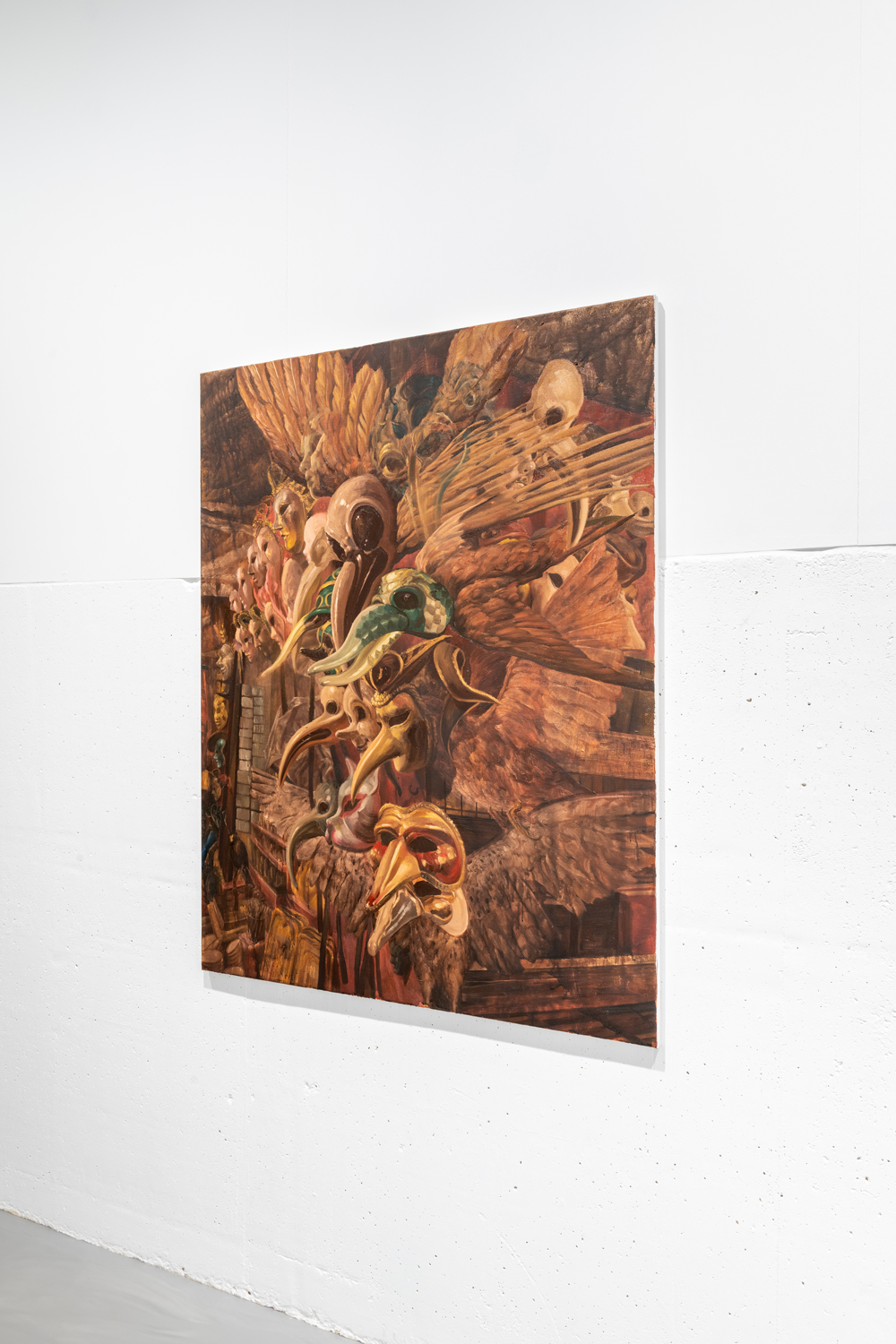
Shimon Kamada, Baalzebul, 2022, Courtesy of Galerie Ron Mandos
Another source of inspiration for Kamada are surrealist painters such as Carel Willink and Adrian Ghenie. Kamada explains, “As an artist, I look for the uncomfortable and inability to fully comprehend what you are seeing. This helps you to look at it your own way.” Take Magic Mirror (2022), for example, a colourful work that leans towards abstraction with its hazy vertical lines. Until it evokes all kinds of associations: are you looking at a hung fish, a church interior or a Rijksmuseum ceiling? This is how Kamada plays with recognisable settings on the one hand and dreamy landscapes on the other. He prefers not to give away the clues. For example, Kamada uses viewers' interpretations to create new imaginary worlds. This works like a vicious circle that continuously produces exciting images.
Whereas Bath's works read like an intimate dream or affectionate poem, Kamada seems to take us into an intriguing thriller that we want to read in one sitting. Wander off into the realm and underworld of these talented painters in the exhibition Teach me to remember, which can be seen in Enari Gallery until 27 May.

Shimon Kamada, Magic Mirror, 2022, Courtesy of Galerie Ron Mandos
Johanna Bath (DE, 1980) studied Illustration Design at the Bildkunst Academie and Design Studies at the Hochschule für Angewandte Wissenschaft in Hamburg. After a short interlude, she picked up her brush again in 2012 to devote herself fully to her art. Bath achieved international recognition through Saatchi Arts, which described her work as 'one to watch' in 2017. Her work is now part of various collections in Sweden, New Zealand and Canada. In 2022, Bath was selected for the Contemporary Art Collectors (CAC) 'Emerging Artist Programme'.
Shimon Kamada (JP, 1997) completed his fine arts education at the HKU in 2020. That same year, his talent was discovered by Galerie Ron Mandos, who presented his work at the 'Best of Graduates', where he was chosen the winner of the RM Residency Award, which led to a residency and exhibition at AVL Mundo Rotterdam. His work has also been exhibited at such venues as Wilford X in Temse (Belgium), Arti et Amicitiae in Amsterdam and HEM in Zaandam.
