03 march 2023, Wouter van den Eijkel
Last chance: Elmar and Elisabeth Trenkwalder
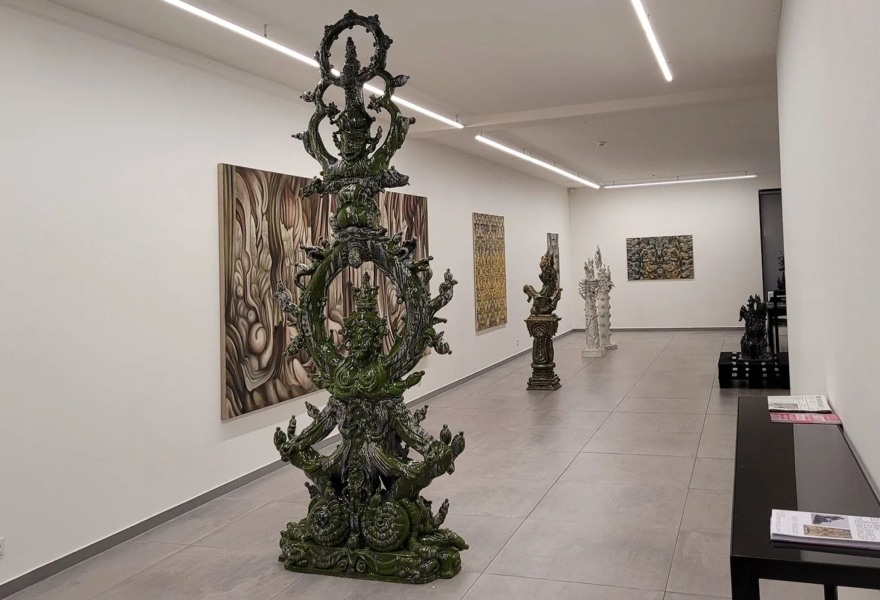
Gallery Maurits van de Laar moved from the centre of The Hague to the Toussaintkade at the beginning of this year. The new space was opened with an exhibition by the Austrian couple Elmar and Elisabeth Trenkwalder, which can be seen for the last time next weekend.
It is no coincidence that Van de Laar opened his new space with work by Elmar Trenkwalder (Austria, 1959). The new space is not only so spacious that Trenkwalder's sculptures come into their own, simultaneously Trenkwalder's Garden of Earthly Delights, a monumental ensemble of sculptures which took him no less than two and a half years to complete, is on display in Museum Beelden aan Zee.
Anyone seeing Elmar Trenkwalder’s work for the first time is probably overwhelmed by its baroque multitude of shapes, exuberant ornaments and details that flow into each other and merge into one overwhelming sculpture. It’s therefore hard to believe that Trenkwalder never trained as a ceramist. Yet, it is probably the lack of formal training gave him the freedom to find his own way.

Elmar & Elisabeth Trenkwalder, Galerie Maurits van de Laar
Trenkwalder only started working with clay while living in Cologne for some years from 1986 on. At the time, he was looking for a way to emboss the frames of his paintings – Trenkwalder was trained as a draftsman and painter in Vienna by Arnulf Rainer and Max Weiler, among others. Not much later he discovered clay as a modelling material. He started making simple figurines that everyone said would pop when baked in the oven. When that didn't happen, he started experimenting with this material that was new to him.
It resulted in images that consist of numerous elements. Often recurring are architectures, human figures, nature - in the form of landscapes or in detail - erotic and Eastern religious representations. Part of this unusual imagery can be explained by his immediate surroundings in Innsbruck. A city with a rich history when it comes to baroque.
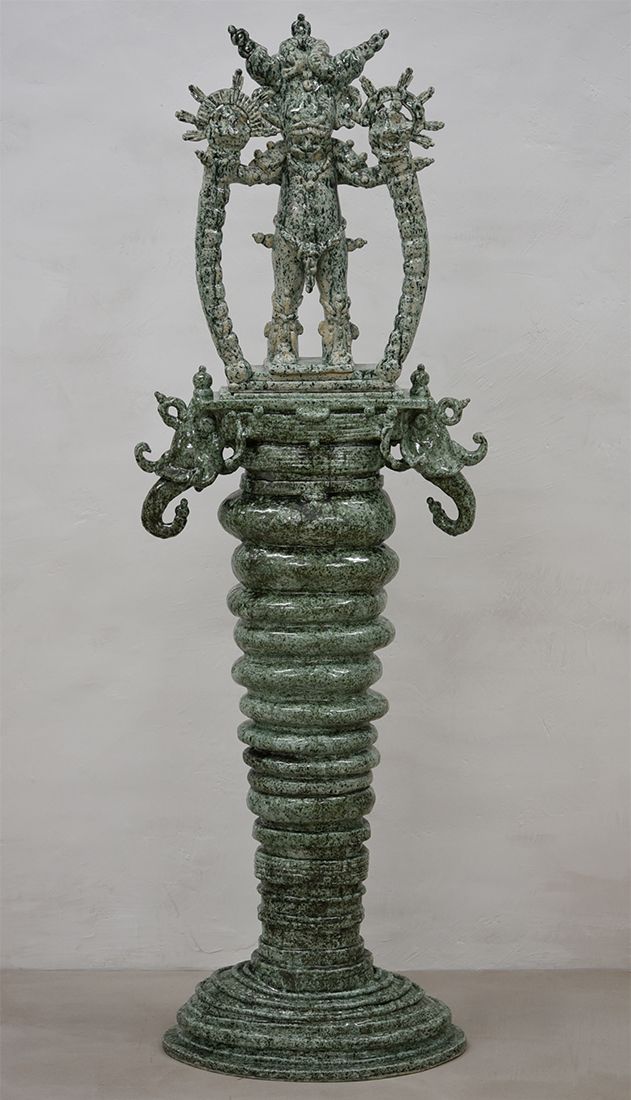
Elmar Trenkwalder, WVZ 362 S, 2022, Galerie Maurits van de Laar
Trenkwalder showed Van de Laar around during his first visit to Innsbruck and showed him, among other things, the Altstadt, the Hofburg and Hofkirche, with the imposing funerary monument for Maximilian I, and Schloss Ambras, the summer residence of the Habsburgs. “Everything exuded power and wealth, which expressed itself in a sumptuous ornamental formal language,” says Van de Laar in the catalogue accompanying the exhibition at Beelden aan Zee.
Although the influence of Catholicism and the Baroque is clearly recognisable in Trenkwalder's work, his visual language is broader than that. He also incorporates references to Asian stupas or the erotic images in the facades of Hindu temples. However, Trenkwalder never made any major journeys and has never visited Southeast Asia. Nor did he study it meticulously. Rather, he takes note of these cultures and incorporates elements of them into his work. In an interview, he mentioned that he wants to break through the dominance of his own culture by using exotic elements, which allowed him to be freer and uninhibited in his sculptures.

Elmar Trenkwalder, WVZ 352 S, 2023, Galerie Maurits van de Laar
Nature, however, is the greatest influence on Trenkwalder's work. Innsbruck is located in a valley surrounded by mountains and forests. Trenkwalder had a special bond with the forests from an early age, and they regularly figure in his drawings. Nature is often also present in a metaphorical sense in his sculptures. Van de Laar: "In the sculptures you often see that a natural, undefined form becomes transformed into the recognisable outline of an architectonic arch or the erotic form of a phallus or vulva, bringing the male and the female into balance." Trenkwalder regards this smooth transition from one form to the other as a continuous process in nature that he tries to make visible in his sculptures.
Nature is also the subject of Elisabeth Trenkwalder’s work, which she too connects with architecture and religion. In recent years, she made a number of paintings in which one sees a tree from below. She mirrored and doubled it, creating patterns and a symmetrical composition. She compares walking through a forest to walking through a cathedral, transforming the tree trunks into the columns of a Gothic church.
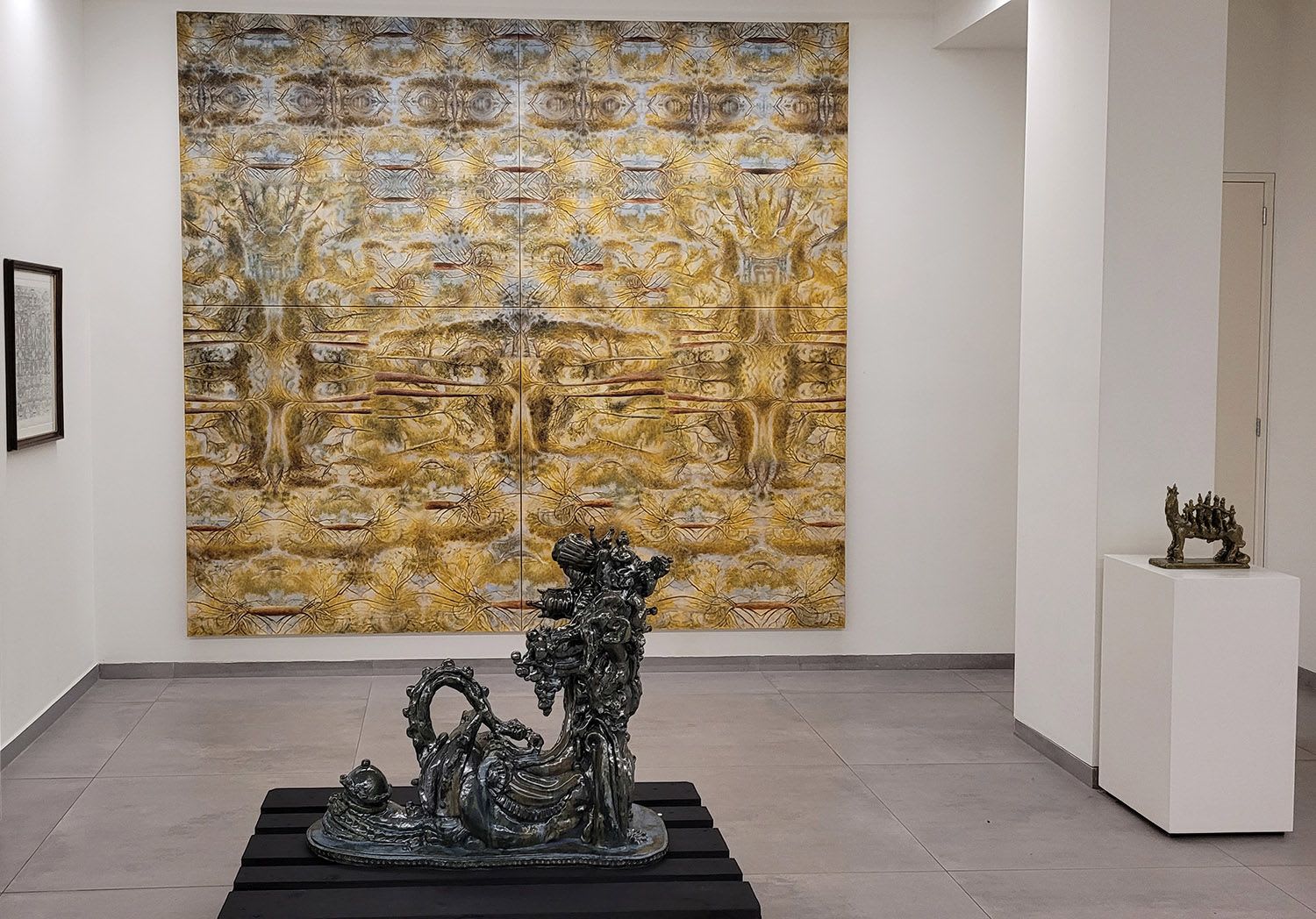
Elmar & Elisabeth Trenkwalder, Galerie Maurits van de Laar
Around the turn of the year, Gallery Maurits van de Laar moved into a 20-metre-deep L-shaped space on the Toussaintkade with natural light at the front and rear and an unobstructed view of the Royal Stables and the garden of Noordeinde Palace. Unlike the previous space on Herderstraat, the new space was already being used as a project space. Van der Laar himself calls the space museum-like, which is understandable given the floor area and the height of the ceiling. With Van der Laar's move, two galleries in The Hague are suddenly next to each other, with Galerie Ramakers being located in the building next door. Moreover, Kunstcentrum Stroom is just around the corner.
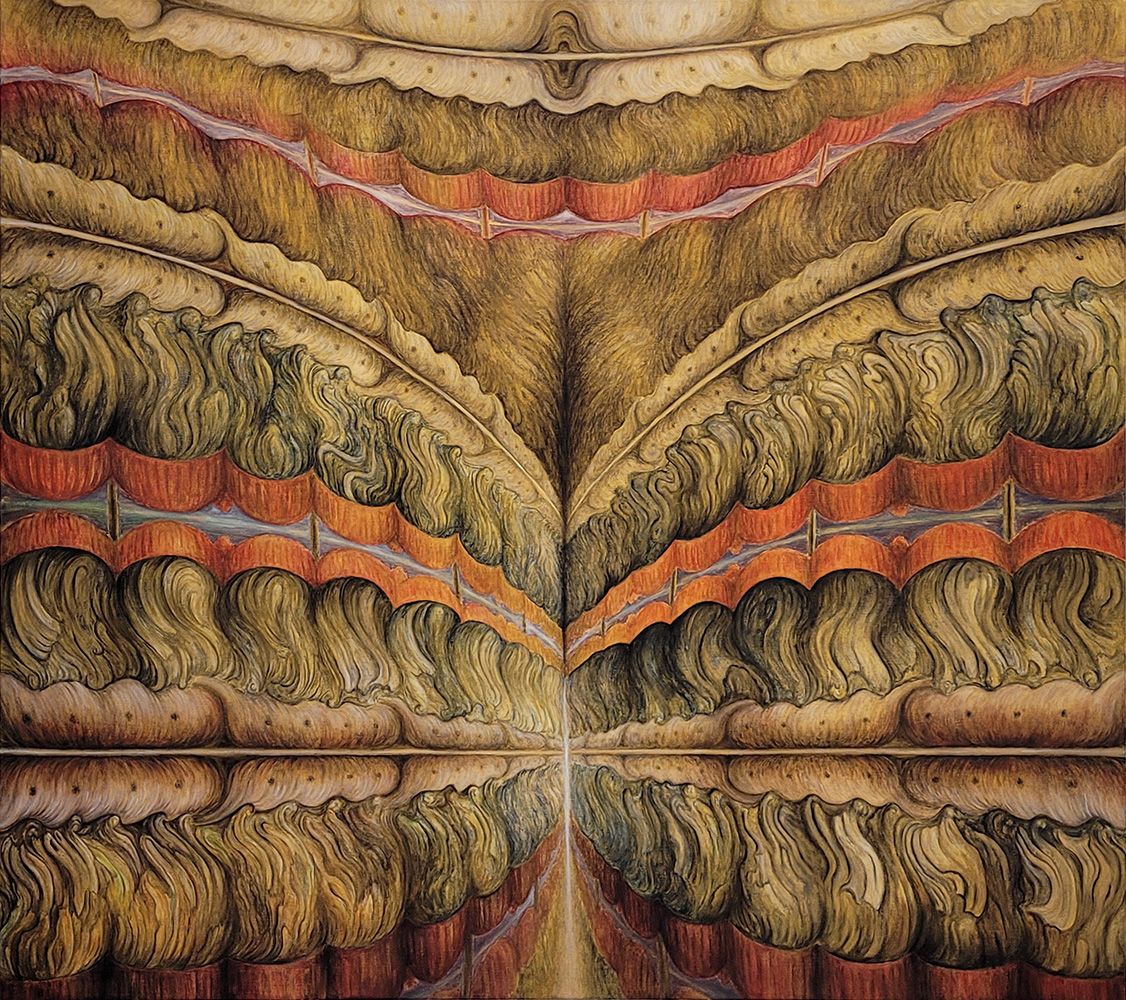
Elisabeth Trenkwalder, zonder titel, 2007, Galerie Maurits van de Laar
This weekend the exhibition of Elmar and Elisabeth Trenkwalder can be seen for the last time. The week after, Peinture Fraîche opens with paintings by Andrea Freckmann, Tobias Lengkeek, Lotte van Lieshout, Peter Vos, Ronald Versloot and Erik Pape
