07 august 2026, Yves Joris
The Ordinary Luminous: Erwin Keustermans at NQ Gallery
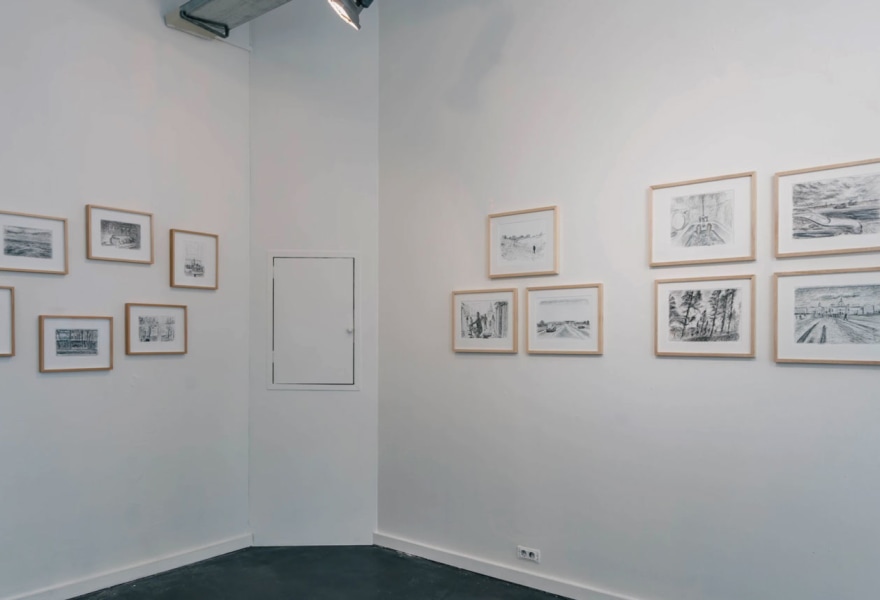
Everything on Erwin Keustermans' website is meticulously organised: categories, dates, an archive readily available for anyone to browse at leisure. But step into the H.F. Room at the NQ Gallery and it immediately becomes clear how little that order has to do with the drawings themselves, as if the artist needed a lifetime to organise his archive precisely, so that once in front of a sheet of paper, he could lose himself all the more completely.
The Ordinary Luminous is a solo exhibition featuring work by Erwin Keustermans (b. 1960) in the H.F. Room at the NQ Gallery, the gallery's smaller, more intimate exhibition space adjoining the main gallery. It runs concurrently with Sculptural III, this year's major group exhibition of ceramic works curated by gallery owner Niqui van Olphen and artist Nick Ervinck.
While the main gallery is concerned with scale, materiality and contrast, the H.F. Room presents a selection of recent work on paper: landscapes, interiors, still lifes and a number of homages to fellow artists, all executed in graphite, marker and occasionally pastel on white or grey paper. The subjects are invariably ordinary: a kitchen window, a football pitch, a pollarded willow beside a country lane. Yet the places from which they originate span a remarkably wide geography: Semmerzake and the Flemish Ardennes, but also Sweden, the United Kingdom, France and Italy —all places the artist has visited, often not as a tourist, but simply in passing: on holiday, travelling through or visiting friends and family.
What brings the exhibition together is not a theme in the conventional sense, but a particular way of looking and, as becomes apparent, a way of drawing that has fundamentally changed over recent years.
The new Keustermans
What happens in this room is that someone loses himself, not in the sense of an artist surrendering control, but someone who no longer determines anything in advance. The gallery website announces it quite explicitly: this is the ‘new Keustermans’—more spontaneous, more intuitive and without a preconceived plan. No longer are the mechanics of line, colour and technique paramount. Instead, the emphasis falls on seeing itself, on the gesture of the hand, on the experience of drawing as an act in its own right.
Three ideas are repeated throughout: direct action, inaccuracy and the absence of intention. Direct action is found with Van Gogh or Twombly: pressing on until the work is finished without stepping back to reassess or pausing for reflection between gestures. Twombly once wrote that every line contains its own experience, illustrating nothing but simply being. A bit of that immediacy—the act of drawing through to completion without the interruption of conscious deliberation—is palpable in the sheets hanging on these walls.
The willow
Take the pollarded willow, for instance, a quintessentially Flemish motif. How many times has this tree been drawn, painted or photographed beside some slow-moving river? Yet this version feels anything but traditional. The crown is made up of hundreds of vertical strokes, black interwoven with a muted purple that in places glows almost violet, while white pastel seems to illuminate the branches from within. The trunk itself, left as untouched paper against the warm beige ground, stands almost naked amid the turbulence above.
What strikes me most is how little the drawing appears to concern itself with accuracy. Not a single branch is ‘correct’, but each one is merely approximate, the result of a swift decision that was never revised. Here, inaccuracy is not a flaw that ought to have been corrected afterwards, but proof that the hand was working without knowing in advance where it would end up—that the tree, in a sense, drew itself while the artist simply watched.
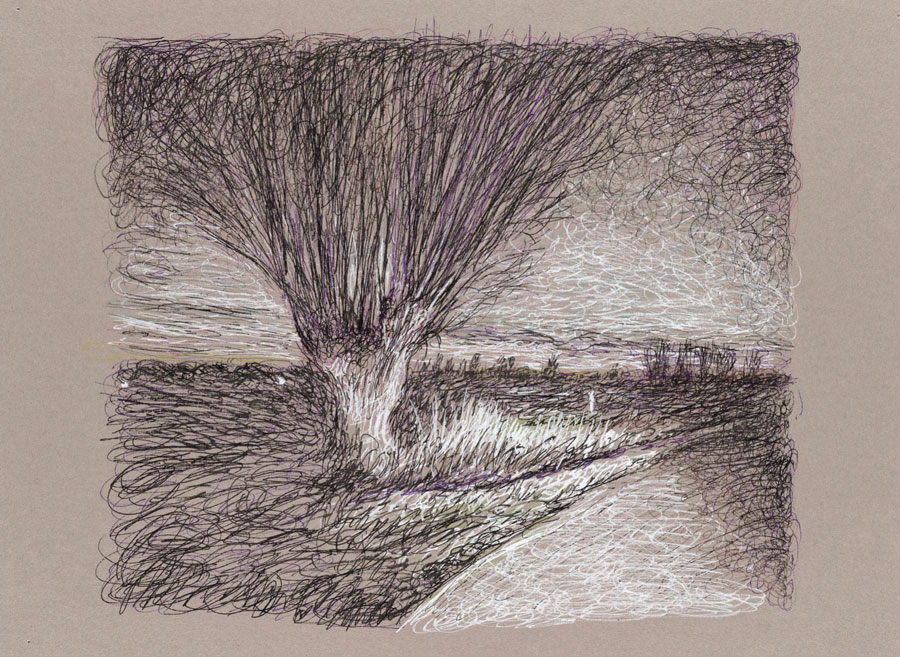
Erwin Keustermans, Pollarded Willow (detail from the exhibition)
In conversation with Doig
Not every work in the exhibition starts with one of the artist's own photographs. Some drawings serve as tributes, conversations with other artists across the decades. One of the strongest examples is a work after Peter Doig's Rosedale House (1996): the same bare tree, the same wrought-iron gate, the same stone pillar and house emerging diagonally behind it.
What is interesting is not the similarity, but the difference in temperament between the two images. Doig's original—an etching with the medium's characteristic grainy, almost photographic depth—constructs its image through layer upon layer of hatching, evoking the physicality of etched plate and ink. The tree trunk acquires weight, the sky becomes veiled and the entire composition breathes a cinematic, almost nostalgic gravity. Keustermans uses precisely the same composition, but redraws it with his own restless hand: curling, swirling lines that cause the sky to churn rather than merely haze over, a canopy that seems to vibrate rather than remain still. Whereas Doig renders the gate with meticulous, almost architectural precision, Keustermans allows every bar to move within the same restless rhythm as the branches above.
The result is a curious paradox: a drawing that remains faithful to another artist's subject, while being utterly unfaithful to his temperament. It is exactly what you might expect from someone who claims not to rely on the imagination, while simultaneously translating an existing composition entirely into his own agitated handwriting. Here, in graphite on grey paper, you can see what ‘direct action’ means when the subject has already been interpreted by another artist: not repeating, but reliving.
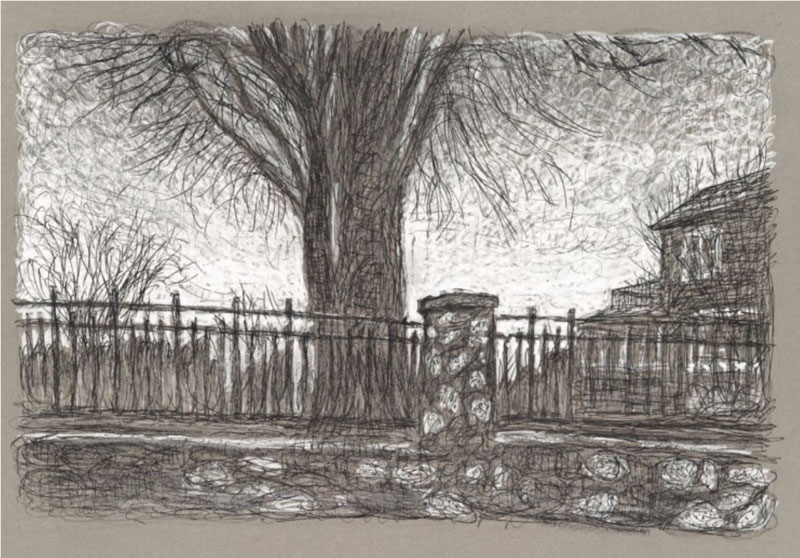
Erwin Keustermans after Rosedale House by Peter Doig
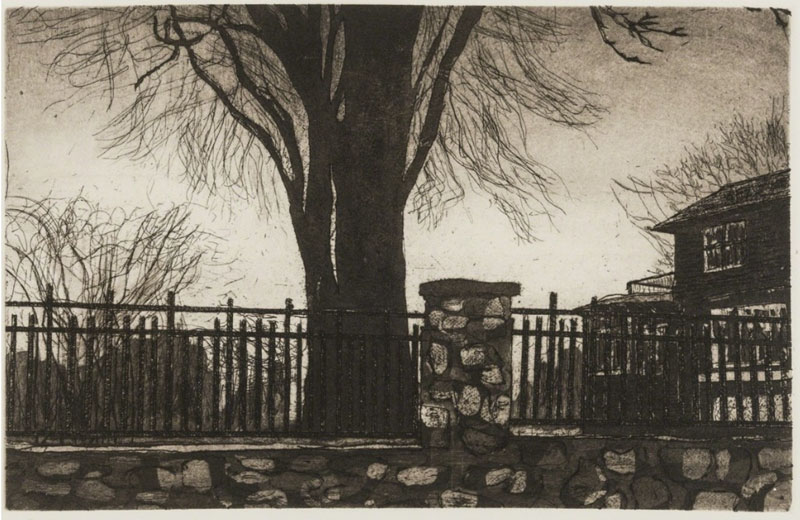
Peter Doig, Rosedale House, 1996 (original)
A contrast with the main gallery
It is no coincidence that this presentation runs alongside Sculptural III in the gallery's main space, an exhibition centred on contrast, where organic ceramic forms collide with the figurative and unsettling. Amid all that weight, materiality and sometimes almost threatening presence of fired clay, Keustermans' work in the H.F. Room offers a light, almost breath-catching counterpoint. There is no sculptural mass, yet something equally tangible: every line bears witness to a physical gesture, only this time executed with pencil and pastel rather than clay.
Moving from one gallery to the other is an intriguing experience, shifting from shapes that have been built up and fired over many months to drawings completed in only a few hours, never aspiring to permanence. Yet both approaches share the same conviction: that a work of art comes alive only when its maker surrenders fully to the material, whether that material is clay or simply a sheet of paper and handful of pencils.
The book
Published alongside the exhibition is a book, also entitled The Ordinary Luminous, bringing together 45 reproductions of work from recent years. It is not a catalogue in the strictest sense, nor a dry inventory of titles, dimensions and dates, but a publication that devotes equal attention to text and image.
The volume opens with a personal letter from Keustermans to his sister Marleen, who commissioned the book as a gift for her brother. The letter immediately establishes an intimate tone: this is not merely a survey of an artistic practice, but also an expression of gratitude, a family story unfolding alongside an artistic career.
Four essays follow, each approaching the work from a different perspective. Philosopher Frank Vande Veire positions the drawings conceptually, offering the subtle characterisation of what he calls ‘bounded boundlessness’: remaining within the limits of what the photograph depicts, while allowing complete freedom within those confines. Collector and therapist Bob Van Eerd contributes a biographical interview tracing the artist's circuitous path through philosophy, information technology and ultimately drawing. American critic and artist Tom McGlynn places the work within an international context, drawing connections to Magritte, Broodthaers and Raoul De Keyser. Finally, art historian Manfred Sellink, a specialist in Bruegel, speaks with the artist about his grisaille drawings, explaining why some of Keustermans' grey-toned works resonate so strongly with that early modern tradition of modelling through light and shadow.
As a result, the book broadly mirrors the exhibition, while offering visitors who wish to linger over the work's underlying motivations several additional points of entry. Those who have seen the exhibition before leafing through the publication will discover that each complements the other without repetition: the gallery reveals the results of this ‘new’, intuitive method of working, while the book explains, through interviews and essays, the long and winding path by which the artist arrived there.
Practical information
Visitors wanting to learn more about how this loose, intuitive approach relates to Keustermans' earlier, more structured periods—years in which patterns and algorithms formed the basis of his drawings—can attend the presentation of the accompanying book at the NQ Gallery on 16 August, with contributions from, among others, Bob Van Eerd.
Until then, there is this room, best experienced without rushing. Not because the drawings themselves took a long time to make—which they absolutely did not—but precisely because they ask of the viewer something proportionate to what they were denied: time.
The Ordinary Luminous featuring work by Erwin Keustermans can be seen in the H.F. Room at the NQ Gallery at Mechelsesteenweg 11 in Antwerp alongside Sculptural III. Book launch: 16 August.

Erwin Keustermans, The Ordinary Luminous, NQ Gallery
