31 july 2026, Martine Bontjes
The studio of... Bo Zhang
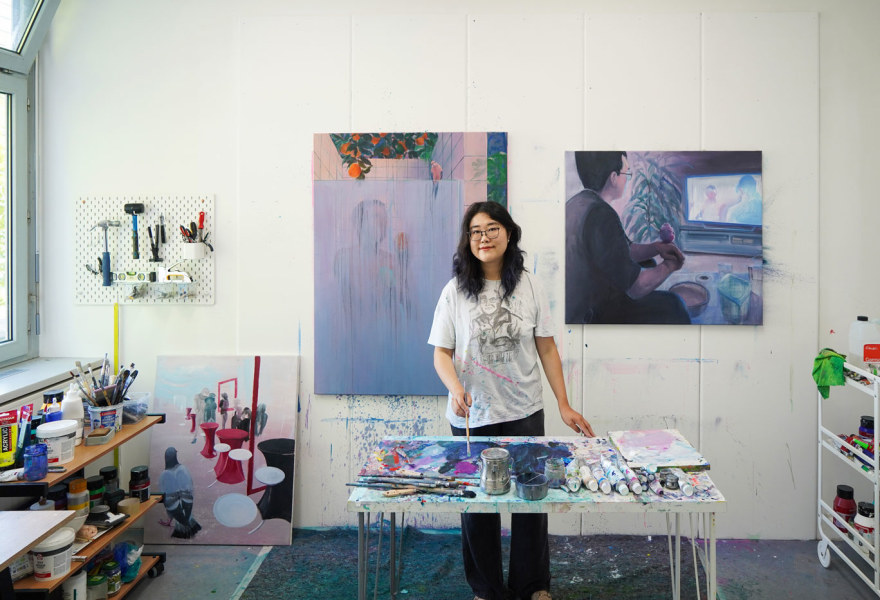
The world as we humans perceive it is only one possible reality. But can we look beyond the limits of human perception? Since childhood, Bo Zhang has kept birds. She is fascinated by the ways in which humans, animals, and plants coexist, as well as by the different lenses through which they perceive the world. While humans possess only three types of colour receptors, birds have a fourth receptor that enables them to see ultraviolet light. Zhang translates this fascination into dreamlike paintings, in which fluorescent colours evoke a world that largely escapes the human eye. Her work is on view at Namuso Gallery through 30 August in the group exhibition ‘The World Re-seen, Remembered, and Felt’.
Where is your studio and how would you describe this place?
I spent a significant amount of time working in Amsterdam before 2026. After graduating from the Gerrit Rietveld Academie, I set up a studio in Munich where my husband works, allowing me to spend more time with my family. My practice remains closely connected to the Netherlands, where I studied, exhibited, and continue to engage with the art community. My studio is a separate room with two big windows facing northeast, which is ideal for painting. It also comes with a separate storage room right across the hallway, so that I can keep my workspace organized, with only the working pieces in sight.
What makes a studio a good place to work for you? Is your current studio your dream space or do you still dream of another space?
I work on medium to large-format oil paintings, so having a dedicated studio is essential for my practice. I cannot imagine working from home, where I'd have to be constantly careful to keep things clean. I am a messy painter, and I need that messiness to be creative.
Practical reasons aside, a studio is a sanctuary where I can isolate myself and fully immerse in my inner world. My paintings are mostly narrative, and I need to be "in character" to tell each story well. I remember reading an interview with Claire Tabouret after seeing her solo show at Museum Voorlinden. She mentioned that it takes her some time to reach the right state of mind after arriving at her studio; she described it as going underwater, a thousand leagues under the sea where everything else disappears. I resonate with that—I might never reach that state of deep immersion without my studio.
I feel blessed with my current studio, but I do dream of another space in the long run. What I miss here is a dynamic connection to fellow artists. It is not in a building dedicated to art, and most of my neighbors are offices. Ideally, I would love to work in a lively Atelierhaus featuring open studios and occasional social events.
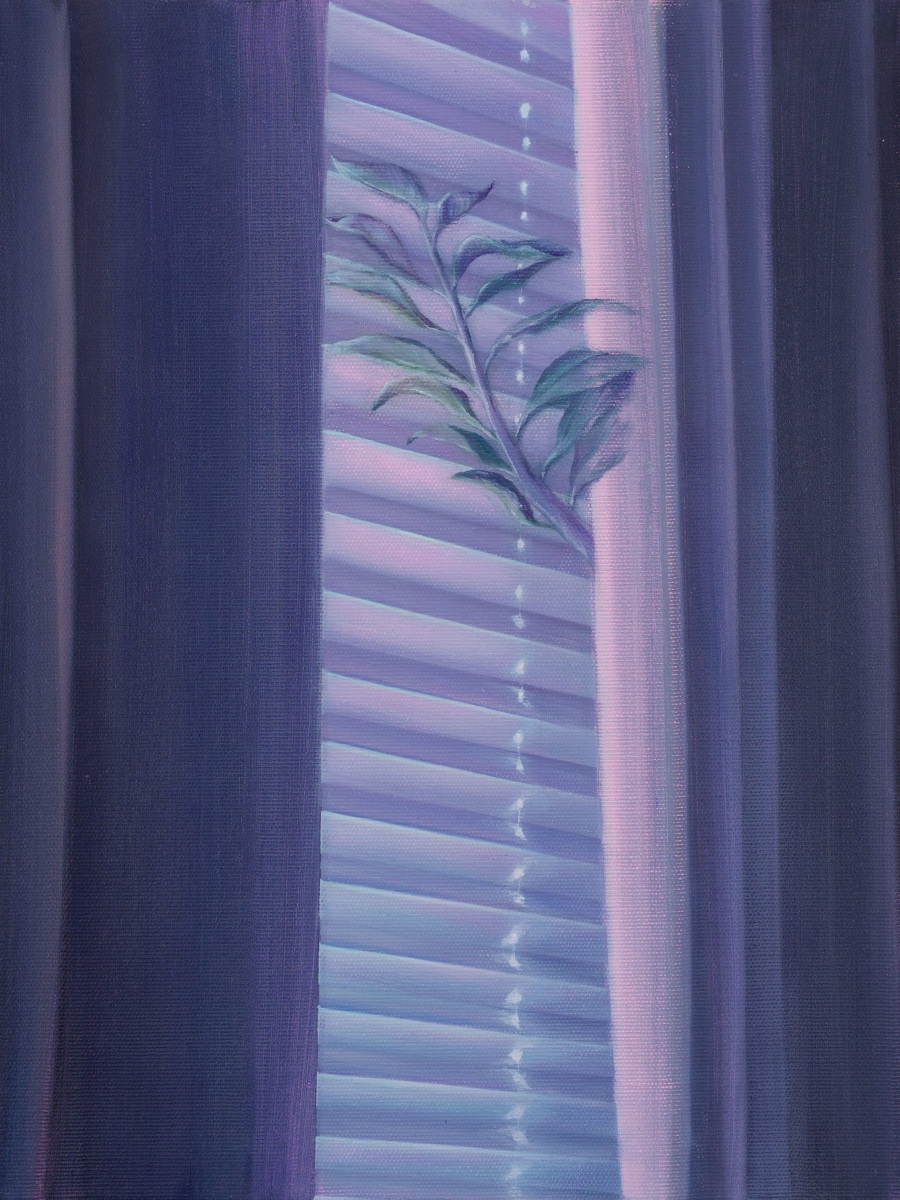 Bo Zhang, Just checking on you, 2026, Namuso Gallery
Before enrolling at the Gerrit Rietveld Academie, you completed a PhD in Cognitive Psychology. When did you decide to make the transition to the visual arts?
It was actually during the second year of my PhD program that I started studying at the Gerrit Rietveld Academie. I enrolled in the DOGtime program, a part-time study that allowed me to pursue a serious art education alongside my research work.
I had wanted to become a painter since childhood and had taken painting courses for many years. However, as neither of my parents were artists, painting was always encouraged as a hobby rather than a possible career path. When I considered attending art school as a teenager, they were strongly against it, so I followed a more conventional path while continuing to carry that ambition with me. In a way, studying human factors and cognitive psychology was a natural extension of this interest. My research focused on how we sense and perceive the world, which is fundamentally connected to the way we experience art.
I decided to become a full-time artist shortly after graduating from the Rietveld Academie. The positive response to my graduation exhibition and the recognition my work received convinced me that I could finally dedicate myself fully to painting. In many ways, it felt like coming back to something I had wanted to do all along.
Congratulations on winning the 2026 Buning Brongers Prize! Your work is on view at Namuso Gallery for the second time. What is it like to see your work in a smaller group exhibition?
Thank you! I'm still incredibly happy about receiving the award. It feels like a reassurance that I'm on the right path and encourages me to keep going. It feels meaningful to return to Namuso Gallery after participating in the gallery's Graduation Show last year. It is wonderful to continue this collaboration while seeing my practice develop.
Seeing my paintings installed in a gallery is always a special experience. While I'm working, I'm very close to each painting, which can make it difficult to view the work objectively. Once the paintings leave the studio and enter an exhibition space, I can experience them in a new way. The curation, the placement of the works, and the relationship between the paintings and the surrounding space all become part of how the work is encountered. This distance allows me to discover new relationships between the paintings and notice details that I may have overlooked while making them.
One of the most rewarding aspects of exhibiting is the opportunity to meet people who spend time with the work, to encounter new perspectives through the exhibition context, and to connect with the artists presented alongside my own. Each exhibition creates new possibilities for dialogue and exchange. I have especially enjoyed seeing my work exhibited alongside Catelijne Boele and Katarzyna Bałdyga. Although our artistic languages are distinct, there are subtle resonances between our practices, and discovering these connections through the exhibition has been inspiring. For me, a painting is never completely finished in the studio. It continues to evolve through the people, conversations, and contexts in which it is experienced.
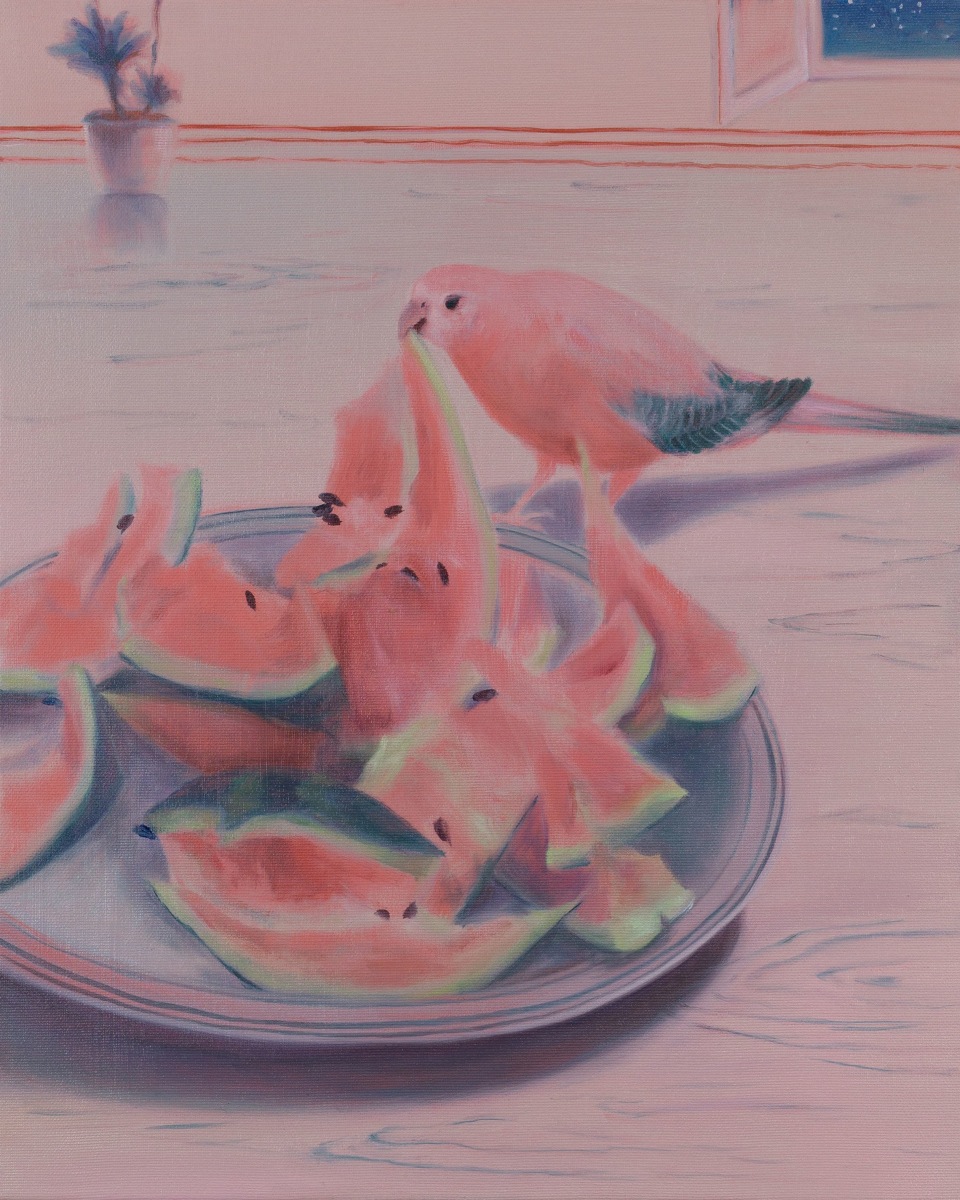 Bo Zhang, Fluffy and melon, 2026, Namuso Gallery
You have said that your paintings originate from your personal photo archive. What does that archive look like? Are these old photo albums or digital pictures?
It's a mix of everything. When searching for intriguing images, I dive into both my recent digital photos on my phone and old analog photo albums from my childhood. I also actively take photos whenever I encounter an interesting scene that I want to work with later. Another source of my archive is photos by friends. Since many of them know I "have a thing" for birds, they will occasionally send me random snapshots of birds. I find this joyful and I love working with randomness and elements that I cannot fully comprehend at first glance.
Birds are a recurring theme in your work and you also keep birds yourself. What have they taught you about perceiving the world?
Birds have taught me that reality is never singular. They move seamlessly between the layers of the world which we humans are usually completely blind to – from the immense heights of the sky to the ground beneath our feet. Learning about their different sensory world has made me question how much of reality remains hidden beyond human perception.
At home, my birds roam freely. They bring a touch of magic to most ordinary scenes. Sometimes they appear to observe and judge us silently; sometimes they are right in the middle of mischief; other times they seem distant and absent, like creatures from another world. By depicting my birds in my paintings, I feel like looking at my life through a bizarre lens. It helps me start seeing things that were always there, but I had never noticed before.
Your use of colour is inspired by animal vision. How does it differ from the way humans perceive colour?
What fascinates me most is how they see colors. Humans are trichromats with three types of color receptors: red, green, and blue, while birds are tetrachromats. They possess a fourth receptor for ultraviolet light, which means they live in a visual world that we can barely imagine. In a bird's eye, the daytime sky might glow fluorescent pink, and our smooth skin might be scattered with patterns.
Three years ago, I began researching bird vision and decided to integrate fluorescent colors into my palette. Since we cannot directly perceive ultraviolet light, we have to use substitution colors to represent this invisible spectrum - most notably, fluorescent magenta. I quickly fell in love with this color and now use it widely in my paintings. For me, this glowing magenta has gradually come to bear a psychological function: it creates a visual and emotional distance from our human-perceived reality, and renders familiar scenes with a dreamy, uncanny atmosphere.
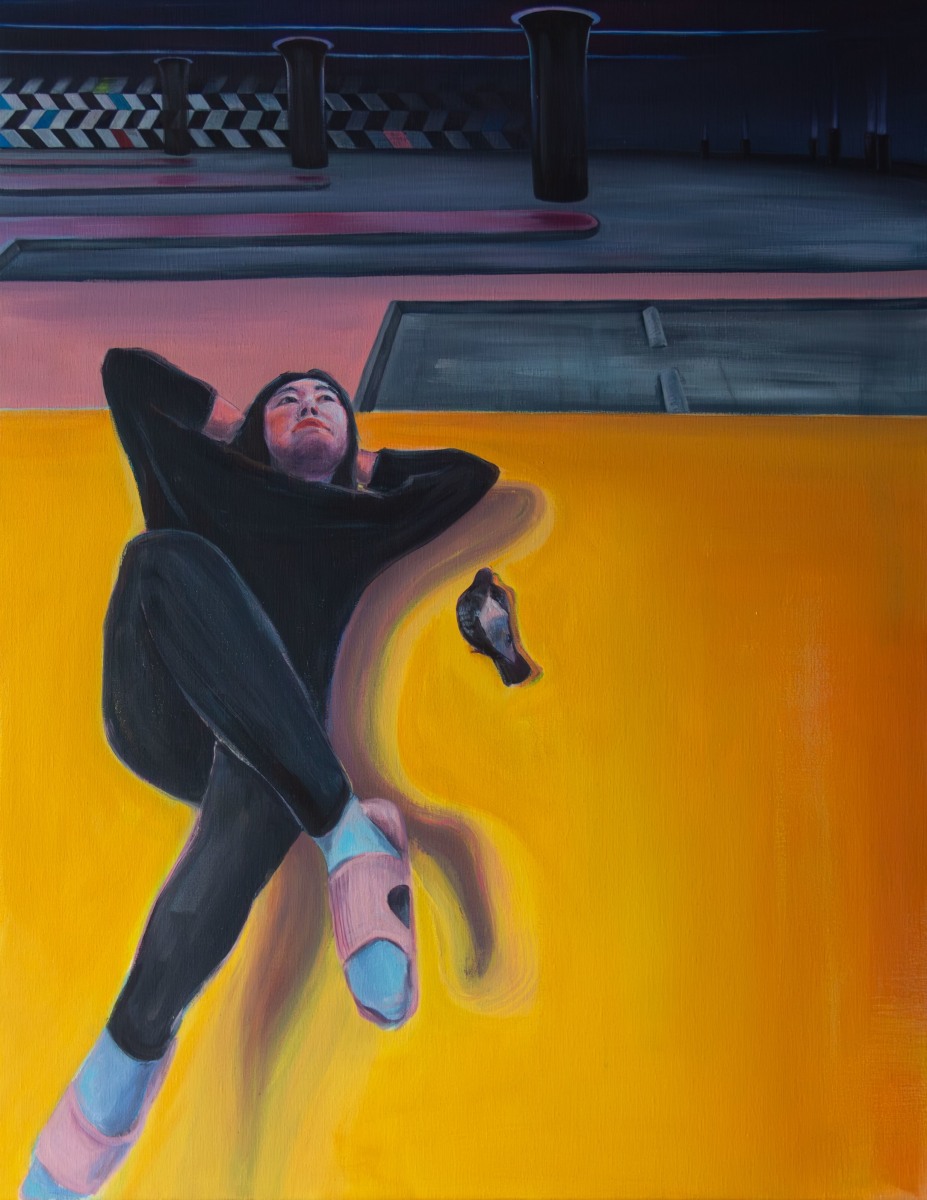 Bo Zhang, Farewell, 2025, Namuso Gallery
Who is the figure in Farewell? Is it a self-portrait?
Yes, it is me, but it can also be interpreted as anyone else. An interesting coincidence is that this painting was inspired by a photograph Katarzyna sent me last year—the artist exhibiting alongside me at Namuso Gallery. We have been classmates and friends for many years. She sent me a photograph of two pigeons resting at a bus stop, which became the starting point for Farewell.
In Farewell, I replaced one of the pigeons with myself, creating a surreal scene where a figure is semi-floating in a familiar yet undefined environment, which gradually opens up and stretches into a vast, immense space. I am always keen to open up a window within mundane scenes, as for a long time, I have desired a life elsewhere.
What are you working on at the moment?
I am currently at the beginning of a new, research-based project, diving deeper into the avian perspective. I am experimenting with technical methods to reconstruct the world through the eyes of birds, building the visual foundation for a new body of paintings. Recently, I was invited by Dr. Francesco Walker, a former PhD colleague now at Leiden University's department of Cognitive Psychology, whose research focuses heavily on art perception. I will take over their exhibition space this coming November and December, which feels like a wonderful opportunity to present these new visual experiments at the intersection of science and art.
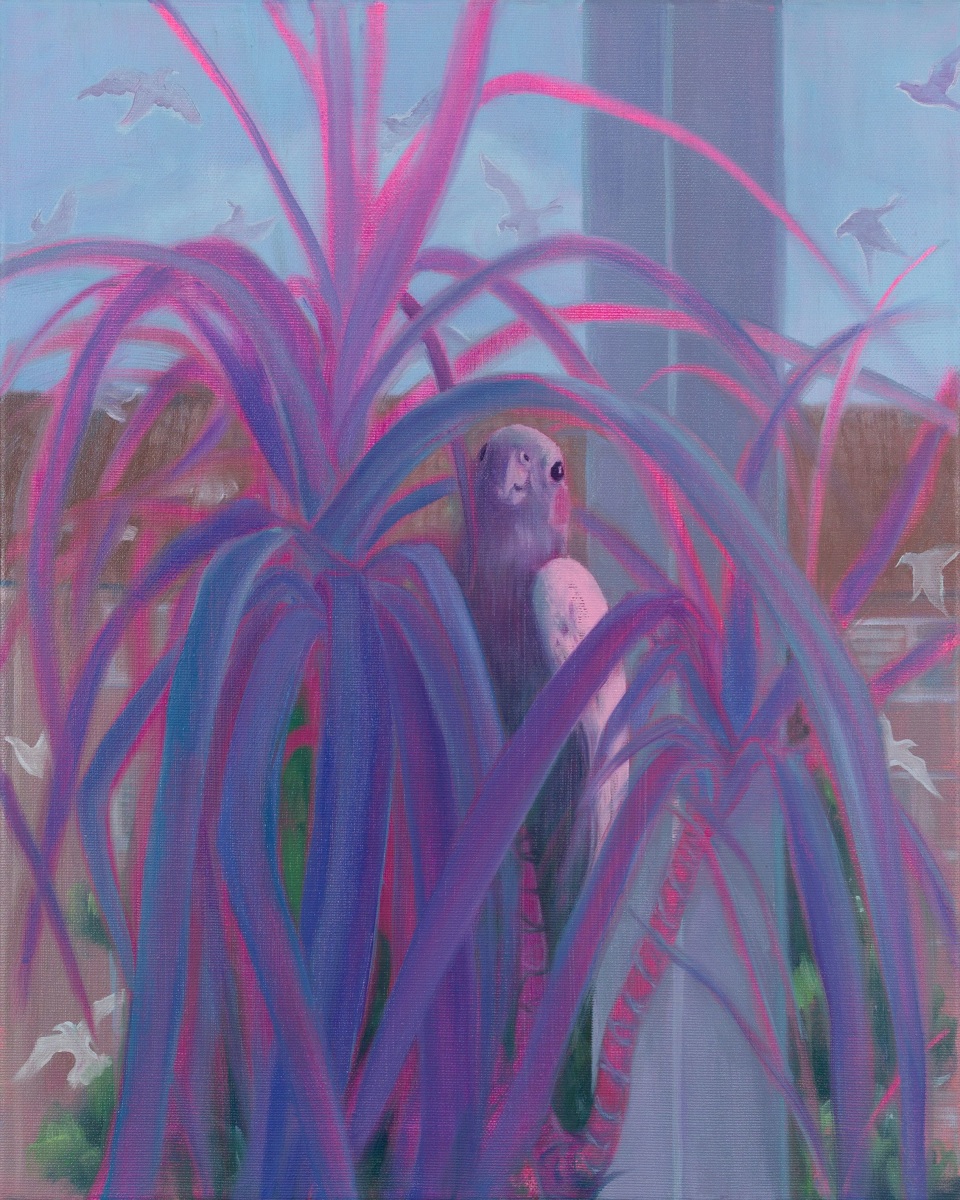 Bo Zhang, Pipi in the tree, 2026, Namuso Gallery