02 june 2026, Martine Bontjes
The studio of... Giuseppe Lo Schiavo
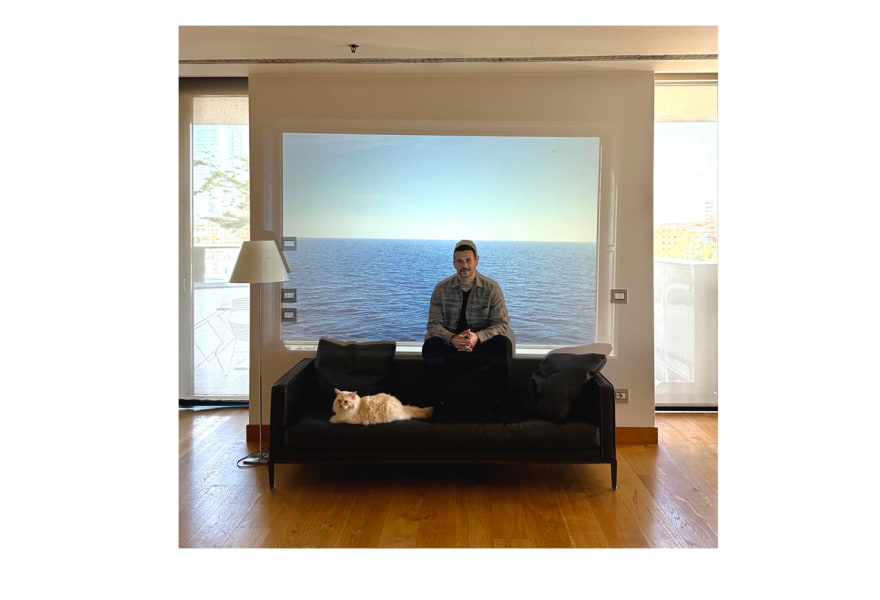
Giuseppe Lo Schiavo grew up along the coast of Calabria, with Sicily and the volcano Stromboli visible on the horizon. The sea and its horizon were part of everyday life, until he left. As memories fade and the mind inevitably reshapes what it remembers, Lo Schiavo began searching for a way to bring those landscapes back to life. Not as they once appeared, but as they survive in our imagination, shaped by time and sometimes more beautiful than reality itself. His work is on view at Spazio Nuovo in Amsterdam until 12 June.
Using 3D scanners, projectors and digital imaging techniques, the Italian artist constructs an alternative reality. Rather than using photography to preserve the image, he uses it to reshape and reimagine it: "The final image may look photographic, but the process is closer to constructing a world than documenting it."
Where is your studio and how would you describe this place?
My studio is currently in Milan, in a separate part of my apartment. This matters because I don't work conventional hours. I often work at night, or whenever an idea arrives, and I need to reach the studio immediately. I would describe my studio as home. I feel privileged to work as an artist, and I don't really feel that I "go to work". It is more a place where my art and my life blend together. The studio also extends into the rest of the house. My cat is part of the studio too. I cannot be productive without him. He is the one who takes me outside when I become too absorbed in what I'm doing, since I walk him on a leash in the park downstairs.

Giuseppe Lo Schiavo, Il Mare Fuori A, 2024, SPAZIO NUOVO
Your images are not created behind a traditional camera but within a digital environment. What does your studio look like, and what kind of equipment do you work with?
I work with powerful computers, a 3D scanner, a projector, test prints, and far too many samples of papers and materials. But also many cameras. I used to work as a traditional photographer, with both digital and analogue medium-format cameras, and those tools are still part of my studio.
Your fascination with window frames began during a summer job. What exactly did you do there, and what caught your attention?
At the time, I was not particularly interested in windows. It was just a summer job for my father, very practical and not connected to art in my mind. I spent several summers there, but my father was always very protective, so even after five years he mostly let me watch and learn rather than actually build things myself. Only much later, after I had already started the Windowscapes project, I reconnected that experience to my past. I find this fascinating, because sometimes we create things from memories or experiences that we are not consciously trying to use. They stay somewhere in the background and return in another form.
About a year after the project began, I started adding the logo of my father's company, which no longer exists, to the lower right corner of the window frame. The first works don't have it, because I had not made that connection yet. My father was very upset when he had to close the company, partly because no one wanted to take it over. So now I sometimes tell him, "Look, Papà, your windows are travelling the world."

Giuseppe Lo Schiavo, Selene and the garden A, 2025, SPAZIO NUOVO
What does the research process for a new work look like? Do you primarily work from your own photographs, or also from found and archival images?
The process changes every time. Sometimes it starts from a photo I take, a place, an object, or a visual detail that stays with me. I don't usually use these images directly. They are more like clues that help me understand a certain light, material, proportion, or atmosphere.
You describe your practice as 'Synthetic Photography'. Could you explain this terminology?
I use this term because my images are not captured from reality in the traditional photographic sense, but they are still built with photographic tools inside a simulated space. I work with light, composition, lenses, surfaces, depth, and atmosphere. I build everything in 3D, as if reality were a scenography, and then I take a photograph inside that simulation. The process is more complex, but this is the basic principle. For me, "synthetic" comes from the idea of synthesis: different elements, memories, scans, objects, architectures, landscapes, and digital materials coming together to form a new image. It is important for me to make this distinction because my work has nothing to do with AI-generated photography. My process is closer to that of a painter. I construct a reality through modelling, scanning, composing, rendering, testing light and materials, with many precise decisions made by hand. The final image may look photographic, but the process is closer to constructing a world than documenting it.

Giuseppe Lo Schiavo, Site-specific audio video installation by Giuseppe Lo Schiavo, curated by serena Tabacchi, Palazzo Vecchio – Sala d'Arme, Florence, Italy
Your work is filled with landscapes and distant horizons. What is it about the sea in Calabria that keeps drawing you back?
Living in a city has probably made my need for nature even stronger. My images often come from a lack, from the desire to see something that is not immediately around me. In that sense, I think of them as "nature on steroids": landscapes that are intensified, almost impossible, but still emotionally familiar. It is not a coincidence that I started the Windowscapes series during Covid. They were born partly to save me, or at least to create a place where I could mentally escape. Over time I understood why many people connect with them. They are not only my personal refuge. They speak to a more general need for distance, openness, silence, and horizon, especially today. Calabria is very important in this sense. I grew up in front of the sea, with Sicily and Stromboli visible from my window, so the horizon was not an abstract idea for me. It was part of everyday life. The sea there is beautiful, but also unstable. I like to use it to tell different stories, as in my recent institutional project Rotta, presented at Palazzo Vecchio in Florence, where I created a video installation filmed on the Mediterranean Sea to address the ongoing tragedy of deaths and disappearances in the Mediterranean.
In your Windowscapes, we often encounter antiques and historical objects. Are these pieces from your own collection, or do you source them through museums and antique dealers?
There is an interesting story behind some of these works. Many of the works I am interested in belong to major collections like the Uffizi, the Vatican Museums, or the Louvre, where access to high-resolution 3D scans is not always straightforward. But in Northern Europe, especially in academic collections, there are historical plaster casts of many of these ancient sculptures. They were made so that students could study classical art without travelling to Rome, Florence, or Paris, and over time these plaster copies became cultural objects in their own right. Some institutions still preserve them today and are more open to digital acquisition. So sometimes I am not scanning the original marble from the Uffizi, but a plaster cast of that original. I find this fascinating because it tells a larger story about European culture: how ancient Mediterranean forms travelled across the continent through copies, casts, and reproductions. For me, using these objects inside a digital image adds another layer. The work is not only about the antique object itself, but also about its movement through time: from marble to plaster, from museum to scan, from scan to synthetic image.
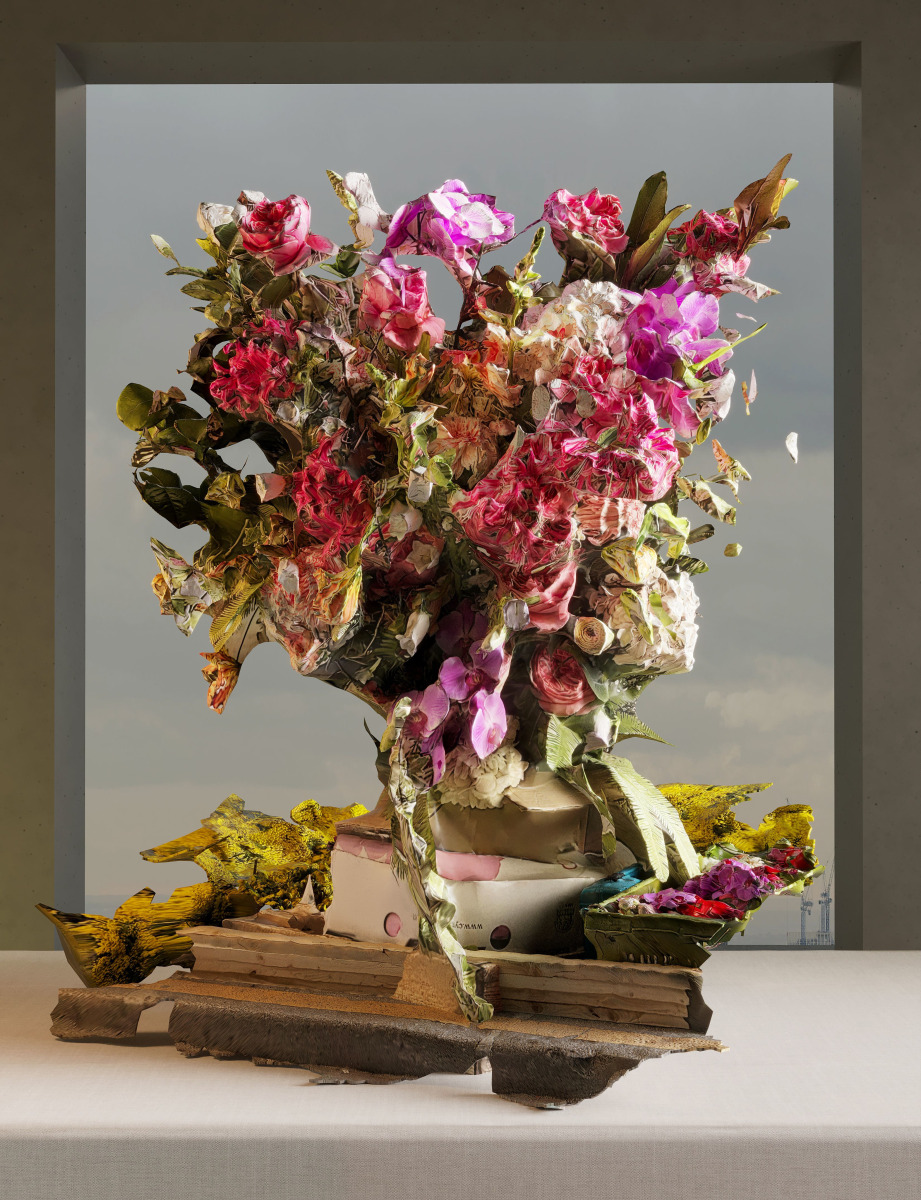
Giuseppe Lo Schiavo, Paris in Rosy Retrospection, 2024, SPAZIO NUOVO
In Paris in Rosy Retrospection, we seem to encounter a bouquet of wilted flowers that nevertheless feels alive. What fascinates you about decay and transformation?
What looks like decay is actually something else. The flowers were intact when I scanned them, on a street in Paris. What reads as wilting is the scan itself: I used a simplified 3D scanning method that loses data and fills gaps with approximations. It does exactly what the mind does when it stores an image. That's where the title comes from, rosy retrospection, the bias that makes us remember the past as better than it was. The surface suggests a memento mori, but the real subject is the mechanism through which we'll remember those flowers.
You work with technologies and media that constantly evolve and become obsolete. Is there software you once relied on that no longer functions today? What new technologies are currently shaping your practice?
I actually have almost the opposite problem. Sometimes I avoid updating software because when a tool evolves, the way it produces images also changes. It is almost as if a painter had been working with a very specific blue, and the company kept changing the pigment every few years. The new version may be more advanced, but it is not necessarily the same colour. At the same time, I see this as an opportunity. Technology keeps changing, and that is part of the work. Right now I am especially interested in 3D scanning, photogrammetry, Gaussian splats, and experimenting with new printing materials.
What are you most looking forward to at the moment? Are there any upcoming projects you are excited about?
At the moment, I am not really in an "excited about the next project" phase. I am in the studio full-time, experimenting without the weight of organizing a show. For me this is a very important moment, and one I had to work hard to create. I need this time to test things without immediately turning them into a project, an exhibition, or a deadline.

Giuseppe Lo Schiavo, PCircular nest, 2026, SPAZIO NUOVO
