29 may 2026, Wouter van den Eijkel
The studio of... Nienke Elenbaas
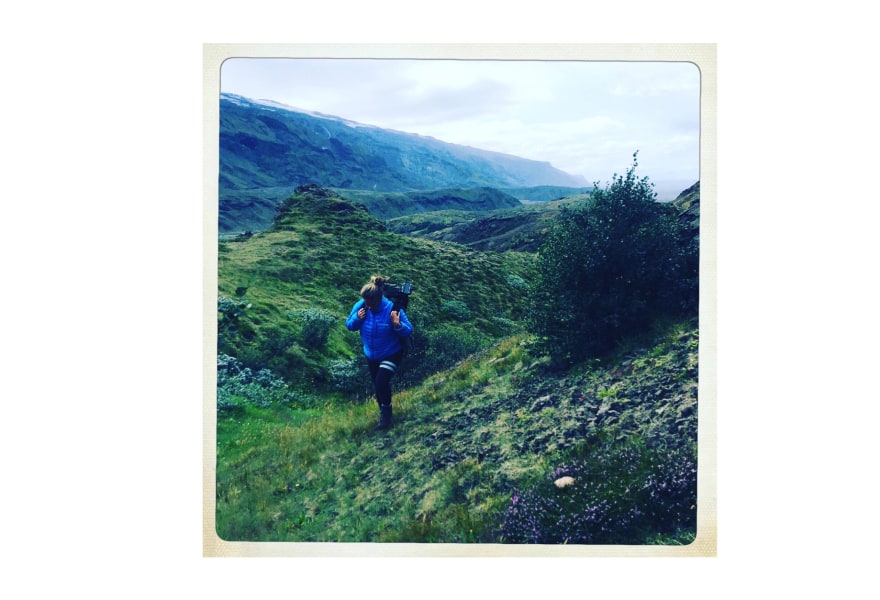
'Something between memory, the body and emotion' — that is how Nienke Elenbaas summarises the essence of her photography. As a child, she already sensed that the atmosphere in a room could be all-defining. No words needed to be spoken for it to be felt. Later, she came to realise that emotions are often passed on unconsciously. That idea naturally found its way into her photography, which is characterised by a charged stillness. It is therefore fitting that the title of the duo exhibition at Galerie Helder is A Kind of Presence.
Elenbaas works intuitively and largely on location. 'For me, making an image is not an illustration of an idea. It is more a way of investigating something I do not yet fully understand myself.' The result is a body of stylised, cinematic imagery that deliberately leaves room for the viewer's own projections. We spoke to her about her work, why she does not have a studio, and the project she would pursue if given the opportunity.
A Kind of Presence, featuring work by Nienke Elenbaas and Lisanne Hoogerwerf, is on view at Galerie Helder until 20 June.
I briefly spoke to you on the phone, and you mentioned that you do not really have a studio. Of course, a photographer does not necessarily need one, but does that mean you mainly work on location?
Yes, most of my work is created on location. That might be inside someone's home, out in nature, or somewhere with a particular atmosphere that can be felt. Because I work with photography, digital collage and a collection of loose elements, I do not need a traditional studio. My "studio" is more in the way I look.
I collect images, colours, light, details and movements. I take many photographs of many different things that may only come together months later in a single image. The final work is created afterwards: building layers, searching for the right tension between beauty and discomfort.

Nienke Elenbaas, Dots of Tsuki, 2024, Galerie Helder
That does make me curious about your working process. Suppose I were interning with you — what would an average day look like?
Probably far less tightly organised than you might expect. My photography days often begin with looking, searching, moving things around and doubting. I work intuitively. Sometimes an image grows from a memory or emotion, sometimes from something very simple: a colour, a piece of fabric, light falling somewhere.
An internship day could mean photographing on location, collecting clothing or objects, selecting images, looking at prints or experimenting with combinations of photography and collage. But it could also mean learning how important atmosphere is — not only in the image itself, but also during the making of it. I explain my starting point and ask the model and make-up artist whether they recognise a certain thought or emotion. We talk about that, and often the model ends up contributing something personal to the image as well. I therefore almost never work with a mood board or shot list; instead, I explore emotions through images.
A Kind of Presence, a duo presentation with Lisanne Hoogerwerf, is currently on show at Galerie Helder. What do you think is the common thread between your work?
Although our work differs visually, I think we are both concerned with what is not immediately visible. A presence that you feel before you understand it. In Lisanne's work there is a stillness that I recognise. A kind of charged silence. My own work may be more cinematic and layered in its construction, but ultimately we are both searching for something that is difficult to grasp. Something between memory, the body and emotion. That is what makes the combination interesting: two visual languages, each with its own voice, yet both carrying an emotional undercurrent.

Nienke Elenbaas, 50 Words, 2022, Galerie Helder
Your work explores the transmission of emotions across generations. I read somewhere that, as a child, you already realised you were absorbing your mother's pain without her ever speaking about it. When did you realise this could become the subject of your work?
That realisation only came much later. As a child, I mainly felt that atmosphere could determine everything. That emotions could linger in a room without anyone saying a word. For a long time, I assumed everyone experienced things that way.
Only as I grew older did I begin to understand how strongly people unconsciously pass emotions on to one another. Not only trauma, but also fears, desires, ways of loving or disappearing.
At a certain point, I noticed that these questions naturally entered my work. Not as a preconceived concept, but because I kept making images about closeness, vulnerability, distance and unspoken feelings. That was when I realised: apparently, this is what my work is about.
I can imagine a subject like that requires a long process before it takes shape in an image. Have you in fact been occupied with this your entire life?
Probably, yes — although in the past it did not yet have a language. Many of the things that now appear in my work were already present in childhood: sensing atmosphere intensely, observing people, the idea that beneath the surface there is always another reality.
For me, making an image is not an illustration of an idea. It is more a way of investigating something I do not yet fully understand myself. That is why I work intuitively. Sometimes I only understand afterwards why I felt compelled to create a particular image.
In that sense, my work runs parallel to my life. It changes along with what I discover.

Nienke Elenbaas, Reversed Embrace, 2025, Galerie Helder
A Kind of Presence includes works from Family Affairs and Crimson Glory (Under My Skin). The images are stylised and almost seem to come from a film. Was that a conscious choice?
Yes, absolutely. I do not want to show a literal reality. By giving the images something stylised or cinematic, space is created for projection. When an image becomes too documentary, you are mainly looking at someone else. Through a subtle sense of estrangement, the image can become more universal. It allows the viewer to bring their own memories or emotions into it. My background in fashion photography also plays a role in that. I am highly sensitive to colour, composition, clothing, light and the choreography of an image. For me, beauty is never purely aesthetic. It is more an entry point — a way of allowing someone to come close enough to feel something beneath the surface.
One of the more interesting questions your work raises is to what extent our emotions are truly our own. Do you have an answer to that?
I do not think there is a definitive answer, but I do believe we carry far more of one another than we realise.
Families pass down not only stories or physical traits, but also ways of reacting, remaining silent, longing or dealing with fear and love. Much of that happens without words.
At the same time, I find it interesting that something heavy does not always have to remain heavy. People can transform pain into care, tenderness, creativity or connection. Perhaps that resilience moves me even more than the trauma itself. My work tries to make that complexity tangible without attaching a conclusion or judgement to it.

Nienke Elenbaas, Dancing with You in My Mind, 2022, Galerie Helder
Suppose I gave you carte blanche — is there a project you would love to realise?
I would very much like to create a large international project in which personal family stories come together with imagery, landscape, archival material and new photography.
A project in which different generations and backgrounds intersect, making visible just how universal emotions really are.
I imagine something that exists somewhere between an exhibition, an installation and a film. Large-scale works, sound, moving image, perhaps even handwritten letters or people's voices incorporated into the space.
Not as a historical document, but as a kind of emotional landscape through which visitors move. As though you are literally walking into someone's memory.
What are you currently working on? I noticed that you also work on commission — do you alternate that with autonomous work?
Yes, very consciously. Commissioned work and autonomous work actually nourish one another. In commissioned projects, I often collaborate very directly with people or organisations, whereas my personal work emerges much more intuitively. In the end, both revolve around the same thing: making visible something that is difficult to express in words.
At the moment, I am engaged in research in which presence and vulnerability take on an even more central role. I am exploring how to make something tangible without showing it literally. Alongside that, I am experimenting with new forms of layering, including combining photography with textiles and embroidery. It feels as though the work is slowly developing a new skin.

Nienke Elenbaas, Sakura, 2024, Galerie Helder
