14 april 2026, Martine Bontjes
The studio of... Nynke Koster
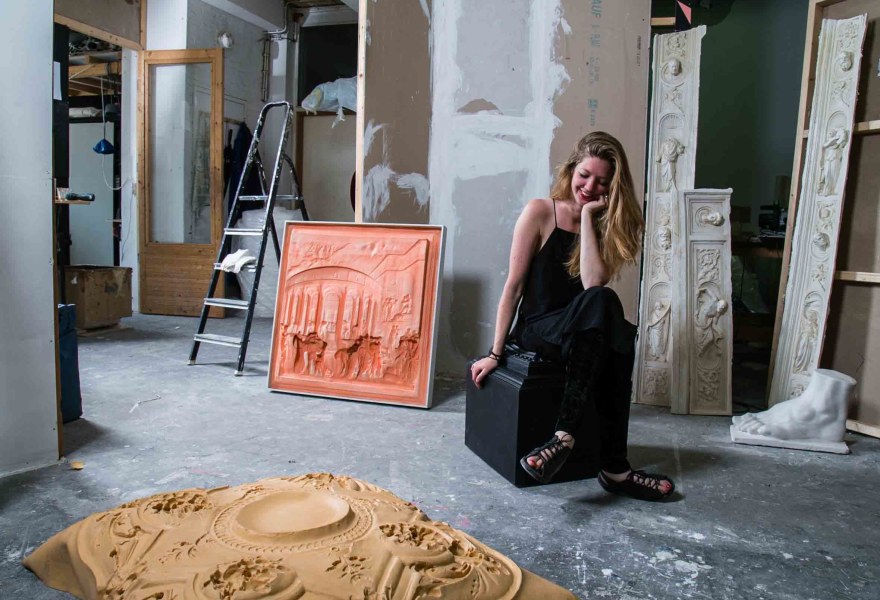
This coming weekend, Nynke Koster (Rademakers Gallery) opens the doors of her studio during Bermuda Open Studio. Visitors are offered a glimpse into her light-filled studio, filled with large moulds, casts and rubber sculptures. Koster translates ornaments from existing architecture into new, soft and tactile sculptures. These works reveal not only their forms but also the stories and traces of use embedded in these places. In her sculptures, Koster documents moments in time, captured as temporary imprints of what once was: "Sometimes I think, I wish I could have cast a place that I could now give back to people, for example in Gaza or Syria."
Koster believes that ornament has never truly disappeared, but has instead transformed in form. Where ornament once appeared visibly on facades, it now often hides within materials and digital patterns. In her view, the future lies in new hybrid forms in which technology, craftsmanship and history converge: "Not as nostalgia, but as a revaluation of detail and meaning within the built environment." Her studio can be visited on April 18 and 19 from 11:00 to 16:00 as part of Bermuda Open Studio in The Hague.
Where is your studio and how would you describe this place?
My studio is located in De Besturing in The Hague, a former industrial building where several artists and designers work. The building still carries traces of its past forms of labour. The space is high and filled with light, with large windows and a raw, almost utilitarian atmosphere. The walls are not neatly finished and show signs of use, which makes the studio feel more like a workshop than a white cube.
In my studio there are heavy worktables, moulds in various stages and rubber objects that fill the room. Architectural fragments such as casts, test pieces and leftover materials hang on the walls and are scattered throughout the space. There is a constant tension between order and chaos. Clarity is necessary for the technical process, while the act of making inevitably brings mess and improvisation.

Nynke Koster, Neoclassicism (Pink), Rademakers Gallery
Do you go to your studio every day? What does your work week look like?
I try to be in my studio as much as possible, but my work week is rarely fixed. Some periods I work in the studio almost every day, other weeks I am mostly on the move. Travelling is an important part of my practice, for example for research, making casts on location or installing exhibitions and fairs.
That variation is essential. Working on site is intense and requires a different kind of focus, while the studio is where everything comes together and slows down. Here I take the time to test, reflect and decide which direction a work will ultimately take. I used to produce a lot of work in my studio, now less so. It is also valuable to outsource certain projects so that I can create space for new ideas.
Which tools and materials in your studio are indispensable? Do you have a favourite item?
Rubber is of course indispensable, in various hardnesses and colours. I work with different types of rubber, pigments and moulds, supplemented by spatulas, mixing cups and scales. The process is artisanal and requires precision and care.
My favourite tool is a Japanese saw that I received from my former Japanese assistant when I was working on a commission at the Tokyo Metropolitan Teien Art Museum. The control and precision it offers allow me to shape moulds and objects with great accuracy. The saw works on a pulling motion. It is a simple yet refined tool that aligns closely with my way of working.
What do you find so compelling about working with rubber?
Rubber is flexible, skin-like and vulnerable. It stands in sharp contrast to the hardness and monumentality of stone, concrete or marble, materials traditionally associated with ornament. By translating an ornament into rubber, it loses its weight and authority.

Nynke Koster, UM 1800 (Marble sea blue look), Rademakers Gallery
In your work you reinterpret ornaments. Where do you find them?
I find ornaments in existing architecture, on facades, in staircases, churches, historic houses and public buildings. Often these are places where ornaments have become part of everyday use and have therefore worn over time. I do not remove them physically, but instead take an impression in rubber on site.
This process happens in situ and is often physically and technically demanding. Making a cast is a direct, tactile encounter with a place. In the studio, that impression becomes the starting point for a new work, while the original context always remains palpable.
That softness makes history bodily and accessible. The material invites touch and challenges the idea of heritage as something that must only be observed from a distance. At the same time, rubber remains an industrial material, creating a direct link to the present.
How do you determine whether an ornament is suitable for casting? Are there forms you consciously choose or avoid?
For me, it is not the form but the story that matters. An ornament must be more than decoration. It needs to carry a deeper layer or context. This can be visible in wear, repairs or in the social and historical meaning of a place.
Ornaments that speak of power relations, changing uses of buildings or social structures interest me most. I often leave aside overly perfect or recently restored forms because they lack that layered quality. Practical considerations such as accessibility and fragility also play a role, but the narrative is always leading.
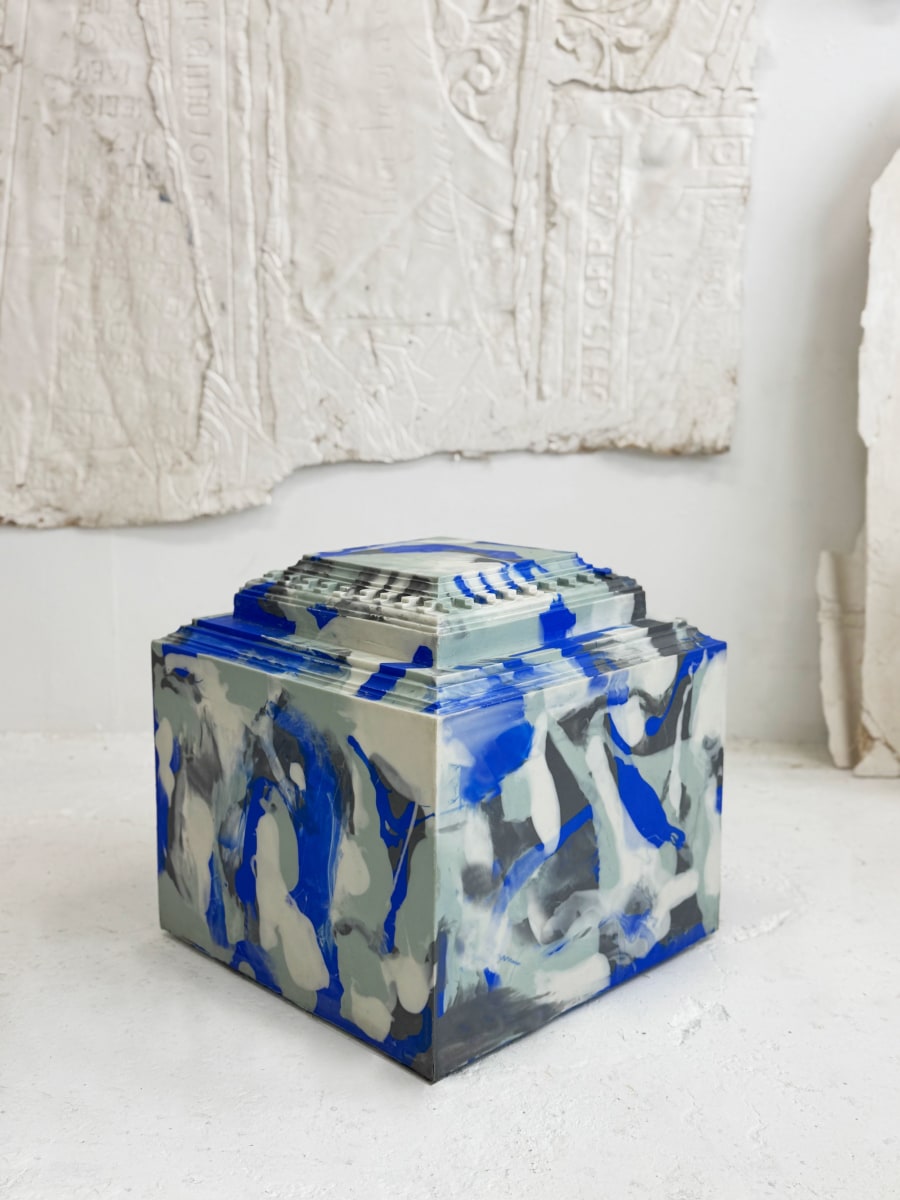
Nynke Koster, Neoclassicism in mixed re-used rubber, 2026, Rademakers Gallery
You travel a lot for your work. Are there places where you felt heritage was especially vulnerable?
Yes, particularly in places where political instability, mass tourism or climate change have a visible impact. There it becomes clear how quickly architecture can disappear or transform. Sometimes I make a cast with the awareness that the original ornament may soon no longer exist.
That sense of transience adds urgency to my work but also makes me cautious. I do not see my actions as appropriation but as a temporary registration of a moment in time. Sometimes I think, I wish I could have cast a place that I could now give back to people, for example in Gaza or Syria.
Do you see your work as a form of preservation or do you add new narratives?
I do not see my work as preservation in the traditional sense. It is more a form of translation. By moving ornaments into a different material, scale and context, new layers of meaning emerge. I also alter the forms at times.
The past is not fixed but reactivated. The works exist alongside their origin and function both as carriers of memory and as autonomous objects in the present. I sometimes return the original moulds, as I did with Paleis Soestdijk.
Your work balances between sculpture and furniture. Have you ever encountered your work in an unexpected place?
Not really. My works in public space, such as in Delft behind the Oude Kerk, are carefully chosen locations. Smaller rubber works are often found in museums or private homes.

Nynke Koster, Art Nouveau Cabinet, Rademakers Gallery
Do you think architecture will embrace ornament again in the future?
I think ornament has never truly disappeared but has mainly changed in form. Where it was once explicitly visible, it is now often embedded in structures, materials or digital patterns.
In the future I see room for new hybrid forms of ornament in which technology, craftsmanship and history come together. Not as nostalgia, but as a revaluation of detail and meaning within the built environment. It would be meaningful if ornament could speak about the past of a place. I see this happening in the Binckhorst area in The Hague, where my studio is located. Entire areas with beautiful historic buildings are being demolished. New towers are rising but they say nothing about the place or its history. That feels like a missed opportunity.
What are you currently working on?
In the coming period I am working on new pieces for the Zuiderzeemuseum, in which my research into ornament, water and materiality is further developed. I am also creating a work for the new city hall of Amersfoort. Recently I launched my first furniture collection in collaboration with Kelly Wearstler, an important new step in my practice.
Together with Rademakers Gallery I am participating in various art fairs. These presentations offer the opportunity to show my work within a broader international context and to further deepen the dialogue between art, design and architecture.
