13 march 2026, Wouter van den Eijkel
The studio of... Catharina Dhaen
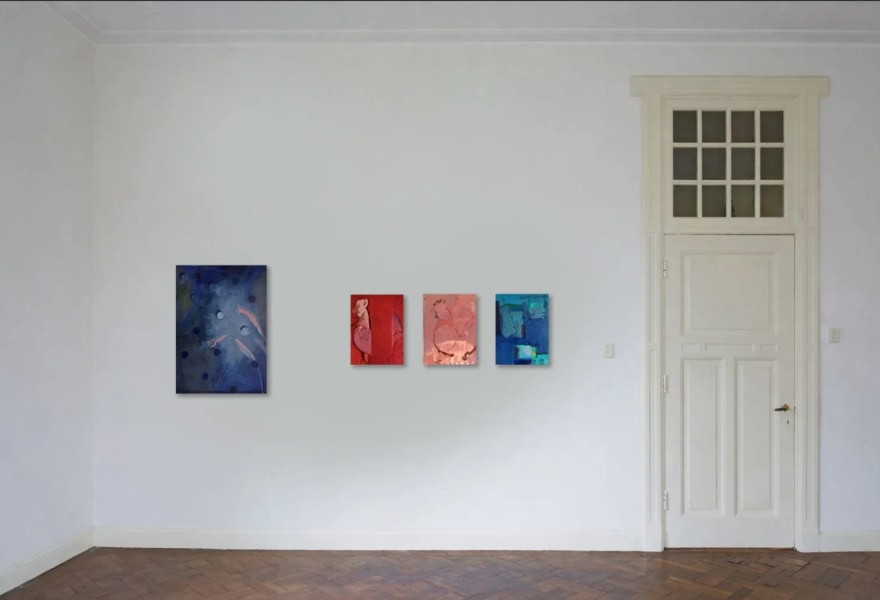
Catharina Dhaen lives and works in Sint-Niklaas, where she shares a studio with her father. Over the past ten years, she has steadily built a reputation with layered canvases in which she intertwines personal memories with everyday observations and fleeting impressions. In Dhaen's work, figuration and abstraction alternate continuously, balancing between the recognisable and the elusive.
Over the past year, Dhaen has taken things more slowly. She found inspiration in theatre and literature, which led her to revisit her archive with a different perspective. In doing so, she encountered work whose form she no longer identified with, while their content continued to resonate — and vice versa.
Dhaen processed that experience into work with reference to the 'ouroboros', the ancient symbol of a snake devouring its own tail. We spoke with Catharina Dhaen about her studio, her intuitive working method and the importance of 'in-between time' while painting.
Compositions in F, featuring work by Catharina Dhaen and Tosja van Lieshout, can be seen this weekend at the Yellow Gallery in Leiden. Dhaen's work will subsequently be on view at Art Rotterdam at the Yellow Gallery stand.
Where is your studio and how would you describe it?
It's quite special because I share it with my father. The studio is in a unique historic building, which is the coach house of the Salons for Fine Arts. It's located in a spacious, open garden with tall trees, a small oasis in the city centre. You hear nothing but birds and are surrounded by greenery.
I especially enjoy being there in spring and summer because I need warmer temperatures in order to paint. Otherwise, the oil paint won't dry. I view it as a laboratory where I can have paintings confront one another, take a step back and paint on a very large scale if I want to.
I'm visited here by collectors, curators, family and friends who are curious about what we create. During the cold of winter, I retreat to a room in my home. The format of my canvases and drawings adapts to that space: smaller, more intimate, with a sense of the shelter of home in them.

Catharina Dhaen, Pentimenti V, 2026, Yellow Gallery
Many painters say that natural light is a requirement for a good studio space. Others emphasise storage, the proximity of family and friends or views of greenery. What is absolutely essential for you in a studio?
What you describe sounds like a dream studio. For me, light and a sense of home share first place. I can paint in all kinds of light and often use a daylight lamp in the evening. But I would find it dreadful to see my work under artificial light only, no matter how good it imitates natural light. A studio needs windows, since they let both air and light in.
People often say a painter's studio should ideally face north, which is true, but I secretly love the changing light from other directions as well — those little patches of light and shadows that the sun cheerfully scatters around the studio. I even dare to capture those temporary passages in my work. The studio is my home. Over time, I've come to the conclusion that I'm not the kind of artist who leaves for the studio in the morning as if it were an office job. Life and work are closely intertwined for me; there is no longer any distinction between the two.
In the studio, I value 'in-between time': everything an artist does when they are not literally brushing paint onto a canvas. I want to be able to read in my studio, sit comfortably, reflect, take time, eat something, discuss things, rest. Some people forget that painting is more than just applying paint to a canvas.
Everything else — that 'in-between time' — is then supposedly not 'real' work. But that isn't true; such statements are driven by a fetish for productivity. I dislike the idea that time must always be used optimally and that something is only worthwhile if it inevitably results in a product, in something functional and efficient. Experience and connection then no longer matter. This stifles the creativity the world is actually longing for. I would even argue that the actual act of 'applying paint' probably doesn't take up the largest percentage of time, though I cannot say for certain because I've never measured it. In any case, doubting, scraping away and starting again, diving into a museum collection, studying books, researching a concept, preparing canvases, consulting peers and simply doing nothing at all for a while — all of these are an integral part of the creation process. The sum of all this 'in-between time' is essential to being able to create, so my studio must allow for it.
Suppose I were to do a day's internship with you. What would such a day look like?
I'm usually up early, often before the sun rises. For me, that is the perfect time to write with a fresh mind or deal with administrative tasks. As soon as it gets light, I settle into my studio. I paint until I leave for the academy, where I teach Painting and Drawing. In the evening, I determine what I need: either landing quietly after the many conversations and questions of the day or continuing to paint with full intensity.
Teaching gives my week structure, but the rest of the week proceeds more intuitively. That time can be quite tightly organised when an exhibition or project is approaching, but if possible, I prefer to be guided by impulse in the moment. Perhaps not the ideal circumstances to take an intern along for the day, but it's always surprising and exciting.

Catharina Dhaen, Ouroboros I, 2026, Yellow Gallery
Congratulations on Compositions in F! A number of the paintings shown are titled Ouroboros. I imagine not everyone knows what that symbol is. What is it and what inspired you to choose it?
Over the past ten years, I've been on a fast track. Projects have followed one another at a rapid pace and I've done a lot of exhibitions. I did all of this with tremendous passion and conviction and would do it all again without hesitation.
But in the meantime, the world is on fire and in my personal world, natural disasters have also unfolded. Over the past year, I deliberately slowed down and handled requests and proposals more thoughtfully. I resumed writing and immersed myself in theatre and literature. Inspired by that, I returned to my archive with a different perspective. This brought the realisation that there were many paintings whose form I no longer identified with, while the content continued to resonate — or the other way around.
In retrospect, I can see the connections more clearly and the larger fabric in which my works relate to one another. Ouroboros means the eternal cycle that feeds itself. You encounter this symbol in almost all cultures, from the Aztecs to ancient Greek philosophy, often depicted as a mythical snake devouring its own tail. I do not depict the ouroboros literally, but it is present in my working method. The older work nourished the new work, and it is wonderful to be able to draw so closely from these experiences, just like in theatre and literature.
I read that you incorporate a lot of autobiographical elements into your work. In two works from that series, we see the silhouette of a rooster. Is that a direct reference to your surname — and therefore to you as a person — or am I mistaken?
The elements or iconography that recur in my work are autobiographical in the sense that I have observed them and for specific reasons, decided to give them a place in my paintings. For example, I often visit archaeological museums. Out of the thousands of ancient objects collected there, it is precisely that one particular object that fascinates me. I feel as though I've found a needle in a haystack.
The little rooster is exactly such a find. It is an ancient Greek terracotta figurine I saw in Lyon and that moved me immediately. Such objects survive time because they are heavily charged with symbolism and therefore become timeless. The fact that the rooster was sacrificed to Asclepius, the god of medicine, and that it also refers to my surname, convinced me even more to do something with it. The floral motifs that recur in my newest work, on the other hand, can be found in Knossos and are based on more than 3,000-year-old Minoan frescoes of lilies and olive trees.

Catharina Dhaen, Ouroboros II, 2026, Yellow Gallery
In your work, abstraction and figuration alternate continuously. This suggests an intuitive approach. Can you tell us a bit about your method?
I do not work towards a final image and therefore never know beforehand what my paintings will look like. Those autobiographical elements we spoke about earlier may find their way onto the canvas at the beginning, in the middle or at the end of the painting process. As a result, they may appear somewhere along a spectrum of readability, or a spectrum between abstraction and figuration if you will.
A painting is a living process of becoming; I am composing. Doubting, destroying, starting again and making radical decisions are inherently part of it. To me, painting will never simply be the execution of a design. I do not force my painting consistently in one particular direction, because I shudder at the thought of routine and uniformity — I find that incredibly uninteresting. My paintings may take different forms of appearance. For my work, that feels like the right thing to do. In that sense, I feel an affinity with Philippe Vandenberg, who said: "There are so many painters living inside me." That is exactly how I feel as well.
In Leiden, you are exhibiting together with Tosja van Lieshout. Were you already familiar with her work and why did you decide to take part?
I did not know Tosja's work, but the freshness and positive character of the paintings appealed to me. I learn a great deal from seeing my work in new contexts and confrontations; it is my curiosity that drives me.
Suppose I were to give you carte blanche. Is there a project you would immediately throw yourself into?
That question fills me with ideas. I'm always fascinated by places that are steeped in history. A residency in a historically charged location would be fantastic, letting me immerse myself completely in the stories and specific peculiarities of the place. I have a real fondness for remarkable or even strange architecture. I always want to investigate it thoroughly and incorporate my discoveries into my paintings.
The challenge of letting my work enter into dialogue with such characteristic spaces keeps me alert. The idea of doing more applied projects also sparks something in me. I'm thinking, for example, about translating my visual work into another medium — textiles or ceramics perhaps. That might happen, but it doesn't necessarily have to become a unique artwork. I have only limited experience with it, but the idea intrigues me and perhaps such a project will cross my path one day.
The most concrete thing at the moment is that I would like to make a book again, a free space where my texts can enter into dialogue with my images. As you can see, I'm open to lots of things. I'd say, just ask me and perhaps we'll jump into the boat together.

Catharina Dhaen, Pentimenti I, 2026, Yellow Gallery
What are you currently working on?
A recent trip to Morocco really inspired me. I am now further exploring what I saw and experienced there. The geometry in the architecture fascinates me immensely; it represents the infinite fabric of the universe. It is something I had already engaged with earlier when I created a series of paintings in which I incorporated diagrams of spacetime. You will soon discover whether all of this is to become a more or less readable element in my work.
