10 march 2026, Wouter van den Eijkel
Bart Lunenburg: invisible Amsterdam
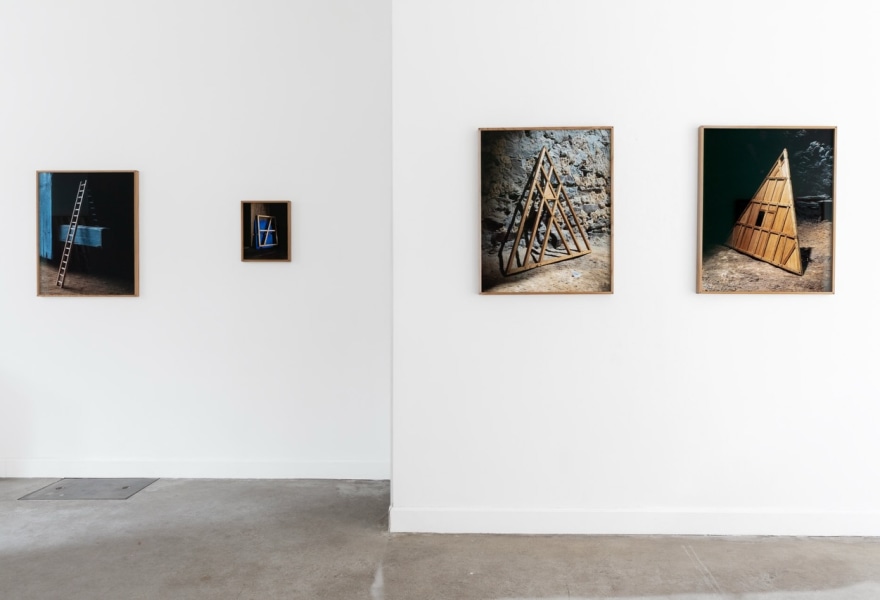
In his new series Oever (Shore, ed.), Bart Lunenburg turns his attention to the oldest parts of Amsterdam's historic city centre. Not the canal belt, but the wooden houses that were built 750 years ago. The timber architecture from the city's earliest days has disappeared from the streetscape. Yet many wooden structures have been preserved — they are simply no longer visible. They are hidden behind plastered ceilings and white walls.
Lunenburg researched timber construction, the supply of wood and the number of hidden building layers. He wrote Driftwood, an essay in which he discusses his research into timber-building traditions and urban development processes and translated the idea of multiple building layers into wooden wall sculptures. The works in the Oever series are a poetic reflection on the numerous incarnations a space can assume over the centuries.
As always, Lunenburg works with wood, but in Oever, the emphasis is not on freestanding sculptures made of solid timber, but on panels with veneer inlay. We see trusses and window sections in different colour schemes, created by oiling the veneer, suggesting the countless layers of paint and plaster that have accumulated over time.
We spoke with Bart Lunenburg about his new work, why he writes essays, the role they play in his practice, his residency in Germany and his participation in the Warmoes Biennale.
The Sound of Night Falling in the Other Room by Bart Lunenburg can be seen at Galerie Caroline O'Breen until 11 April. The essay Driftwood by Bart Lunenburg is published by Soft Concern Hard Concern and can be read online at MisterMotley.
Not every artist writes a 6,000-word essay — complete with footnotes — for a new exhibition or series. Why have you done so and what role do essays play in your work?
I have only been taking essay writing seriously for the past few years. I started doing it because during a research project, my head fills up with information and I have a great deal I want to say. If I put it down on paper, at least it exists somewhere, and afterwards, my mind is free again.
The research phase is an essential part of my practice, but recedes into the background once I start working. My work is abstract, which means that as a viewer, you might not always recognise certain references. The essays are also a way for me to share more information.
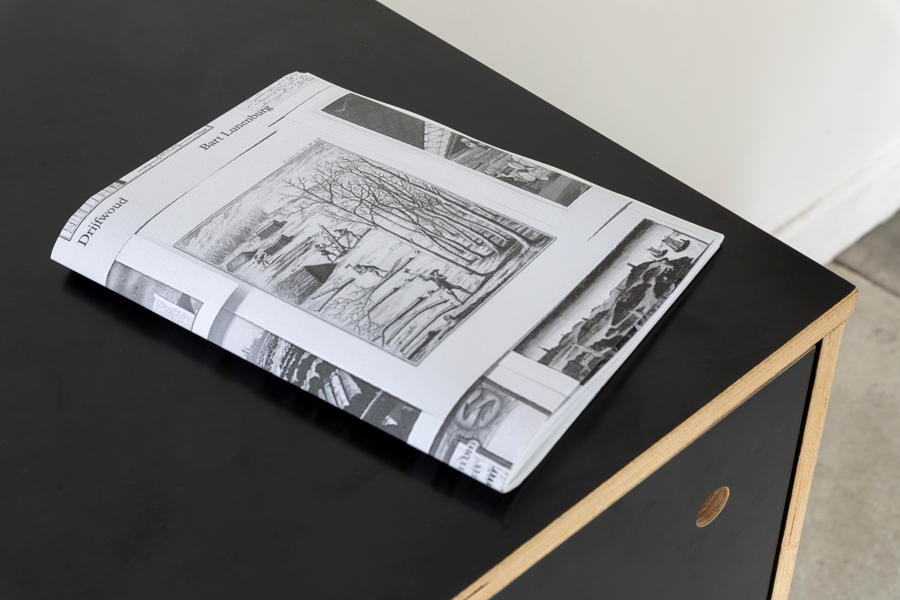
Bart Lunenburg, The Sound of Night Falling in the Other Room, Galerie Caroline O'Breen
What research question gave rise to the works in Oever, currently on view at Caroline O'Breen?
The Amsterdam Fund for the Arts awarded me a grant to research timber-building traditions in the city of Amsterdam. I wanted to find an answer to the question of how important wood has been for Amsterdam, a city that has no forests of its own.
The answer is fairly obvious. Wood was extremely important for the development of Amsterdam. The city was built on marshland — an inconvenient location, because building there requires foundations and therefore timber. You hardly notice it today, but day in, day out, we are supported by countless wooden structures.
Your research also brought you to Weilermattes in Rhineland-Palatinate, a small town in rural Germany where you did a residency. That is not the first place that comes to mind when it comes to Amsterdam's timber construction. What is the connection?
Yes, you might think there is a big difference between rural and urban architecture, but that is not really the case. Both rely heavily on wood, although it is less visible in the city. You tend to assume there is a contrast, but keep in mind that Amsterdam once began as a small settlement.
Initially, I intended to work on something else in Germany and continue my research on Amsterdam after returning home. But it turned out these regions have a historical connection. Much of the wood used for foundations in Amsterdam came from this part of Germany.
Is there such a thing as doing too much research? I can imagine that all that knowledge might become suffocating.
Personally, I enjoy working within a context, an all-encompassing framework within which I can make new connections in what already exists. At the same time, my work is speculative. After all, I am not a historian.
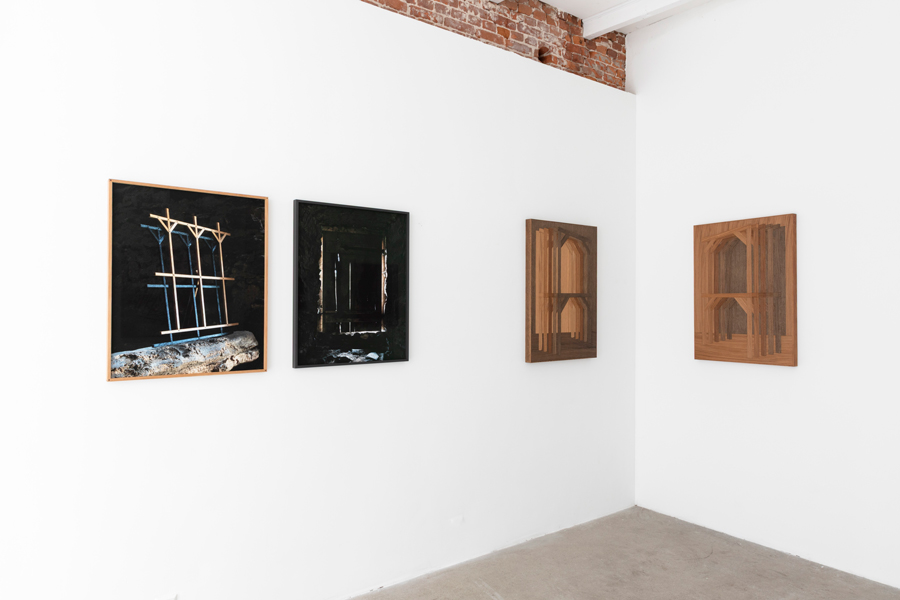
Bart Lunenburg, The Sound of Night Falling in the Other Room, Galerie Caroline O'Breen
The work in Oever is not the first series in which inlay appears, but it is the first time you have used this technique so systematically. Can you explain how you arrived at inlay and layers of colour for this new work?
My interest in inlay originated during a residency in Ljubljana a few years ago. I was staying at the home of the architect Jože Plečnik, whose name is synonymous with the formation of Slovenia, and his work is the wrought iron of Slovenian identity. The Slovenians have elevated this architect to the status of a genius.
Plečnik passed away long ago, but his spirit still lingers in those rooms. Inlay lends itself to something similar. It allows you to evoke the suggestion of a space that is not actually there — a trompe-l'œil effect through which you can summon a kind of animism in architectural scenes. I wanted to relate that to the timber structures in Amsterdam.
The Warmoes Biennale opens on 7 March. Artists will be showing work in 19 pavilions in and around Warmoesstraat. Your work will be shown at the Salvation Army on Oudezijds Achterburgwal. What can we expect?
I will be showing several works from the Oever series. They are larger and more irregular than the works currently on view in the gallery.
Why did you decide to take part?
I received an invitation from Bonne Suits to participate in the Biennale. It was a great opportunity because Warmoesstraat is one of the oldest streets in Amsterdam. Excavations have uncovered no fewer than 16 building layers there. That is not surprising if you consider that this area once lay directly by the sea, meaning the houses stood in marshland — which is why another nearby street is called Zeedijk.
All sorts of materials were used for those layers and foundations, from older foundations to vaults taken from ship hulls. In effect, you are dealing here with a house within a house. Or put differently, a house that carries other houses. It is a kind of architectural ghost. A house is not a fixed entity, but an assembly of layers and times, with wood from various parts of Europe. By oiling the veneer, you can work almost like a painter and visualise those layers of time.
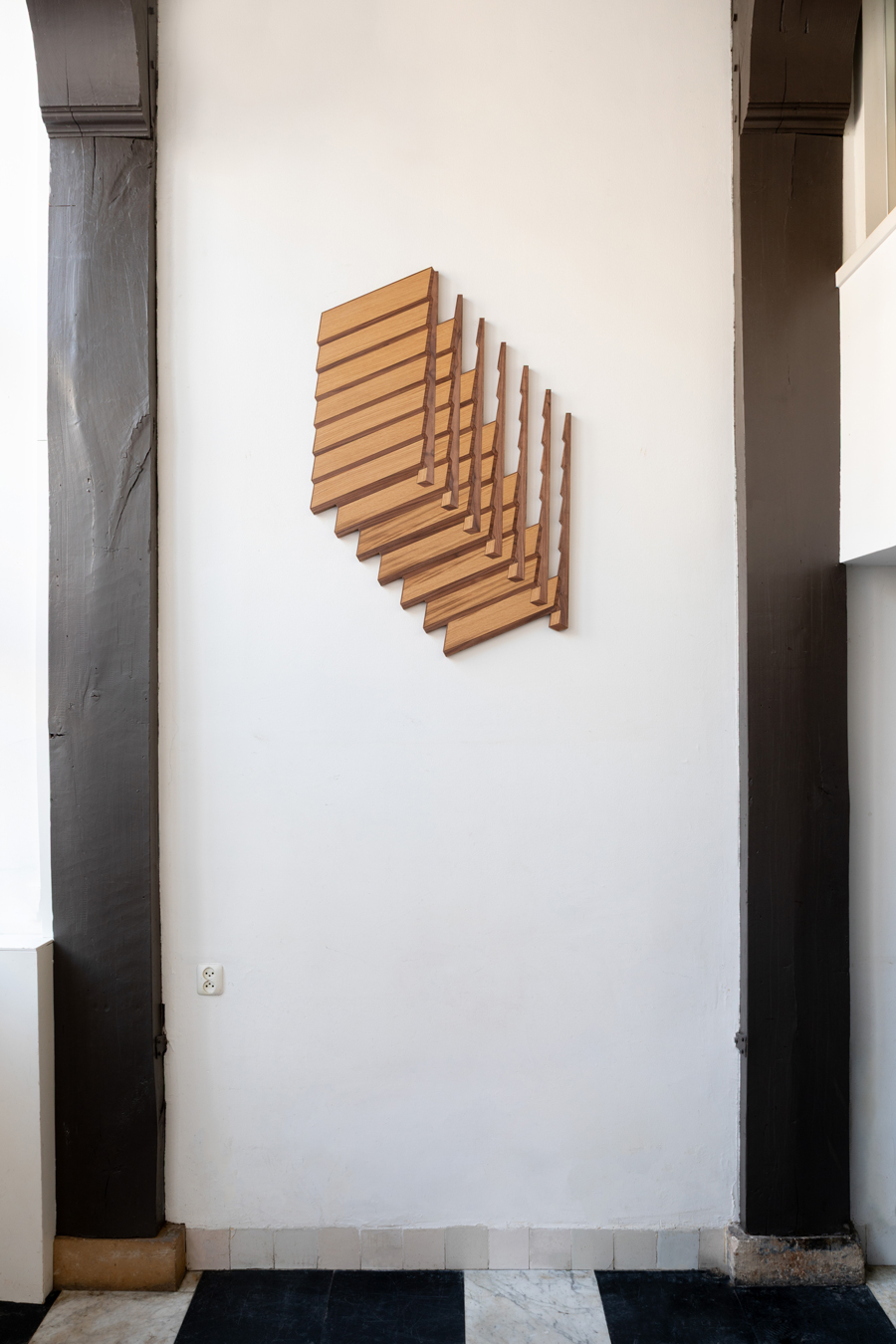
Bart Lunenburg, Warmoes Biennale
The Warmoes Biennale runs until 3 May in and around Warmoesstraat in Amsterdam.
