06 march 2026, Emily Van Driessen
Notwendige Formen by Horst Linn at Hilde Vandaele Gallery
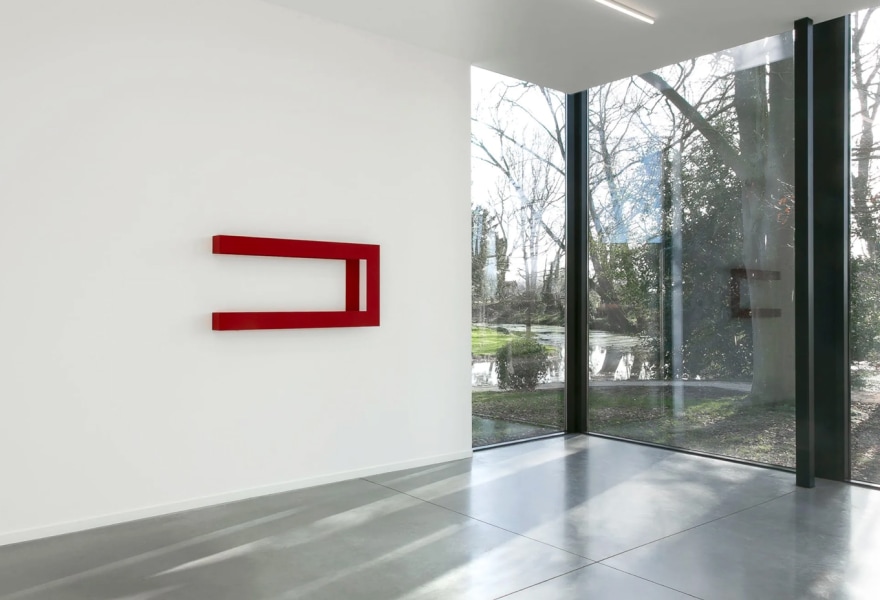
With minimal interventions, clear angles and taut arcs, the artworks of the German artist Horst Linn (1936–2025) take hold of the gallery space at Hilde Vandaele Gallery in Watou. Just as Linn worked meticulously with ruler, compass and set square to shape his simple yet complex spatial configurations, the new exhibition Notwendige Formen presents a precise curatorial exposition of Horst Linn's oeuvre.
First and foremost, Linn is a sculptor. He thinks and works in three dimensions; everything else is subordinate to this. To preserve this fundamental three-dimensionality in the reading of the exhibition, the text departs from three cornerstones within his practice.

Horst Linn, exhibition Notwendige Formen, Hilde Vandaele Gallery
Form as notwendige action
The word notwendige carries more meaning than its English translation "necessary." The German term contains movement within it, a turning, a shifting, that resonates strikingly with Linn's concentrated material actions. Linn cuts, folds, creases, kinks and bends flat sheets of aluminium, steel or copper into spatial configurations.
A rectangle is kinked, a plane is folded and gains depth, a profile is twisted and opens itself to space. In doing so, he approaches industrial metals (still highly experimental in the 1960s) as materials with their own laws and resistance. With minimal interventions he constructs forms that arise out of necessity, presenting themselves as the only correct solution within the logic of their own construction.
Importantly, Linn almost always works in series that build upon one another. Angles shift by only a few degrees, while proportions change deliberately but minimally. Colours are applied by hand. With acrylic paint he introduces a clear sense of sensitivity into an industrial formal language.
In contrast to the Zero artists, whom Linn also joined, and for whom reflection and the effects of light were central, Linn was not interested in the optical theatricality of light but rather in the more abstract notion of the inevitability of material intervention. The result is a sculptural language in which thinking and acting proceed solely from the necessity of the material itself.

Horst Linn, Arrivée, 2006

Horst Linn, À Gauche
Space as an active partner
For Linn, space is a highly determining element. Walls, corners, the incidence of light and distance all determine the legibility of his artworks. Shadow extends the physical form of the works and reinforces their spatiality. In some cases this attunement to space is pushed so far that it assumes an active role for Linn, causing his sculptural objects to leave their conventional genre: neither classical reliefs nor freestanding sculptures. They become constructions that stage their own forms in situ.
In his chrome steel reliefs from the 1970s, spatiality is constructed through a linear base fold within which smaller creases articulate the tension between the inner structure and the wall. In the works made of folded sheet iron, the profile objects and wall reliefs, he lets planes leap forward and recoil again. In this way, the third dimension of the sculptural object is often perceptible only through the shadow in space as one physically moves around it. Through openings he develops a visual language that fully disorients. The viewing angle in space determines whether the objects are interpreted as squares or as rectangles.

Horst Linn, Controvers Bordeaux

Horst Linn, Torsion S-1
Radical simplicity as the highest complexity
The title Notwendige Formen positions Linn's work formally while also giving it a philosophical undertone. In German philosophy (Kant, Hegel, …), the concept of Notwendigkeit refers to that which does not arise by chance. It follows from an unavoidable development.
This idea also underlies modernism, of which Adolf Loos (1870–1933), the Austrian architect and architectural theorist, was a founding figure. Loos is best known for his essay Ornament and Crime (1908), with its radical rejection of ornament because he considered it superfluous.
In Linn's oeuvre we likewise see a reduction to the essence: a formal austerity, systematically rational compositions, the absence of narrative, and a focus on structure over expression. His radical simplicity is the end point.
Yet this simplicity is not closed. In that sense Linn's vision aligns with what Loos's essay calls "a double obstinacy": a kind of independent position on two fronts simultaneously. In Linn's case this means that the gaze of the artist, who reduces form to its necessary minimum, is essential, but equally important is the obstinacy of the viewer, who, in confronting this reduction, activates their own perception and opens the form within space.

Horst Linn, exhibition Notwendige Formen, Hilde Vandaele Gallery
Notwendige Formen can be seen at Hilde Vandaele Gallery in Watou until 12 April. The exhibition was realised in collaboration with the gallerists Anne Voss and Frank Hendrickx.
