26 february 2026, Wouter van den Eijkel
Maja Daniels: Gertrud at Galerie Wouter van Leeuwen
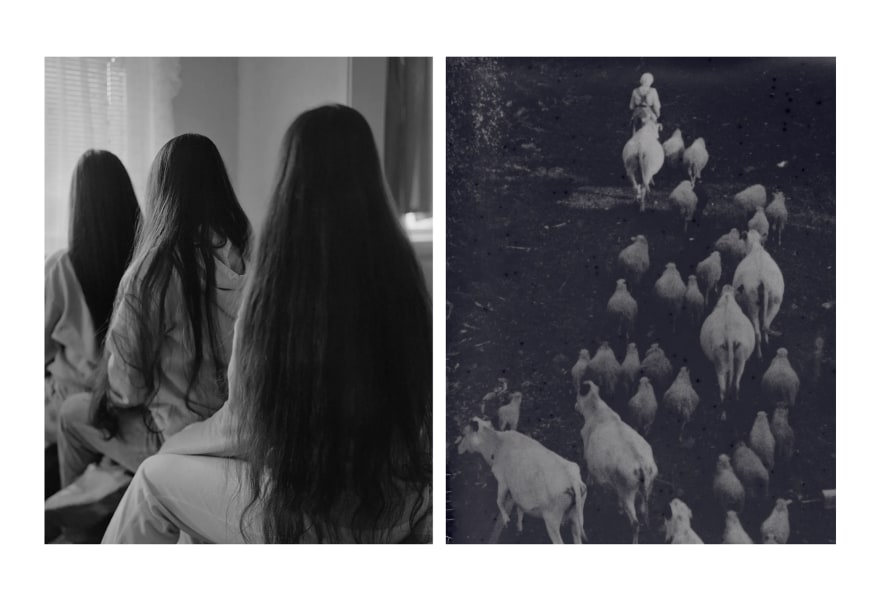
Gertrud, or how an argument over a sandwich can still reverberate centuries later. That may well have been the full title of the book Gertrud. In 1667, a nine-year-old boy named Mats accused a twelve-year-old girl, Gertrud, of witchcraft. He claimed he had seen her walk on water. Shortly before, they had argued over a sandwich.
The consequences were immense. The boy's statement marked the starting point of a period of witch hunts in Sweden. Over the course of eight years, 300 people were sentenced to death for witchcraft. The period is considered a dark chapter in Swedish history and Älvdalen remains synonymous with witchcraft and the occult in Sweden to this very day.
Maja Daniels' family comes from Älvdalen. With the award-winning Elf Dalia (2019) and Gertrud, she aims to reshape perceptions of this community. She does so using uncanny archival imagery and a narrative of resistance. According to Daniels, myths are always fluid and can therefore be changed by adding new images to the narrative – which is precisely what Daniels does.
Gertrud by Maja Daniels can be seen at Galerie Wouter van Leeuwen until 28 March.

Maja Daniels, Gertrud, Galerie Wouter van Leeuwen
A view of the world
Everyone in Sweden is familiar with Älvdalen. That is a bit odd, given that it is a remote hamlet some 350 km northwest of Stockholm surrounded by mountains and forests. The reason it is so widely known lies in the statement of nine-year-old Mats and everything that followed.
Before becoming a photographer, Maja Daniels (Sweden, 1985) studied sociology — not to answer grand questions, but to question the status quo. History with a capital H, as she calls it, the narrative accepted as uncontested truth. Like her previous book Elf Dalia (2019), Gertrud takes place in Älvdalen, where her family originates from.
Älvdalen became synonymous with witch hunts. Daniels counters this stigma with a different image — a story of resistance. The local language, Älvdalish, for instance, is closest to Old Norse, the language spoken by the Vikings and therefore attracts scientific interest. Historians and linguists cannot explain how this language survived. A rational explanation is lacking, as the local economy depends on trade with outsiders for survival. For Daniels, Älvdalish is therefore more than a language; it is a worldview, a form of resistance by the periphery against the centre of power.

Maja Daniels, Gertrud, Galerie Wouter van Leeuwen
Separate worlds
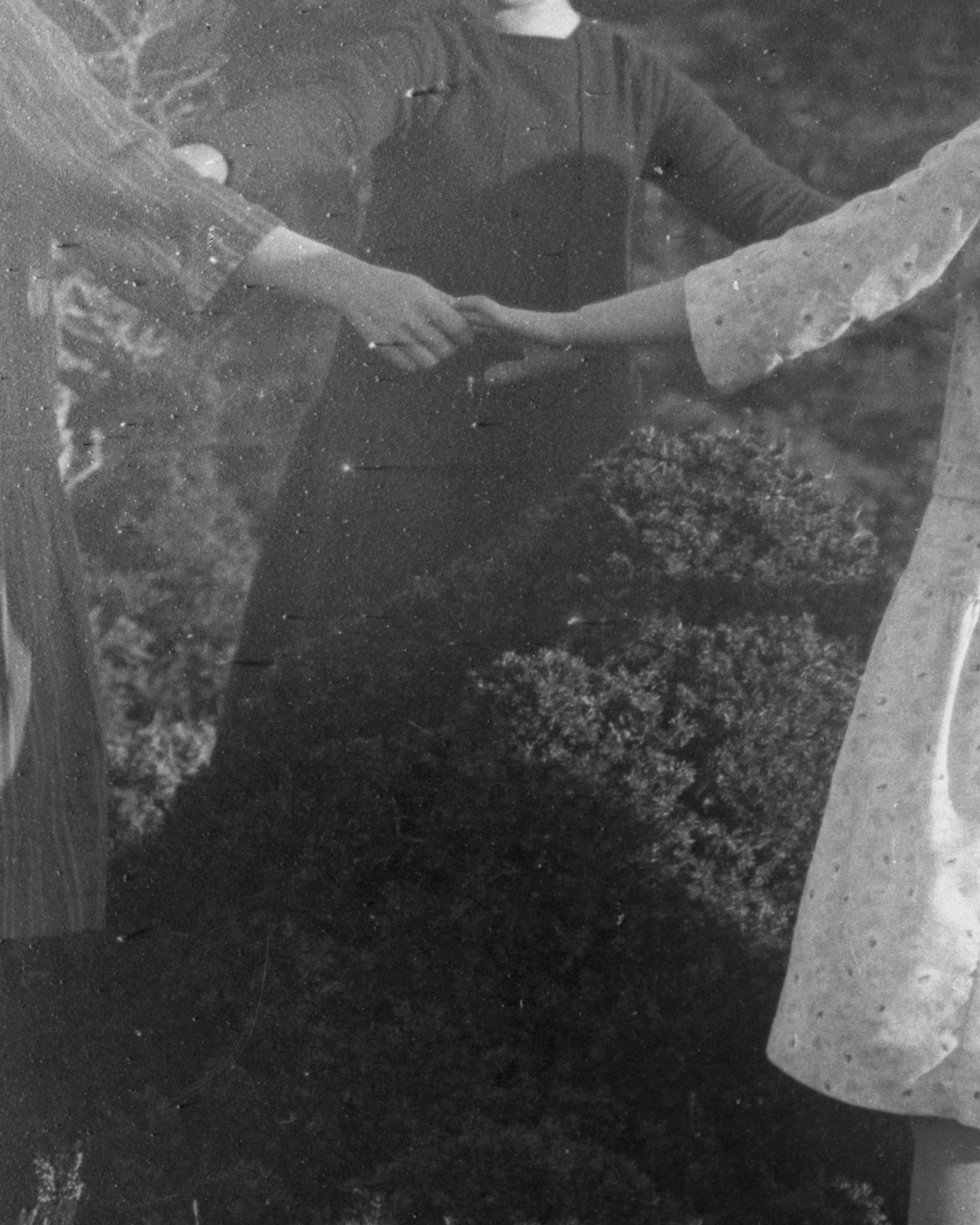
In Gertrud, Daniels once again engages in dialogue with the glass negatives from the archive of Tenn Lars Persson (1878–1938), a local amateur photographer, scientist and inventor with an interest in magic. Persson's early experimental photography produced, alongside glimpses of daily life, uncanny images. In one photograph, two men float in the air. In another, two women sit on a crescent moon. The book also includes a photograph of villagers wearing pig-head masks.
Partly for this reason, Daniels' work recalls True Detective, the police series about occultism in rural regions such as Louisiana and Alaska, yet set in a forested environment reminiscent of Hilma af Klint. This impression is reinforced by the fact that Persson photographed in the early twentieth century when the occult — such as a belief in witchcraft — and science were not yet strictly separate worlds. Both were forms of knowledge, but distinctions or hierarchies between them, especially in rural Sweden, were not yet firmly established.
By combining Persson's images with her own work in colour and therefore partly returning to the early twentieth century, Daniels makes it possible to question the status quo anew. One question that naturally arises while viewing her photographs is whether we look at forests with an overly economic perspective. Is a forest merely a collection of trees and shrubs intended for logging and consumerism or also a mysterious place where alternative, occult ideas can exist?
"Myths are open to interpretation," Daniels claims. "As are photographs. The essence of what is visible is often invisible and lies in unspoken associations." A myth or dominant view can therefore be changed by adding new images to it.
The photographs from the Gertrud series invite association. Like Persson, Daniels' images span the spectrum from the everyday — we see residents at home, with their families or by the lake — to the occult and supernatural. The latter appears not only in the subject matter, but is emphasised through long exposure times that produce light trails. She also allowed light leaks, creating an occasional orange glow. As a result, the images do not immediately reveal themselves. To read them requires effort and personal interpretation.
Maja Daniels, Gertrud, Galerie Wouter van Leeuwen
Collotypes
In 2024, Maja Daniels won the prestigious Benrido Hariban Award. Established in 2014, the prize aims to draw attention to collotype printing, a nineteenth-century process using glass negatives and known for its rich pigmentation.
The winner gets to spend two weeks in Kyoto and have their work printed with Hariban's master printers. Several of these collotypes are on display in the gallery. The depth and softness of the brown tones combine exceptionally well with the mysterious environment presented by Daniels.

Maja Daniels, Gertrud, Galerie Wouter van Leeuwen
