20 february 2026, Emily Van Driessen
The Importance of Soil at Working Title Gallery in Amsterdam
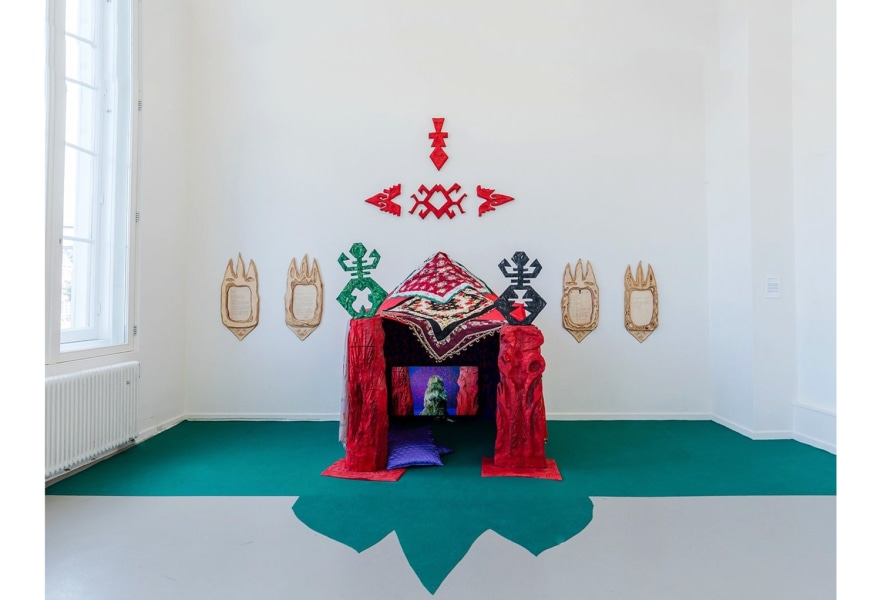
Soil is a fertile entanglement, the condition for life itself. It is within this shared ground that Müge Ylmaz (°1985, Turkey) and Sophie Steengracht (°1991, the Netherlands) meet in the duo exhibition The Importance of Soil at Working Title Gallery in Amsterdam.
Ecofeminism runs through the exhibition as an undercurrent, rooted in the understanding that the oppression of women and the exploitation of nature are results of the same patriarchal, capitalist structure. The exhibition is a layered narrative, like strata of soil, showing, among other works, Ylmaz’s striking new video installation A Brief History of Naturalisation (2026). With the single line “the wild tulip was never native”, the work anchors its intention and draws a parallel between the artist’s journey towards Dutch citizenship and the historical migration of the tulip to the Netherlands.
To introduce the artistic practices of both Ylmaz and Steengracht, what follows is a selection of three artworks that use organic pigments and subtly foreground the importance of soil.
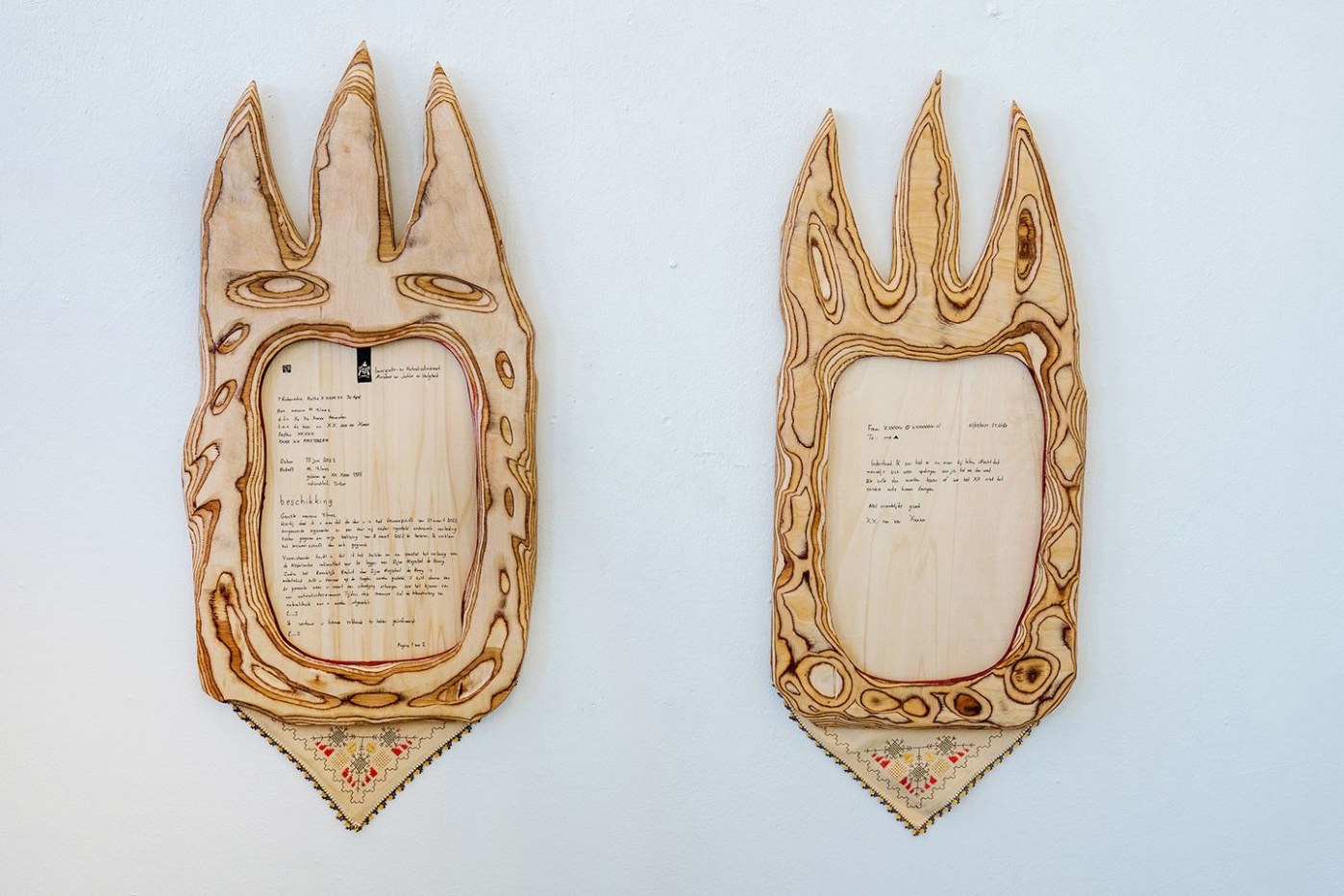
Müge Ylmaz , A Brief History of Naturalisation, 2026, Working Title
Müge Ylmaz, Inanna (2024)
Parts of present-day southeastern Turkey were historically part of Upper Mesopotamia, often referred to as the “cradle of civilization”. Many mythologies took root here, of which many centred on powerful female figures. In her practice, Müge Ylmaz reactivates ancient Anatolian goddesses, rearticulating them within a contemporary visual language, as exemplified in Inanna.
This work could be read as a contemporary translation of the Burney Relief (also known as the Queen of the Night relief), dated between 1800 and 1750 BCE. The relief originates from southern Mesopotamia and still bears traces of red pigment on the figure’s body, evidence that it was once fully coloured.
The most significant shift lies in the contemporary material methods that Ylmaz uses. She combines computer-controlled CNC cutting with hand wood carving to realise the work. The artist’s choice of material is equally compelling. Birch wood is organic, once living matter. Plywood, by contrast, is laminated and industrially engineered. The sculpture carries within it a layered tension between the natural and the constructed. Ylmaz also retains the use of organic red pigment, subtly referencing the traces found on the original relief.
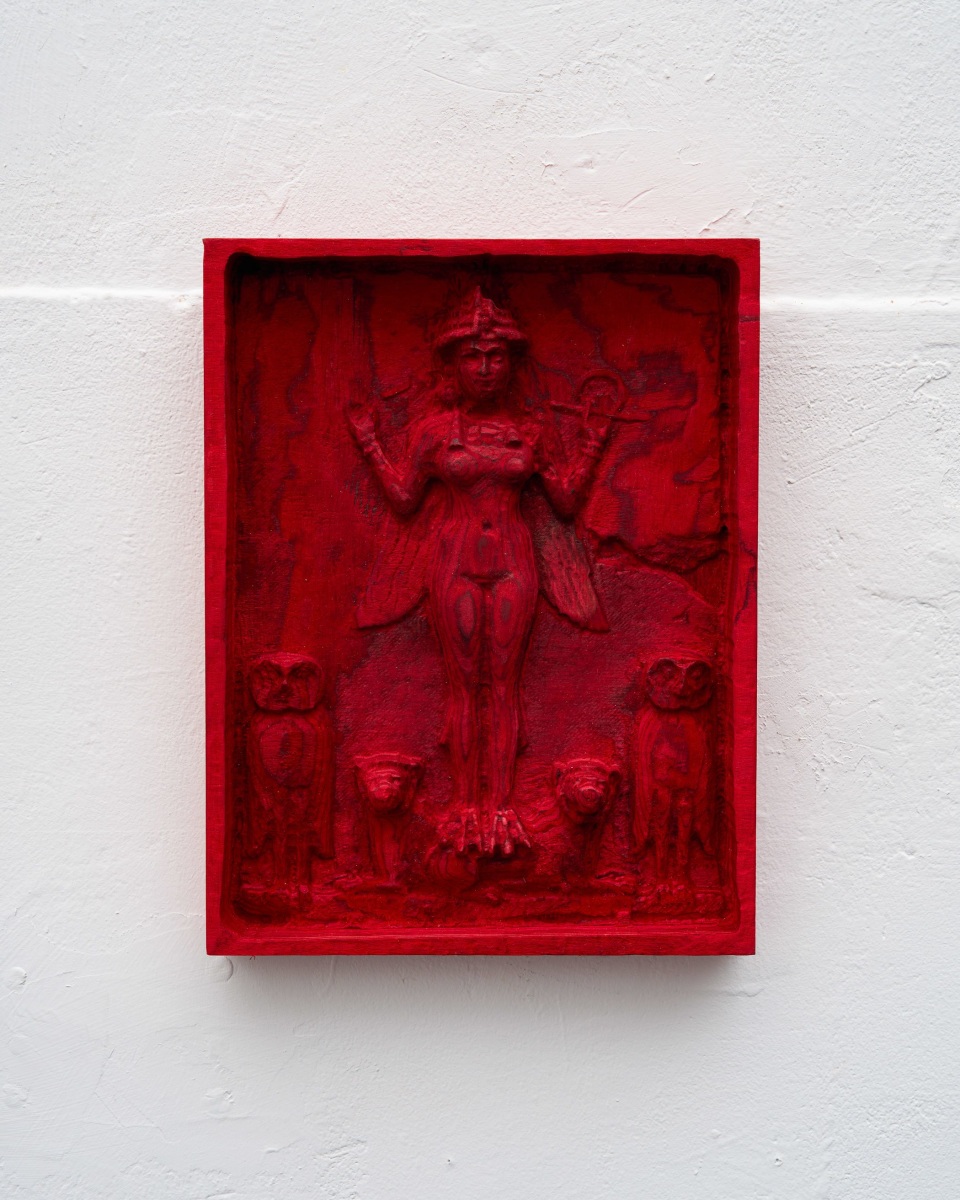
Müge Ylmaz, Inanna, 2024, Working Title
The work depicts Inanna, the goddess of opposing forces: of love, sexuality and fertility, yet also of war, power and political authority. In one of the most enduring myths, Inanna descends into the underworld. At each gate she is required to leave behind something, until she stands naked and stripped of status. She dies symbolically, only to be resurrected thereafter.
The myth is often read as a cycle of death and rebirth. Ecofeminism reclaims precisely this cyclical, non-linear system in opposition to the capitalist, phallocentric construct of vertical growth. And in this artwork Ylmaz turns to a pre-monotheistic goddess as an example of an alternative symbolic world order, one that predates the dominance of strongly hierarchical, patriarchal monotheistic systems.
Sophie Steengracht, Mycchoriza (2026) & Microcosm (2026)
Steengracht captures the earthly using botanical and mineral pigments she harvests herself, applying them to linen. For this series, she draws inspiration from the book Entangled Life by Merlin Sheldrake, which explores the interaction between complex networks of fungi and plant roots.
Mycorrhiza literally means “fungus-root”. It describes a symbiotic partnership between fungi and plant roots. Through these interdependent underground networks, plants gain increased resilience as nutrients are properly redistributed. Forest ecologies are thus sustained as collective systems. For this reason, such fungal networks are sometimes referred to as the “wood wide web”.
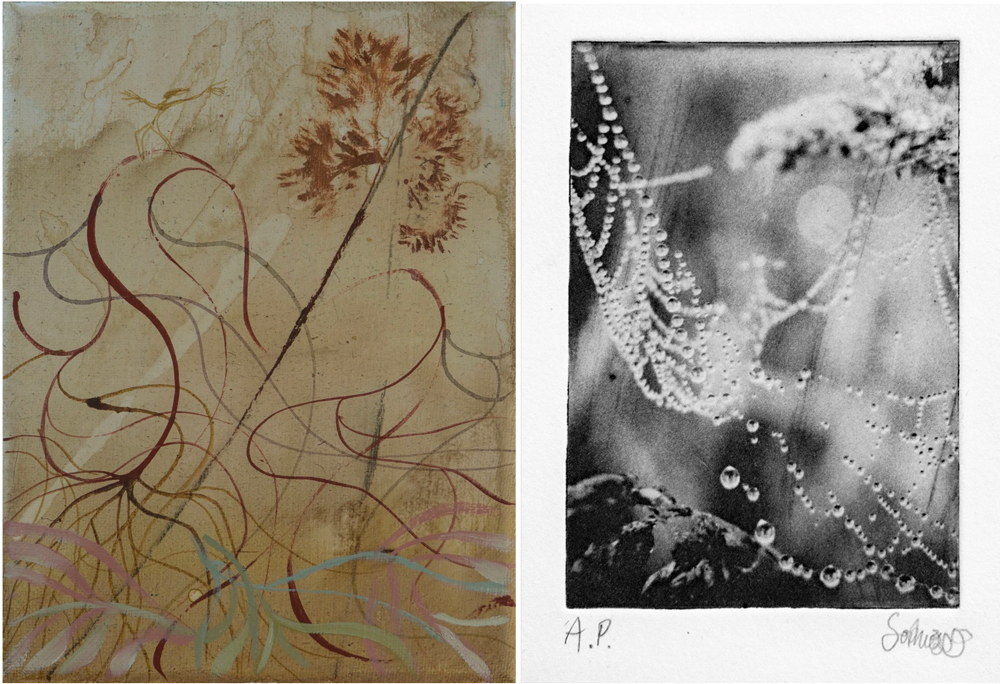
Sophie Steengracht, Mycchoriza, 2026 & Microcosm, 2026, Working Title
Within an ecofeminist framework, Mycorrhiza can be read symbolically as a preference for a horizontal, interdependent, earthly network that acknowledges non-human intelligence, instead of a vertical system that promotes individualistic progression.
In this context, Microcosm becomes an equally resonant and enticing title and artwork. The term refers to a miniature system that mirrors the structure of a bigger system. In the artwork, this idea is visually illustrated: each droplet may reflect an entire landscape, while the web itself resembles a network whose pattern repeats at different scales.
The exhibition The Importance of Soil is on view at Working Title Gallery in Amsterdam until Saturday 22 March.
