23 january 2026, Flor Linckens
Movement as a starting point: René Groebli in Bildhalle
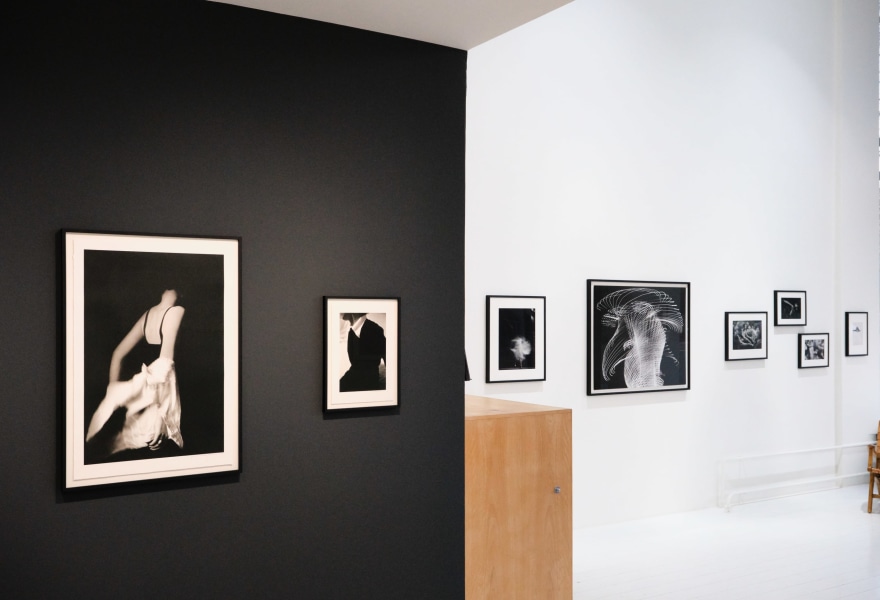
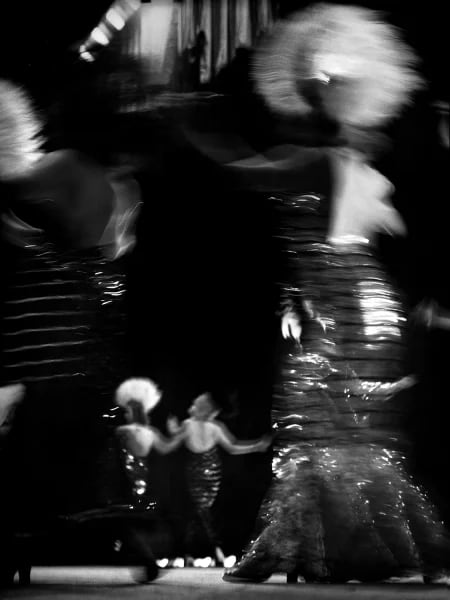
With the exhibition ‘Movement’, Bildhalle presents a telling cross-section of the oeuvre of Swiss photographer René Groebli. The title refers not only to his recurring motif of physical movement, but also to his way of working: a practice that continually develops and reshapes itself. Time and again, Groebli searches for ways to bring time, emotion and dynamic movement together within a single image. The exhibition can be viewed online on GalleryViewer and in person in Zurich until 31 January 2026.
Groebli was born in Zurich in 1927 and trained as a photographer in the 1940s at the Zurich Kunstgewerbeschule, where he studied under Hans Finsler. The art world of post-war Switzerland was marked by the coolly objective and tightly ordered visual language of Neue Sachlichkeit, The New Objectivity, a sober reaction to the expressionism of the preceding period. For Groebli, this approach left too little room for his own, more intuitive and movement-oriented way of looking. He quit his studies and instead obtained a diploma as a documentary cameraman at Central Film and Gloria Film in Zurich, where he developed the eye of a filmmaker. Yet here too, he missed space for personal expression and he soon realised that his interest lay elsewhere: in capturing the elusive qualities of speed, chance and a subjective experience of the world around him.

With the money he earned from his first freelance assignment, Groebli made his first trip to Paris in 1948, which inspired his first photobook Magie der Schiene in 1949. In it, he captured industrial power in grainy, cinematic images shaped by smoke, rhythm and motion blur. At the same time, he paid close attention to human details: a sleeping traveller, a head leaning out of a train window. The series reflects a new, personal and more expressive approach to the medium that would only be fully appreciated at a later stage. Groebli was just 22 years old at the time.
In the early 1950s, Groebli worked as a photojournalist for international magazines and agencies, which meant he travelled extensively. At the same time, one of his most personal series took shape: "The Eye of Love", a tender, gentle and carefully orchestrated visual essay of his honeymoon with his wife Rita. The series largely unfolds in their hotel room in Paris, which effectively turns into an intimate, shared space. We see a nude silhouette, the line of a shoulder or a collar, a transition from light to shadow, without reducing Rita to a sexual object. The book caused some controversy at the time due to its explicit imagery by the standards of the period, but it is now regarded as a milestone within the genre.

In 1954, Groebli was admitted to the Council of Swiss Photographers and a year later his work was shown at the MoMA in New York for the first time, in the exhibition ‘The Photographer's Eye’. That same year, he opened his own studio for advertising and industrial photography and specialised in complex colour photography processes. He also published several texts about that topic. Yet Groebli did not use colour merely as a means of registration, but also as an autonomous visual material. When colour processes became faster, simpler and more affordable in the 1970s, he rediscovered his fascination with black-and-white photography. In 2015, Groebli received a Lifetime Award from the Swiss Photo Academy. He continues to live and work in Switzerland.
What makes Groebli’s practice so distinctive is its versatility and the new ways he continually found to express himself. Driven by intuition, curiosity and experimentation, he responds to the energy of the subject he captures. His work cannot be confined to a single genre, period or technique. The exhibition ‘Movement’ at Bildhalle invites us to engage with this versatility, precisely by offering a broad and layered view of his practice.

Groebli’s oeuvre has previously been shown at institutions including the MoMA, Fotomuseum Winterthur, Tate Britain, Centre de la Photographie in Geneva, Kunsthaus Zurich and at the Rencontres Internationales de la Photographie in Arles. His work has been included in the collections of the MoMA, the Maison Européenne de la Photographie, The Museum of Fine Arts Houston, Museum Folkwang and the FMAC Collection d'Art Contemporain Ville de Genève.