30 december 2025, Martine Bontjes
The studio of... Octavie Wolters

From her studio on the edge of Roermond, Octavie Wolters works on her animal worlds. In her latest linocuts, currently on view at Gallery Untitled, her familiar birds are joined by hedgehogs, badgers and a vixen. The central character in this series is “Haassie” a little hare that symbolises a sense of safety and security. The linocuts were made for her newest book “Jij bent mijn begin” [You are my beginning]. In this book Wolters offers an ode to the warm feeling of the nest. That longing resonates through every print: the quiet promise that you are allowed to belong somewhere.
The character of Haassie is based on a toy hare that Wolters received from her aunt when she was a small child. It symbolizes her own childhood, a feeling of safety that she wishes to pass on to others as well: “I made the book to offer everyone the warm feeling that Haassie embodies.”
The exhibition “Jij bent mijn begin” can be seen at Gallery Untitled in Rotterdam until 18 January 2026.
Where is your studio and how would you describe this place?
I have a studio at home on the edge of Roermond. We searched for a long time for a house with a large workspace and three years ago we finally found this place. It is a space that fits me perfectly with a large gate that I open every morning which is my ritual. I have a separate room for my printing press and sink and two large storage rooms. One wall functions as a gallery wall where I display my most recent works. I have bookcases for all the books I have made and their translations a very large paper cabinet and a drying rack for all the linocuts. Scattered throughout the space are large colorful objects that I have sawn myself. It is a packed workspace but an incredibly pleasant place to be.
You have been through a turbulent period due to an optic nerve infarction. Now that you are back working in your studio, has your way of working changed?
About four months ago I woke up and had partially lost the sight in my right eye. That loss is permanent and will not improve. The past months have been about finding a new path and learning how to live and work with impaired vision. I am doing well because the infarction coincided with finishing my new book so I did not have to return to work immediately. I could calmly explore how my vision had changed and what that meant for my work. What I feel now is an even greater urgency to make. If something were to happen to my other eye as well I want to work through all the ideas in my head as quickly as possible. There is still so much to imagine.

Octavie Wolters, hazenslaapje, 2025, Gallery Untitled
How do you remember everything that catches your attention in nature?
In my linocuts I do not work in a highly naturalistic way. I create an image that reflects my interpretation of what I see and what I feel. When I am in nature I mainly look at lines and how they connect to my emotions. That is what interests me and what I want to convey because that is where my communication with the audience lies. Sometimes I do need a point of reference of course. If I want to make a bird in lino the anatomy has to be correct. For that I take photographs or look up images and then I give it my own interpretation.
You carve many organic forms in your linocuts from fur to grass and feathers. Do you use specific tools or techniques to achieve that delicacy?
I use very simple gouges. My favorite tools are the cheapest ones available. I do own more expensive and advanced tools but I prefer to work with the most basic ones. For the printing plates I do not use traditional linoleum but a kind of synthetic material. It is more flexible than old lino and suits the shapes I want to create: flowing and undulating.
In earlier works you focused on wild birds but in this new series we see many more animals. Is there a favorite animal you most enjoyed working on?
I love everything with fur and feathers and I could not choose. Every creature has its own appeal. I feel it is my task to highlight that and to render it, so others can see its beauty as well.
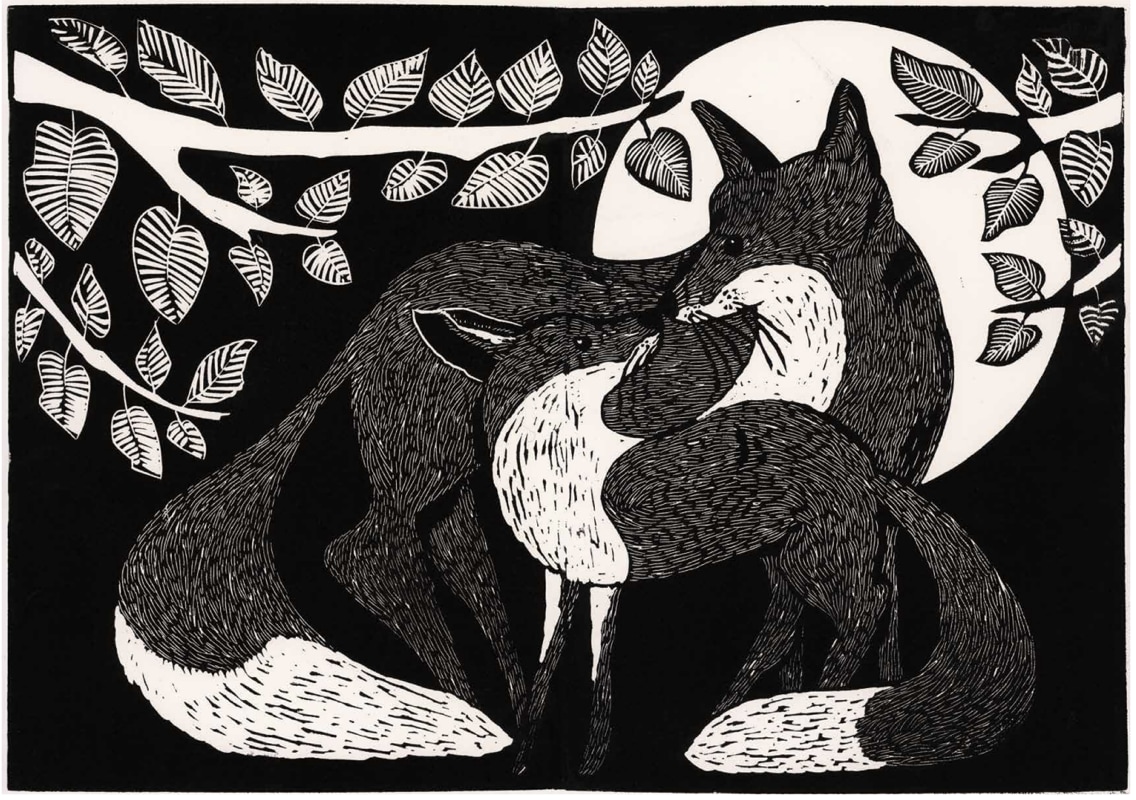
Octavie Wolters, de vossenmoer en haar jong, 2025, Gallery Untitled
In your new exhibition the character of Haassie takes center stage. Why did you choose this little hare?
The work is really an ode to the warmth I feel in my own nest. I am very aware that this warmth and sense of shelter are not self-evident for everyone. I have had my stuffed toy hare Haassie since I was two years old and it symbolizes my childhood. I made the book to offer everyone the warm feeling that Haassie embodies.
Haassie travels through the seasons. What do those seasons symbolize?
In the story of “Jij bent mijn begin” the parent child bond is central. Haassie wonders where he comes from and his parents tell him that everything that lives starts from spring, so he goes in search of it. He travels back in time through winter, autumn, summer and finally arrives in spring. He journeys toward his own origin and there he sees his parents again and feels: I am where I began.

Octavie Wolters, haassie en de egel, 2025, Gallery Untitled
Is there an animal you have never seen but dream of encountering in real life?
No I am perfectly content with the most ordinary animals. A blackbird makes me just as happy as a rare species. I am not someone who hides in the bushes with binoculars to spot unusual animals. I love animals because they move or soften me. A simple sparrow looking at me from the wall in front of my studio can make me profoundly happy. I need nothing more than that.
What are you working on at the moment?
I always let my work develop organically. I never work on commission and I make whatever comes to me. Only after I have been working one something for a while, I start to consider whether it might lead to a new book or a new series. I let the images tell the story and then I continue from there. I am now in a phase where I am stepping away from lines and sharp contrasts and moving more towards color and color combinations. It feels as though I am discovering a new code through color. Perhaps it has something to do with my eye, I do not know. It does not really matter. I let myself be guided by my own desire to make and then I see what emerges.
