16 december 2025, Martine Bontjes
The studio of... Tian Teng
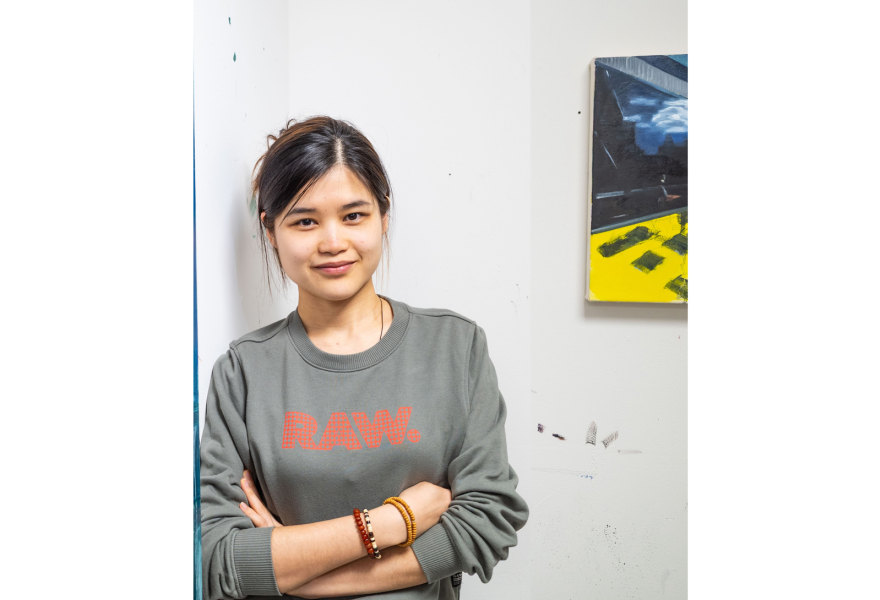
The Chinese artist Tian Teng travels between Utrecht and Shanghai. She maintains a studio in both cities where she creates her vibrant oil paintings. A recurring theme in her work is an everyday yet revealing subject: the windowsill. Teng is fascinated by these carefully composed still lifes: “There is an openness to showing a little bit of one’s interior life and at the same time inviting the gaze of the passerby.” Plants, lamps and seasonal decorations, all those small gestures add personality to otherwise ordinary streets, she explains. Her windows can be seen until 10 January 2026 in the group exhibition "Boundaries: The Coping Individual" at Namuso Gallery in The Hague.
Teng’s work is also currently on view in the exhibition "THUIS. Het thuisgevoel in hedendaagse kunst" at Museum Rembrandthuis, where thirteen contemporary artists explore what it means to feel at home. “Showing my work in a place so deeply connected to Dutch art history made me reflect on how contemporary interior scenes continue a long tradition of observing everyday life.” This exhibition is on view at Museum Rembrandthuis until 4 January.
Where is your studio and how would you describe this place?
After completing my BA in the Netherlands, I set up my studio in Utrecht, which stayed my base even while I was doing my MA in London. Now that I’ve returned, it still feels like the centre of my practice. I recently opened a second studio in Shanghai, where I was born and where my family still lives, so dividing my time between both cities feels natural. Being an artist gives me the freedom to move between places, though it also means paying double the rent so I can paint wherever I happen to be. Despite their different locations, both studios play the same role: they are places where the outside world softens and I can fully dive into the work. This is where I slow down, reflect, and let ideas unfold, and where I translate my thoughts into pigment. Most simply, they are the birthplace of all my paintings.
Is there a particular scent or sound you like to have around you while you work?
There is always a strong smell of oil paint in my studio, it’s unavoidable. To soften it, I keep a few plants for air purification and open the windows whenever the weather allows. The smell feels the strongest only in the first few minutes; after that it fades, just like how you stop noticing your own perfume halfway through the day. I simply remind myself: give it five minutes, and the room becomes part of the work. What I listen to depends entirely on my mood. Some days it’s music; other days, it’s a series I’ve already watched countless times, playing in the background like a familiar companion. Sometimes I prefer no sound at all, just the quiet of the studio.
Do you have any rituals for ending your day in the studio?
I wash every brush one by one until it looks completely new and I wipe my palette until it is spotless. The palette in my Utrecht studio has been with me for six years and is so clean it almost reflects like a mirror. I’m quietly proud of that.
The title of one of your series, The Shape of the Unseen, is based on the philosophy of Alain de Botton. Can you explain what inspired you in his ideas?
Alain de Botton writes that one of our major flaws and causes of unhappiness, is that we find it hard to take note of what is always around us. We suffer because we lose sight of the value of what is before us and yearn, often unfairly, for the imagined attraction elsewhere. This struck me immediately. It reminded me of the puzzled looks I sometimes received in the Netherlands when I stopped to photograph what I saw as beautiful, quiet corners. And the same happened in reverse: my boyfriend was questioned by locals in China when he photographed what they considered ordinary daily scenes. It made me realise that we were both searching for something extraordinary, but always in places others overlooked. What feels invisible to those who live inside it can appear quietly magical to someone arriving with fresh eyes. In that small exchange of confusion and curiosity, I realised how easily we overlook the beauty we’re already standing in. We often recognise it only when it appears as part of someone else’s everyday life.
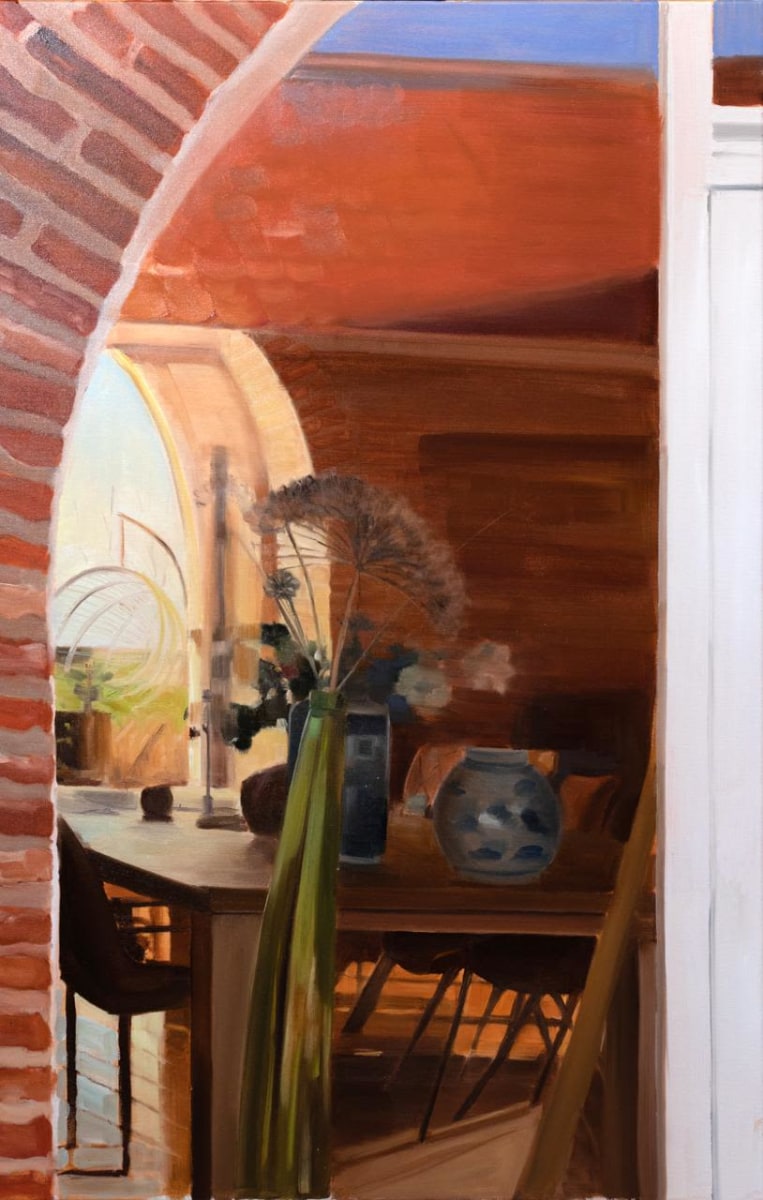
Tian Teng, 3841 EA, 2023, Namuso Gallery
How do you record the things that catch your attention? Do you take photos, keep a journal, or do you have a photographic memory?
I have a good memory for text, but unfortunately not for images, simply because too many intriguing visual moments happen every day. I can’t hold on to all of them. So I rely heavily on my phone. It allows me to capture those small, beautiful fragments of daily life before they slip away. Later, I paint from these photographs, but not literally. I paint with the feelings I had at that moment. The photo is only the starting point, the painting grows into its own world.
Where do you prefer to walk to gather inspiration for new work? Somewhere close to home, or do you travel specifically to other places?
I don’t have a preferred location, but I do have a preferred condition: sunlight. When the sun is out, even the most ordinary corner feels generous. Sometimes I travel to a city I’ve never visited to gather new images, and sometimes I simply wander around the place where I live without any real goal. My boyfriend always says I’m directionally challenged, so I often get lost, which surprisingly has become a gift. Getting lost means everything stays new to me. In retrospect this small “disadvantage” has played an unexpectedly important role in my work.
Is there anything in particular you notice about the way Dutch people arrange their windowsills?
I’ve noticed that I almost never walk past two windows that look the same. Dutch windowsills feel like tiny curated exhibitions, small compositions that reveal not only someone’s taste, but also their relationship to the outside world. There is an openness to showing a little bit of one’s interior life, and at the same time inviting the gaze of the passerby. So while a window is technically a boundary, it also becomes a place of gentle exchange: a stage where objects, plants, lamps, ceramics, or seasonal decorations say something about how someone enjoys their life. These small gestures add personality to otherwise ordinary streets. And then there is the very Dutch phenomenon of the cat bed on the windowsill. Sometimes there’s even a custom-cut hole in the window covering so the cat can (angrily) look outside. It’s such a charming detail. I keep noticing it.
If you would paint the windowsills in Shanghai, what would we see?
I’ve painted a few window scenes in Shanghai, but they often carry a quiet mix of East and West. The city has many layers, from old European-style buildings along the Bund to very local neighbourhoods, so traces of that history appear naturally in the windows too. What stands out to me, compared to the Netherlands, is the difference in attitude. Dutch windows feel open, almost like a small display for the street. Shanghai windows are more private. I think that contrast is what makes Shanghai windows interesting to paint.
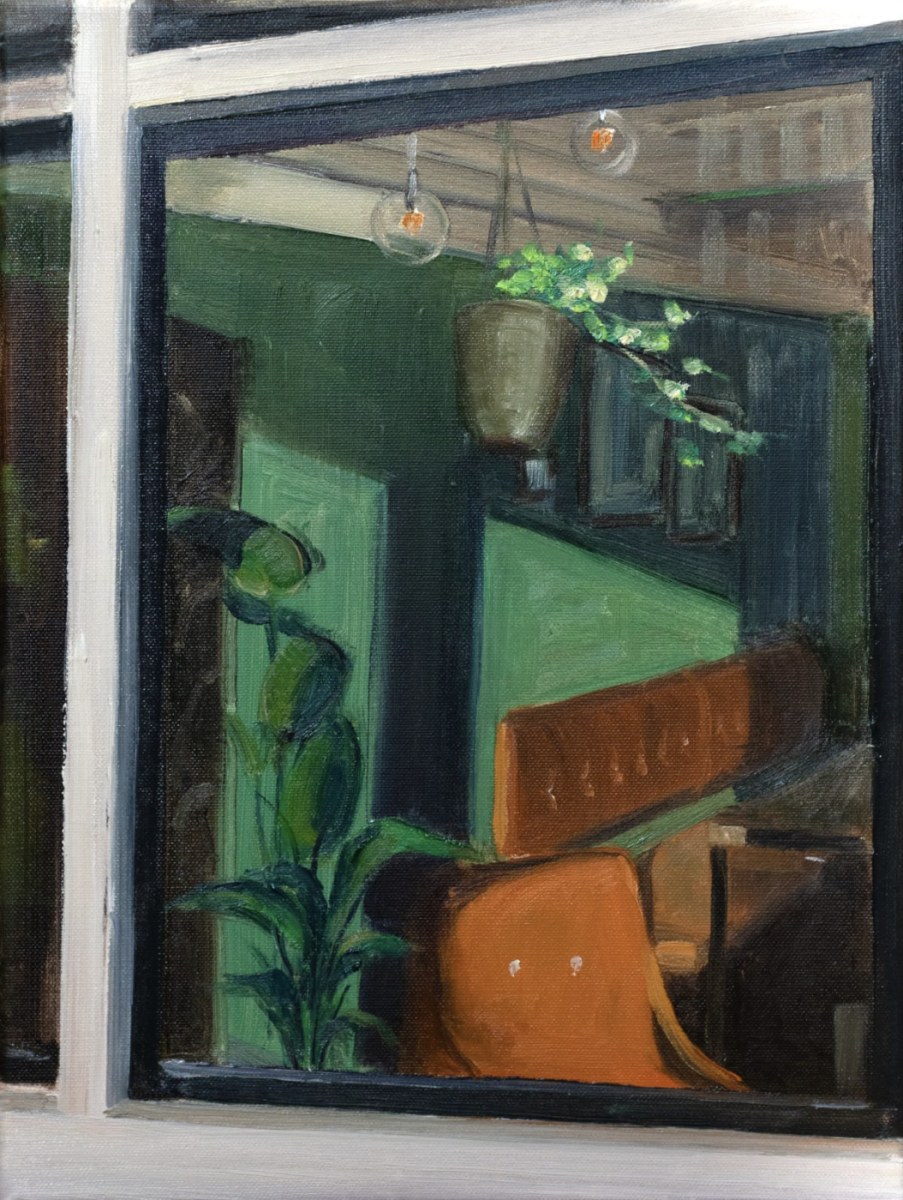
Tian Teng, Shape of Unseen 1011 CV, 2025, Namuso Gallery
Are the places you paint accurate representations of real spaces? For example, is your work Shape of the Unseen 1011 CV based on an existing interior?
Yes. All my works begin from real spaces I’ve encountered. Shape of the Unseen 1011 CV also comes from an existing interior, 1011 CV is the postcode of a street in Amsterdam where I came across the scene. I always start with reality, often by taking a quick photo, but I never paint it literally. I adjust the colours, shift or remove certain elements and reshape the atmosphere according to how the moment felt to me. The photograph holds the factual details, the painting holds my interpretation.

Tian Teng, EH2 2EL, 2025, Namuso Gallery
Are we looking at a picture frame in your work EH2 2EL? Where did you see this?
Yes, it is a picture of a frame. I’ve always been fascinated by the beautifully crafted frames in museums. Sometimes I’m even more intrigued by the frame than by the painting itself. Each one is unique, meticulously carved and plays an essential role in how a painting is experienced. The frame I painted comes from the National Galleries of Scotland: EH2 2EL is the postcode of the area, as well. It surrounds Lady Agnew of Lochnaw by John Singer Sargent, one of my favourite painters. I visited the museum while studying in London and the moment stayed with me. I like using postcodes as titles because they point to a place without revealing it too literally. It keeps a sense of mystery, and in this case, it allows viewers to search for the frame themselves, almost like a small treasure hunt inside the museum.
The year is almost over, what has been your favorite project to work on this past year?
Two projects stand out. One is "Boundaries: The Coping Individual" at Namuso Gallery, and the other is "THUIS. Het thuisgevoel in hedendaagse kunst" at Museum Rembrandthuis, both currently on show. "Boundaries" has been especially meaningful because it brings together The Shape of the Unseen with a new series I created in London. Showing works from different periods side by side allows them to “speak” to each other on the same wall. It gives me the rare chance to look at my practice as a whole, to see what has shifted, what has stayed consistent, and what the core of my work really is. "THUIS" at Museum Rembrandthuis is meaningful in a different way. Presenting my work in a place so deeply connected to Dutch art history made me reflect on how contemporary interior scenes continue a long tradition of observing everyday life. Both projects helped me understand my practice from new perspectives across time, place, and the quiet boundaries that shape how we see.
