11 december 2025, Martine Bontjes
The studio of... Dieuwke Spaans
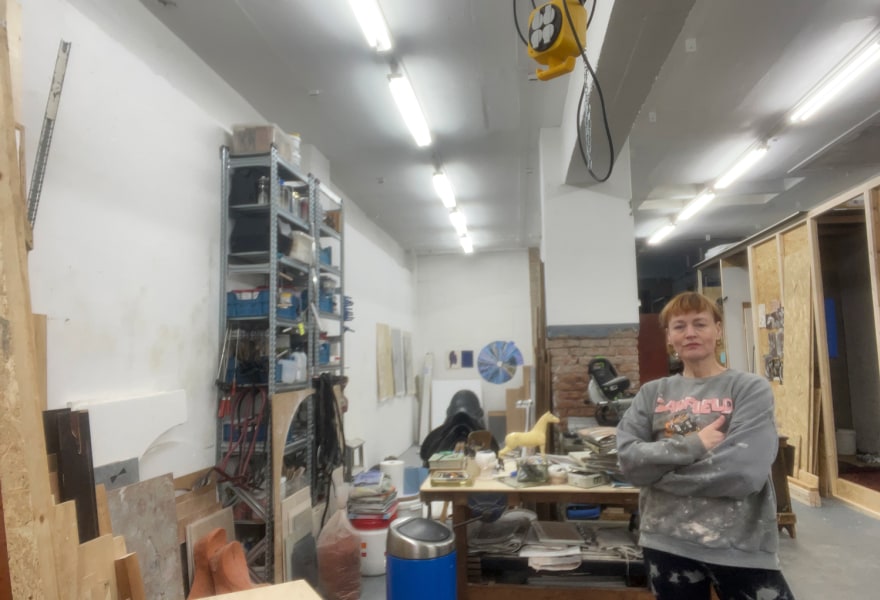
The spacious studio of Dieuwke Spaans in Amsterdam gives her the freedom to work across a wide range of techniques. She moves between printmaking, ceramics, film and photography. In the group exhibition "Interrupted Whispers" at tegenboschvanvreden, she presents an installation consisting of a collage flanked by two porcelain sculptures titled terra. For Spaans, form and material are always part of a shared narrative. These perfect circles allude to the ideal, yet they are shaped from what she calls the ‘arrogant’ porcelain, refined but at the same time fragile and difficult to control. Spaans invites us to find a sense of direction within what cannot be controlled.
Although she works with many materials, Spaans continually returns to paper. She is fascinated not only by the material itself but also by the many ways in which paper carries meaning, whether as an endpaper in a book, in the transparency of a sewing pattern or in the clarity of a blueprint. Her collages are route maps composed of erased traces in which she invites the viewer to unravel the path. Her work can be seen until 10 January 2026 in the group exhibition "Interrupted Whispers" at tegenboschvanvreden in Amsterdam.
Where is your studio and how would you describe this place?
After living and working in Berlin for several years I returned to Amsterdam in 2008. I had the opportunity to rent a studio at Nieuw en Meer, an independent artist collective situated between the Zuidas and Schiphol. The complex houses more than one hundred studios. A very diverse group of artists works here across many disciplines and media. To mark the thirty fifth anniversary of the site, filmmaker Agnes de Ruijter, made a documentary titled de regels van de rafelrand about the origins of the site and the people who work there.
My studio is on the ground floor of one of the main buildings and looks out over the ring canal. It measures roughly one hundred square meters and is laid out quite naturally in three zones. One part is where I experiment with materials that leave a mess such as ceramics, printmaking, inks and glazes, a middle section is where I can work cleanly, and at the back is a room that can be closed off and heated properly where I write and keep storage.

Dieuwke Spaans, Terra, 2025, tegenboschvanvreden
Are there certain rituals that help you get into your work mode?
When I enter my studio I put on my work clothes and then make coffee. Because I want to start working straightaway, I walk through the space and move the piles of paper that are scattered everywhere. I also go through my collections of visual material. Meanwhile I look at the works and studies I am currently engaged with. During this ritual ideas begin to connect, possible next steps surface and new questions present themselves. At that moment my working day is already in full swing. My process is always organic yet at the same time chaotic. It often happens that later in the morning I notice a cold cup of coffee, the first one I made that day and forgot immediately after pouring it. That tells me it is time to make fresh coffee and sit down for a moment. That is when I reflect and look attentively at the work before moving on. For the actual making, drawing, painting and shifting of the visual material I need a different kind of focus.
You began your artistic practice with film and drawing, yet you now work with a mix of media. How did that path unfold, and when did you realize that other materials and techniques aligned more closely with what you wanted to express?
At art school I enjoyed working with film and focused on making installations in which film and sculpture played the leading roles. I stalled in both media because the planning and technical stages of production held me back. In my third year I was mentored by American video artist and pioneer Nan Hoover. On her advice I began putting my ideas on paper first. Bringing different film stills and scenes together in one sketch on a single sheet finally gave me insight into the stories I wanted to tell and how I could tell them. The freedom I discovered while drawing shifted my attention more and more toward two dimensional work. This eventually led to a graduation series of large drawings, almost like a single film captured in a single moment. During that period I also became acquainted with movements such as the Nouvelle Vague and the Neue Welle. The filmmakers and artists from these movements continue to influence my visual language.
A graphite pencil alone did not suffice. In my early drawing series I already worked with materials such as human hair, animal hair and sand. Finding the right tone for a work has always gone hand in hand with searching for materials that fit. My curiosity about materials grew during my academy years, as did the question of how I could stretch existing boundaries or even let go of them altogether. Gradually this created the space to incorporate unusual materials with their own meaning and charge.
In your collages you use many different kinds of paper. Where does that fascination with paper come from?
The outcomes of my material experiments allow me to view my work from different perspectives. My work has always maintained a strong kinship with film. Material is content. The paper I once used for my monumental drawings began to feel empty. It became merely the carrier of my ideas. By delving into the different functions paper can have such as the endpaper of a book, the transparency of a sewing pattern or the clarity of a blueprint I can play with an extra visual and conceptual layer in my two dimensional work. The material I use can come from anywhere. What matters is that there is always a diverse supply available in my studio. During the making process I never know in advance what I will need.
The new exhibition “Interrupted Whispers” at tegenboschvanvreden includes two ceramic works from the series Terra and one collage. Can we regard these as a single installation?
For the exhibition at tegenboschvanvreden I made a second version of an existing installation. This second version is the result of the constant motion and change that runs through my work. By allowing new materials to enter and repeatedly shifting perspective while making I can express how I try to find a sense of grounding in the world around me. For a viewer this relationship may not always be immediately visible, but all my work is organically connected. Whether they are my first large drawings, the ceramic reliefs or the collages I make every day, what I aim to explore always grows from the same foundation.
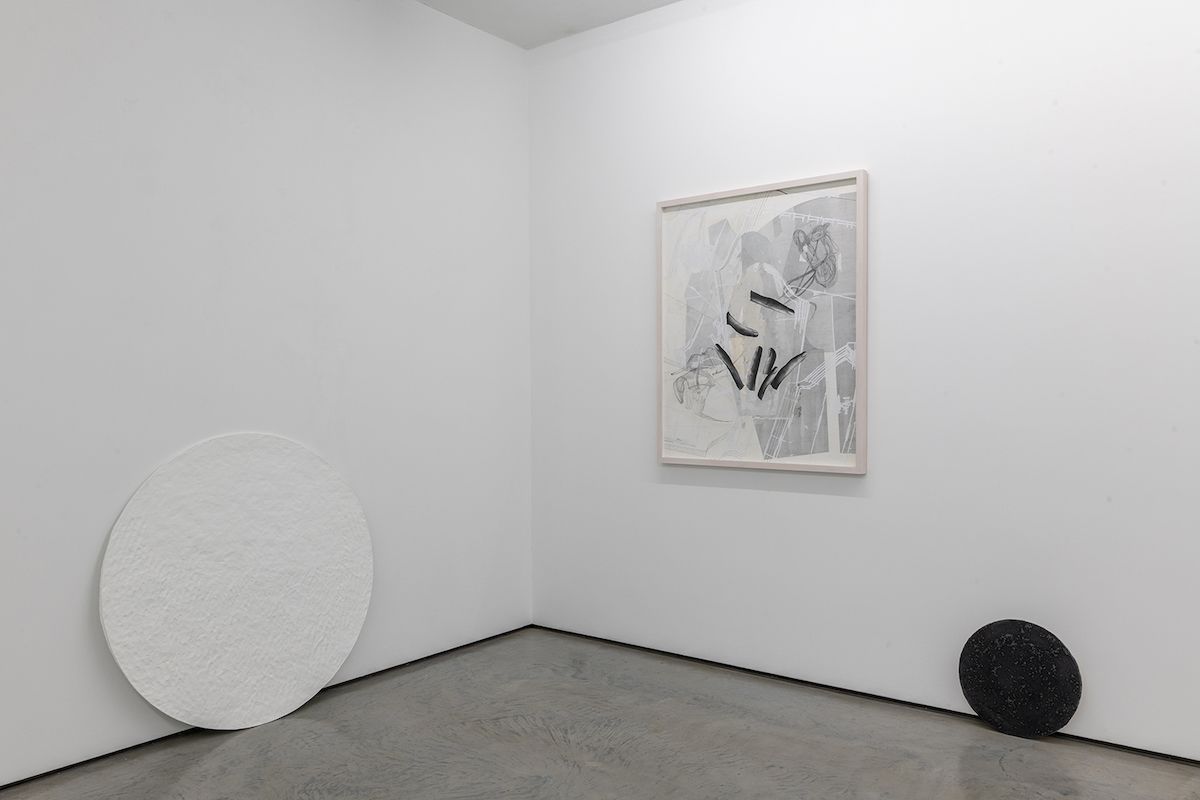
Dieuwke Spaans, A Window Into Something, 2025, tegenboschvanvreden
The two ceramic works are titled Terra. Why did you choose that title?
I have always had a love/hate relationship with titles and dates. I group my works so I can bring together pieces from different periods. The works carry the title of the group often followed by a subtitle. For the ceramic pieces in the current exhibition I looked for a subtitle with a clear resonance. Terra, Latin for earth. Their meaning is wrapped into their form and material. There is the perfect circle next to the complexity and arrogance of a material like porcelain, and at the same time the suggestion of the made and the makeable set against the unpredictable such as working with oxides on stoneware, and then the placement of the works leaning casually yet vulnerably against the wall: together these elements express where we stand in space where we are present in the here and now.
You speak of ‘not knowing’ as a necessary state. What do you mean by that?
The collage drawing on the wall is an accumulation of forms and figurations. The information erased by Typex leaves a trace of lines that can be read as mapped out routes on a fictional terrain. This work belongs to the group Portals. It imagines a possible passage to another dimension, a place about which we can never say anything with certainty or truly know anything at all. The work asks the viewer to take time to associate freely and to trust in everything we can never know for sure. Questions such as what shape the universe has or where our thoughts go when our life in the present ends or how we might find each other again.
What are you working on at the moment?
I feel an urgency to bring together the work of recent years in a book. Alongside setting up that project I am currently working on a new series of drawings in which I place several images at the centre such as the flower the Kniphofia from the video work Ever is Over All by Pipilotti Rist and the organic abstract forms of Eva Hesse. The work and vision of various artists and filmmakers have shaped the way I think look and make. In that sense I bring together visual languages that are important to me in order to develop a new one. This is how I feel connected to my own work and to the time in which I live. This is my canon and the canon of my time.
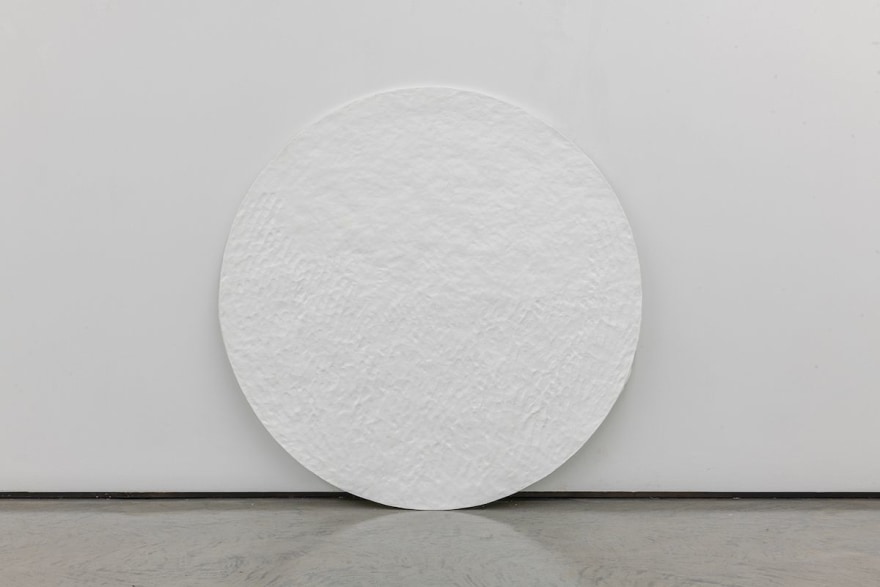
Dieuwke Spaans, Terra, 2018, tegenboschvanvreden
