28 october 2025, Flor Linckens
The echoes in Günther Förg’s studio
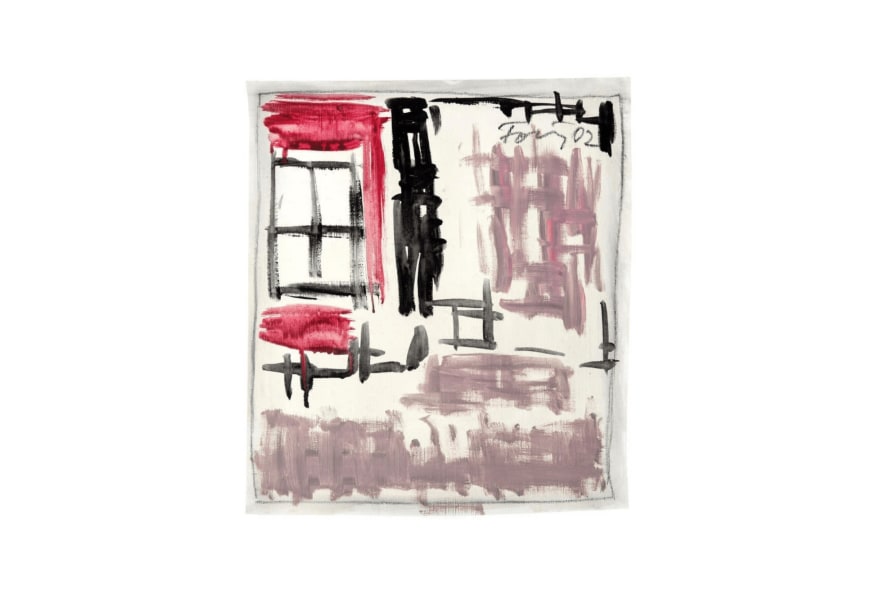
In 2026, Livingstone Gallery will celebrate its 35th anniversary. To mark the occasion, the gallery will present the exhibition ‘Günther Förg: Echoes’ from 19 December, in collaboration with Galerie Lelong in Paris and New York. The show builds on twenty years of collaboration between the gallery and the artist, with a significant highlight being his solo exhibition ‘Windows to Abstraction’ in 2011, two years before his passing.
The title of the exhibition refers to a distinctive practice in his studio. When large paintings left for exhibitions, Förg would sometimes create small versions on canvas or panel to preserve the essence of the work in his studio. These paintings reveal something fundamental about his way of thinking. They also reflect his working method: Förg never made preparatory sketches but carried the concept for a work entirely in his mind. Once a painting left the studio, nothing tangible remained to return to. For this reason, he systematically created small versions between 2002 and 2007 that captured the essence of each work, carefully arranging them side by side in his studio as echoes of the paintings that had left the space.
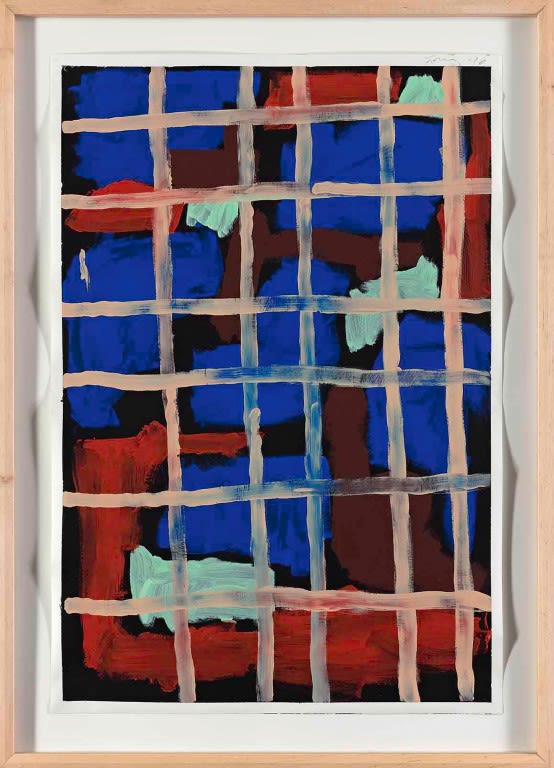
Günther Förg (1952–2013) was born in Füssen, in the southern German region of Allgäu, and studied at the Akademie der Bildenden Künste in Munich. Even as a student, he developed his own artistic direction, distancing himself from the expressive figuration that dominated the 1970s. His early black and grey monochromes reveal a search for freedom within self-imposed constraints. From the 1980s onwards, the artist began to introduce colour into his practice, bringing his visual language to life.
Förg’s oeuvre is remarkably diverse, encompassing painting, sculpture, printmaking, photography, and even murals, of which he created no fewer than 140. He is best known for his geometric, abstract paintings defined by colour and rhythm. Rather than thinking in disciplines, Förg approached his work through space, material, mass, proportion and rhythm, making his practice difficult to categorise within a single movement. He drew inspiration from architecture, film, literature and landscapes, but also from Germany’s political context, the art world and the visual language of modernism, whose ideals he examined with a critical eye. He also found inspiration in the work of other artists, particularly twentieth-century contemporaries such as Barnett Newman, Blinky Palermo, Henri Matisse, Paul Klee, Willem de Kooning, Mark Rothko and Cy Twombly.
His fascination with modernist forms and with architecture as a carrier of history led him to a series of monumental photographs in the 1980s. Förg captured buildings that had once symbolised progress but had since come to bear the marks of time and ideology: from Bauhaus architecture and fascist structures in Italy to post-war constructions in Germany. He photographed these buildings not as monuments, but rather as traces of human ambition: quiet reflections on power, beauty and decay.

In his work, Förg continually sought the tension between order and freedom, discipline and spontaneity, thought and action. His approach was highly analytical (the grid, for example, is a recurring motif) yet equally driven by a constant urge to experiment. Unlike many of his contemporaries, he was less interested in the symbolic or spiritual meaning of painting and more in its tangible, material qualities: in how paint, colour and surface interact. He worked with a wide range of materials, including lead, copper, bronze, watercolour, acrylic, oil paint, charcoal, chalk, ink, wood, plaster and mirrored glass.
Following his death in 2013, international recognition of Förg’s work grew significantly. Major museums acquired his works and presented large solo exhibitions, including the Stedelijk Museum Amsterdam, Kunstmuseum Basel, the Dallas Museum of Art, Kunstmuseum Den Haag and the Long Museum in Shanghai. His work is held in the collections of various institutions, including Tate, the MoMA, the SFMOMA, Hamburger Bahnhof, the Louisiana Museum, the François Pinault Foundation, Arken Museum of Modern Art, the Museum of Contemporary Art (MOCA) and The Broad in Los Angeles, the National Gallery of Art in Washington, the Art Institute of Chicago, Museo Reina Sofía in Madrid, Kunstmuseum Basel and Stedelijk Museum Amsterdam.
