17 october 2025, Wouter van den Eijkel
Secret Door: Sara van Vliet and Jan van der Ploeg at Yellow Gallery
Visits by appointment only.
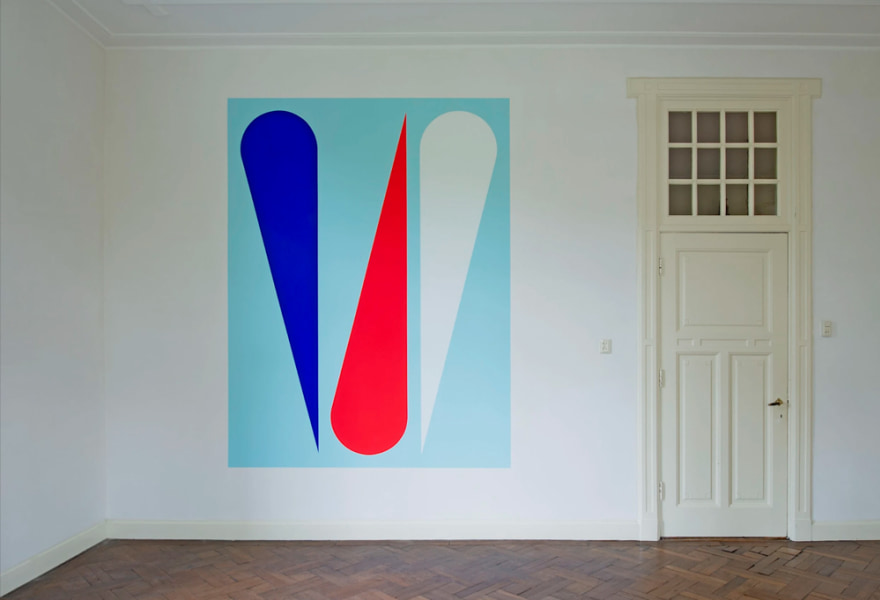
“If you buy it, the artwork becomes yours,” says gallery owner Jantien Herfst, gesturing toward Wall Painting 567, a site-specific piece by Jan van der Ploeg (b. 1959, Amsterdam), crafted solely for the Yellow Gallery. “The wall here will be painted over again and the piece will be reinstalled in your home. Even if you move, you can whitewash it again — Jan will recreate it in your new place.”
It’s a tantalising premise: an original piece that can be dismantled and reconstituted — reborn with every move or change of ownership. It opens up a Pandora’s box of musings on authenticity. If an artwork is remade, is it still the same work? And what if Van der Ploeg sends an assistant to execute the work, as Sol LeWitt famously did — is it still a Van der Ploeg? Suppose the new owner, in a moment of impatience or longing, decides to replicate it— is that an act of homage or plagiarism?
There’s something inherently fascinating about wall art. It demands a different commitment than a painting. A framed canvas can be easily taken down, while a wall piece is semi-permanent, ‘clinging’ to the space. What softens the edge of this commitment is that the Yellow Gallery is not located inside a sterile white cube, but a charming historic residence known colloquially as Het Kasteeltje (‘The Little Castle’). This domestic setting gives visitors a visceral sense of how the work might look in a lived-in space.
The same goes for the more modest-sized works by Van der Ploeg and evocative canvases of his much younger co-exhibitor, Sara van Vliet. The way these pieces are arranged — near a sunlit window, above an old chest or gracing a mantel — makes the decision to live with them less abstract more real.

Jan van der Ploeg, Untitled (No. 1627) 2025, Yellow Gallery
The most famous unknown artist
If there were an accolade for the best-known unknown artist, Jan van der Ploeg might very well take the crown (though Tom Claassen — with his elephant sculptures along the A6 motorway near Almere — would be a strong contender). Everyone recognises Van der Ploeg’s work, but few can pin a name to it. Like Claassen, he often works in public spaces and civic buildings. His most recognised piece? The vibrant, geometric fence adorning the Ministry of Finance at Korte Voorhout in The Hague.
Van der Ploeg currently lives and works in Amsterdam, but spent part of his upbringing in Leiden. Naturally, Het Kasteeltje was already familiar to him — and it felt poignant to create something bespoke for this storied spot. Not that you need travel to The Hague to see his work. His abstract language is scattered across the Dutch landscape, from the boldly painted bike parking at Doornroosje and Nijmegen music venue (inside and out) to the patterned walls of Maasstad Hospital in Rotterdam. He also created the 35-metre-long crimson corridor in Museum Boijmans Van Beuningen and brought a signature chromatic identity to Schunck in Heerlen.
Wall painting 567
Back to Leiden and back to Wall Painting 567. The piece features a light blue field punctuated by three of Van der Ploeg’s signature shapes: sharp-pointed at the base, gracefully arched at the top. The crispness of the point, the flawless curve of the semicircle — you might assume these were the result of rigid stencils. Not so: “It’s measuring, measuring and more measuring — then carefully masking with painter’s tape,” explains Herfst. Van der Ploeg sent his concept over before summer. The background was originally meant to be cobalt blue. But when he arrived in September to install the work, he abandoned that idea. On overcast days, the darker blue would have felt too oppressive in the low natural light of the space.
Some viewers see a droplet. Others, a beak. Van der Ploeg himself offers no interpretation. He leaves the reading up to the audience, says Herfst. “People either adore Jan’s work or feel alienated by it. Abstract art rarely sits in the middle — it provokes.”

Sara van Vliet, BTS, 2025, Yellow Gallery
BTS
Those unmoved by Van der Ploeg’s abstraction often find themselves drawn to the organic vigour of Sara van Vliet. This young painter graduated from HKU only three years ago, turning heads with her vibrant juxtapositions of natural flora and human-made environments — such as wildflowers bursting against industrial backdrops.
Currently enrolled at the Frank Mohr Institute in Groningen, Van Vliet’s recent piece BTS explores the life cycles of flowers —birth, bloom and decay. Her work meditates on nature’s continuity and impermanence, urging viewers to reconsider where cultivated spaces end and wilderness begins.
She achieves this masterfully in another untitled piece in which her technique is almost tactile. Thick impasto florals erupt from a delicately rendered background, nearly touchable in their texture. Yet behind their painterly density lurk faint, ghostly shadows, a whisper of nature’s unyielding spirit and reminder of its quiet dominion.
