15 october 2025, Yves Joris
In the Morning Laughing Happy Fish Heads: Groupshow in Shoobil
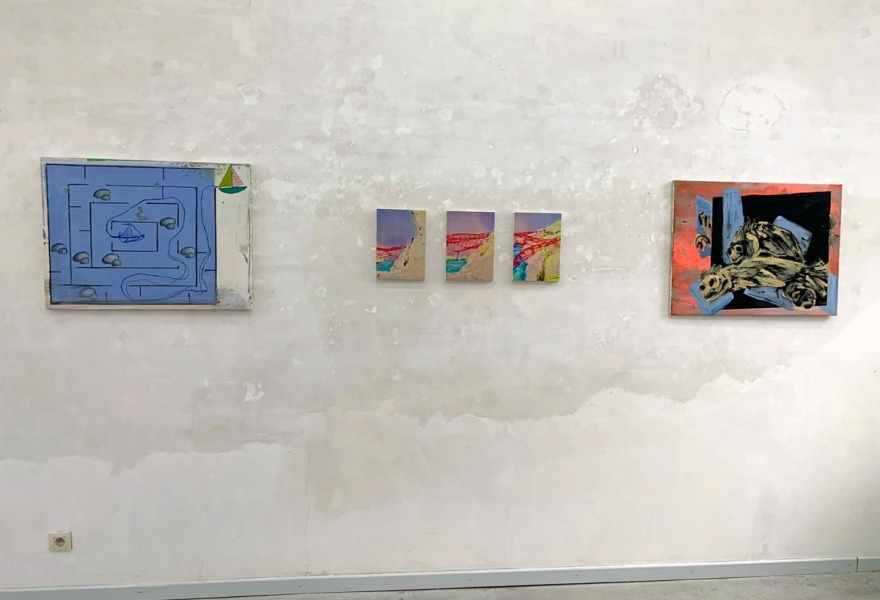
In the morning, laughing happy fish heads, In the evening, floating in the soup.
— Barnes & Barnes, 1978
I’m not familiar with the song, but thanks to YouTube, was able to journey to the naive, cheerful tunes of the seventies — Chirpy Chirpy Cheep Cheep, Ob-La-Di, Ob-La-Da — songs that begin lightheartedly, but always carry a trace of melancholy. That’s also how this fragment from Fish Heads sounds, hovering somewhere between satire and a children’s song. An absurd refrain about fish heads that laugh in the morning and float in the soup by evening. At first, you smile; then something odd lingers — a feeling of finality that cannot be waved away.
At Shoobil in Antwerp, that strange tune finds a visual continuation. The exhibition In the Morning Laughing Happy Fish Heads in the Evening Floating in the Soup brings together works by Yann Bronder, Jef Gysen, Kenan Hasimbegovic and Catharina Hell — four artists who, vacillate between humour and gravity and between vitality and decay, each with their own unique rhythm. The laughing fish head becomes a metaphor for artistry itself: the ability to smile while slowly dissolving into one’s own material.
A space that breathes
The two rooms of the gallery function like a body: what begins in one space seems to exhale in the other. There’s no frontal presentation, no clearly defined path. Those who step inside enter a conversation already in progress — between materials, colours and voices.
That open structure fits with Shoobil’s DNA. Artists don’t show an endpoint, but a stage in an ongoing metamorphosis. In that sense, the exhibition wonderfully reflects its title: everything moves, nothing remains. Even the smile is temporary, a vibration in the air before it fades into silence.
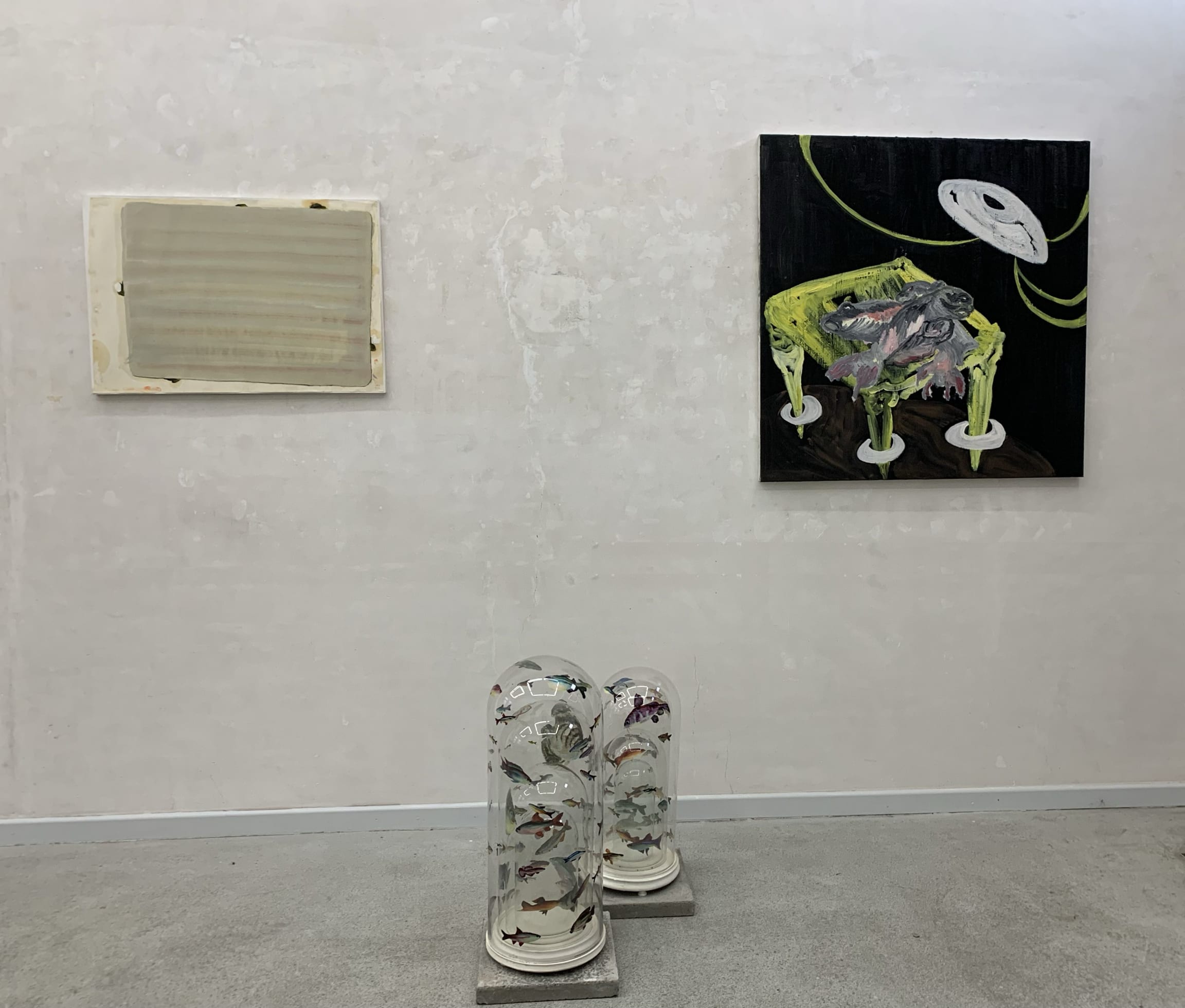
In the morning, laughing happy fish heads in the evening, floating in the soup. 2025, Shoobil
Four voices, one breath
The four participating artists seem to form a single breath: inhalation and exhalation, tension and release:
Kenan Hasimbegovic works with the deliberate slowness of someone attuned to the material itself. His sculptures — often abstract, yet charged with physical energy — seem to live just beneath the surface. Water, skin, breath all merge in his work into a visual stillness in which time slows down.
Yann Bronder constructs images that resemble fragments of bodies or landscapes, yet always with a sense of disappearance — as if she is painting what is barely visible. Her work suggests a vanishing point, a horizon where the image dissolves into breath.
Jef Gysen explores the memory of paint. His canvases are not flat surfaces, but breathing skins on which layers of time, doubt and correction remain visible. Each piece is a search for the right tension between chance and control, between matter and meaning.
Hokusai Dream 1
Then there is Catharina Hell, who approaches colour and rhythm as a form of breath. In her work Hokusai Dream 1, an ocean of light blue wells up from a field of pink dots. What at first glance seems playful and decorative turns out to be a carefully constructed field of tension between repetition and chance. The dots — at times sharp, other times blurred — suggest scales, eyes, pores. They seem to breathe on the canvas, like the skin of a living memory.
The title refers to the Japanese master of the wave, yet no actual wave is recognisable here. Hell doesn’t evoke the sea itself, but its dream, its aftershock in memory. The paint moves like a tide retreating and returning, a memory of motion within a static plane. There’s something deeply human about the work: the desire to touch the intangible, to capture movement that continually escapes. It’s not so much a painting about water, but about time — about how every image trembles between emergence and disappearance.

Catharina Hell, HOKUSAI DREAM 1, 2025, Shoobil
Water as undercurrent
Water, incidentally, runs like an invisible thread throughout the entire exhibition, not only thematically, but as a mental state. Everything is becoming, nothing is definitive.
In the symbolism of countless cultures, the fish carries meanings of prosperity, faith or liberation. But at Shoobil, it sheds its religious connotations and returns to its essence: swimming: moving without purpose, without judgement.
The works engage in dialogue like surfaces of water refracting light. No single work dominates, no voice overwhelms. Everything flows, everything is connected by the slow pulse of liquidity.
The smile of disappearance
The smile of the fish head seems odd at first glance. Neither cheerful nor sad, but something in between. It is the smile of the artist who understands that everything created is impermanent. The smile of the material that resists, yet yields.
At Shoobil, that smile is a gentle one without irony. It is not a mockery of death, but a form of gentleness towards the temporary. In that tension, something touching emerges, an art that doesn’t elevate itself, but dares to disappear.
The song by Barnes & Barnes after which the exhibition its named is steeped in the same ambiguity. It plays with absurdism, but touches on existential questions. How long do we keep laughing? What remains after the laughter fades?
Silence as an answer
When you leave Shoobil, the refrain lingers in your head like a slow wave. The colours of Hokusai Dream, the breathing whites of Gysen’s paint, the echoes of Hasimbegovic’s textures and Bronder’s traces of absence blend into a single memory: something fluid, something that does not stop moving.
Ask a fish head anything you want to, They won’t answer, they can’t talk.
- Barnes & Barnes
I leave the gallery and the door closes behind me. The fish heads are silent, but that silence is not empty; it is a silence that holds wisdom, a form of knowledge that needs no words. Or is it a silence out of respect for the bad news recently received by the nearby M HKA?

In the morning, laughing happy fish heads in the evening, floating in the soup. 2025, Shoobil
