11 september 2025, Flor Linckens
Bob Bonies 88 years: a life in colour and form
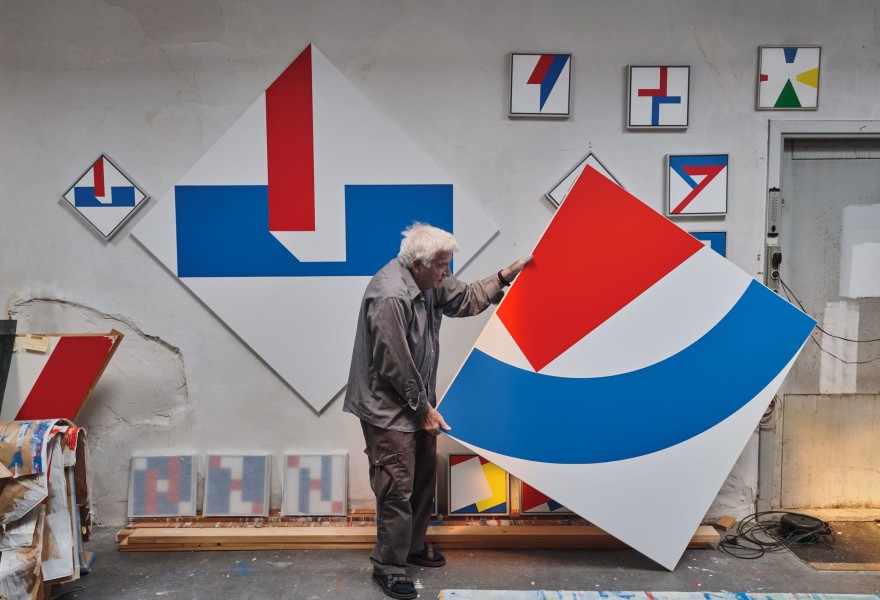
This autumn, Galerie Ramakers in The Hague celebrates the 88th birthday of Bob Bonies in the city where he was born. In a unique solo exhibition, on view until 12 October, the gallery combines paintings from the 1960s and 1970s with new work. The resulting exhibition highlights the remarkable consistency and continuous renewal in a practice that has spanned more than six decades.
Bob Bonies was born as Bob Nieuwenhuis on 3 October 1937 in The Hague. He lived most of his life in and around his native city but also spent extended periods in Stockholm, Washington and Montreal. There, he encountered color field painting, hard edge painting and minimal art, in particular the large scale on which they were executed. But long before that, in his youth, he frequently visited the Gemeentemuseum (now the Kunstmuseum) in The Hague, where the extensive Mondrian collection left a profound impression on him. The influence of De Stijl, the Russian avant-garde and constructivism has remained a constant factor in his work, yet his oeuvre has always developed from a clearly defined and personal starting point.

Since the mid-1960s, Bonies has worked according to a strict system of self-imposed rules. His aim is to explore how far one can reduce and simplify without undermining the visual tension of the image. Within these parameters, he searches for a form of synergy, in which the interaction between elements creates a total effect that is greater than the sum of its parts. In his conceptual practice, he restricts himself to primary colours, supplemented with green and white, and employs a visual language based on elementary forms such as rectangles, squares and circles. This systematic approach lends his work a distinctive clarity. Within these boundaries, he has developed a practice that is both dynamic and compelling.
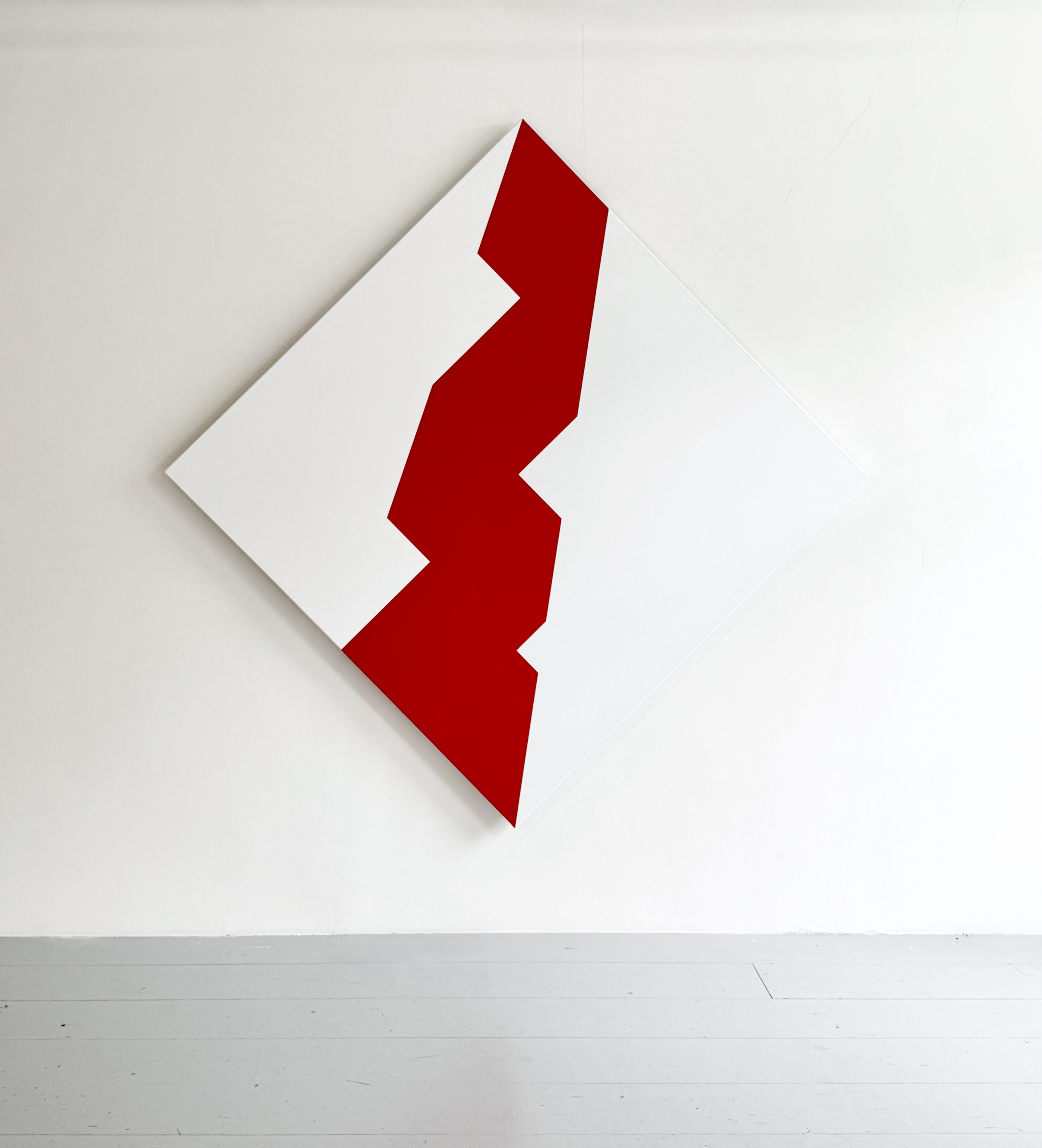
The paintings of Bonies often appear closer to spatial structures than to two-dimensional images. They push at the limits of what a painting can be, for instance in his shaped canvases or in works where multiple canvases are joined to form new configurations. His compositions evoke a sense of movement: planes seem to tilt, shift or extend beyond the edge of the canvas, effectively occupying the space around them. In doing so, Bonies continues to explore the relationship between form, colour and space. For him, a painting is not merely a surface that carries paint but a construction that directly engages with its surroundings.
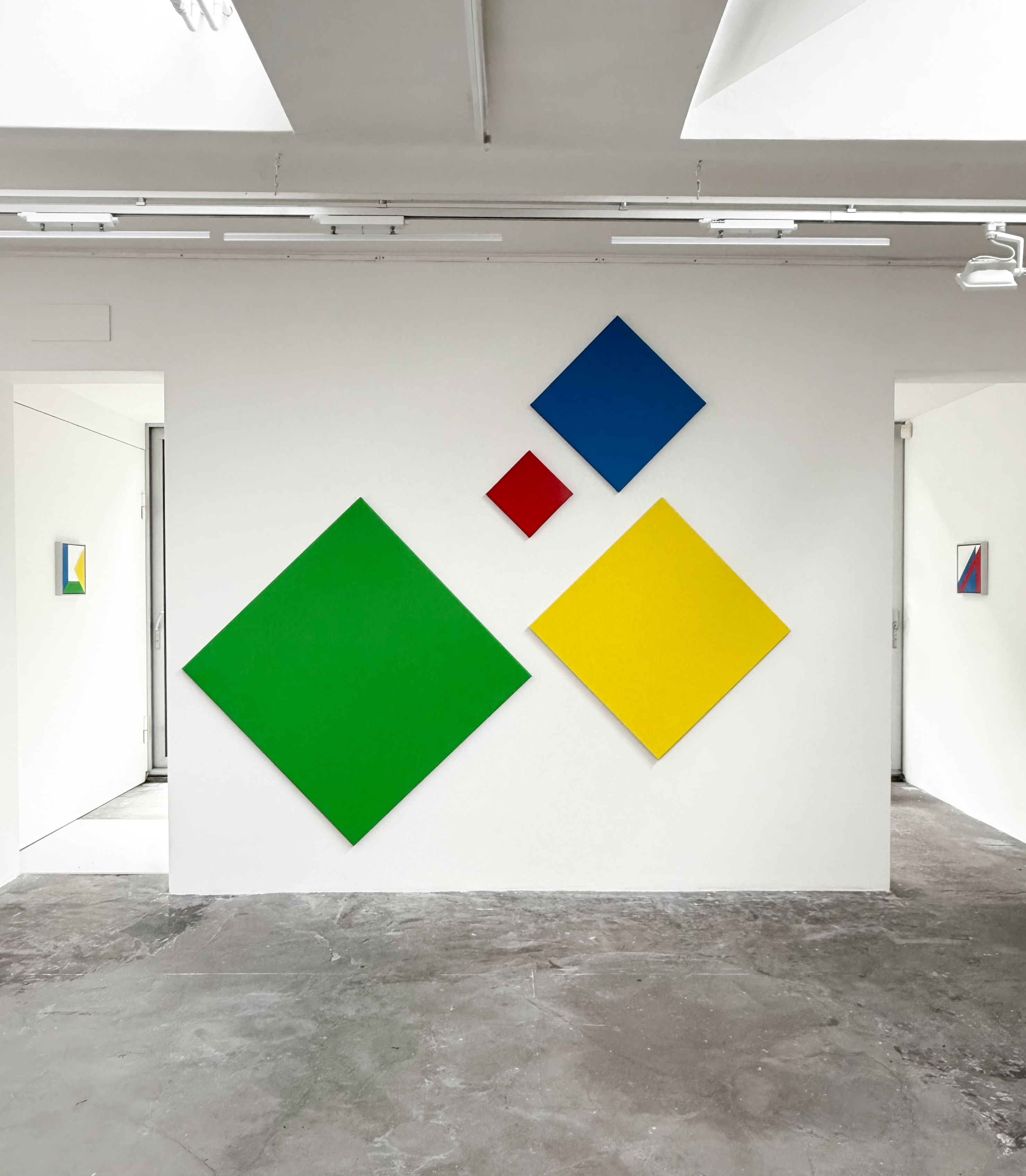
Bonies works on linen stretched over wooden frames, applies four layers of paint from the same manufacturer, and begins with an initial sketch on graph paper, followed by a study, often on a smaller canvas. By rotating, repeating or shifting elements, he generates an unexpected dynamism. Although he regards himself as a ‘constructor of space’, his work remains accessible, direct and legible. Rather than symbolism or narrative he seeks the essence of colour and form.
The exhibition at Galerie Ramakers demonstrates how Bonies has remained faithful to his principles for over sixty years, while continually questioning and deepening them. The juxtaposition of older and more recent works shows both the consistency and the evolution of his practice. His geometric clarity and bold use of colour have proven to be timeless and confirm his position as one of the most important representatives of geometric abstraction in the Netherlands.
Bob Bonies studied at the Vrije Academie voor Beeldende Kunst and the Koninklijke Academie in The Hague, where he initially specialised in sculpture. He also pursued interior design and design studies at the Konstfackskolan in Stockholm. In 1966, he was given his first solo exhibition at the Stedelijk Museum in Amsterdam. That same year, he took part in a group exhibition alongside Ellsworth Kelly, Donald Judd, Frank Stella and Barnett Newman. As recently as 2021, his work was the subject of a solo exhibition at Kunstmuseum Den Haag. Alongside his painting practice, Bonies collaborated with choreographer Hans van Manen, couturier Frans Molenaar and composer Simeon ten Holt, and served for many years as director of the Vrije Academie in The Hague. He was also one of the founders of the Union for Visual Arts Workers. His work is represented in the collections of Kunstmuseum Den Haag, Museum Boijmans Van Beuningen, Museum Voorlinden, the Stedelijk Museum, the Van Abbemuseum, the Centraal Museum, the Groninger Museum and the ABN AMRO collection.
