21 march 2025, Flor Linckens
Günter Tuzina: abstraction on a human scale
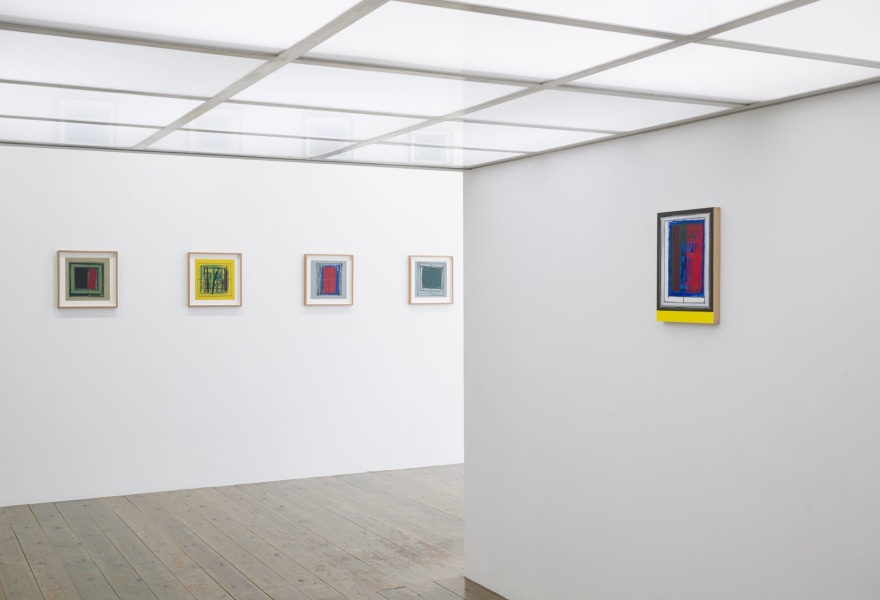
With the exhibition 'Frühschnee', Slewe Gallery in Amsterdam celebrates a long-standing collaboration with Günter Tuzina. For 25 years, the gallery has regularly presented work by the German artist. This anniversary exhibition brings together new paintings alongside works on paper that are being shown for the first time. Its title refers to a monumental painting from 2002, also on view in the exhibition. That work in turn references the painting of the same name by Caspar David Friedrich and reflects Tuzina’s interest in reinterpreting Romanticism. It is also an interesting piece as most of the paintings in the exhibition are untitled.
Günter Tuzina was born in 1951 in Hamburg, where he studied at the Hochschule für bildende Künste. In the early 1970s, he began an inquiry into the essence of painting, a process he continues to this day. Since then, he has worked with a consistent and recurring vocabulary of lines, planes and geometric forms. While his work may appear rational and systematic at first glance, there is a second layer beneath that order — marked by searching, shifting and hesitation. He not only investigates the image but also the parameters of the medium itself.
In 2011, Tuzina was interviewed by Robert-Jan Muller during an earlier exhibition at Slewe Gallery. He remarked: "Looking at the painting, one should be able to trace every step, every gesture. I am always interested in providing a density, a kind of high-pressure… like an energy oven or a high-pressure cooker, made visible in this form of painting. [I want to] make that energy visible in painting."

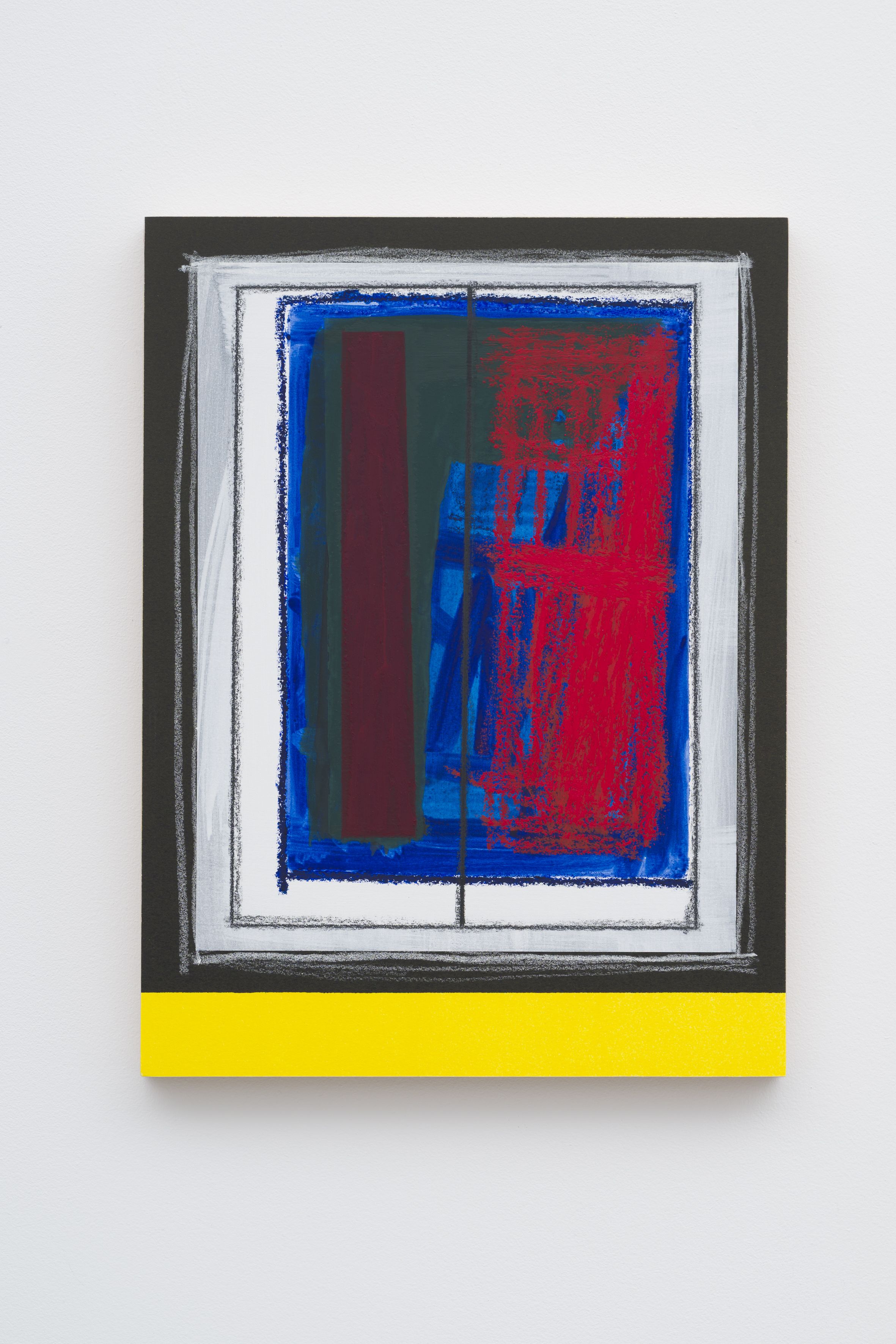
De schilderijen en tekeningen van Tuzina worden vaak omschreven als ramen, al is dat volgens de kunstenaar zelf niet wat ze zijn. Het zijn eerder velden waarin kleur en lijn met elkaar in balans worden gebracht — of juist voorzichtig uit evenwicht gebracht worden. Donkere tinten blauw, rood en groen worden afgewisseld met felle kleuraccenten en doorkruist door lijnen die zelden perfect recht zijn. Juist die kleine afwijkingen geven zijn werk een zintuiglijke lading. Tuzina gebruikt een beperkt aantal middelen en verschuivingen, maar weet daarmee een beeldtaal op te bouwen die prikkelt, visueel geladen is en ruimte biedt voor interpretatie. Het voorziet zijn werk van een zekere heldere en gelaagde spanning. Zijn schilderijen zijn geen ramen om doorheen te kijken, maar om even bij stil te staan.
Tuzina’s paintings and drawings are often described as windows, though the artist himself disagrees. Rather than offering a view, they are fields where colour and line are brought into balance — or carefully nudged out of it. Deep tones of blue, red and green are offset by bright accents and crossed by lines that are rarely perfectly straight. These small deviations lend the work a tactile charge. With a limited set of elements and subtle shifts, Tuzina constructs a visual language that is stimulating, layered and open to interpretation. It imbues his work with a distinct clarity and quiet tension. These are not openings to the world beyond, but quiet surfaces that invite you to pause and rest your gaze.
He invites the viewer in: Tuzina leaves the act of making visible, with lines drawn, painted over and traced again. His practice connects to the abstract visual language that emerged in the early twentieth century and was later developed within minimalism and concrete art, while simultaneously questioning the boundaries and possibilities of those traditions. His works are never impersonal; they are anchored in a sense of human scale. In earlier periods, he also created wall paintings and floor pieces, where the relationship between artwork and space becomes even more immediate.
The artist works with a range of materials including acrylic, oil paint, pencil, oil stick and chalk, either on canvas, paper or wood. A notable feature of this exhibition is his return to earlier work: works from previous periods serve as starting points for new pieces. Repetition and reinterpretation are central to his practice. For Tuzina, each work becomes part of a continuous exercise in looking, shifting and composing.
Tuzina’s work has been widely exhibited in the Netherlands and abroad, and is held in the collections of institutions such as the MoMA, Museum Boijmans Van Beuningen, the Stedelijk Museum, the Van Abbemuseum and the collections of Deutsche Bank, the Federal Republic of Germany and Société Générale in Paris. He was recognised early on in the Netherlands: in 1978 he had his first solo museum exhibition at the Van Abbemuseum, followed by the Stedelijk Museum in 1983 and multiple presentations at the Kunstmuseum Den Haag in 1985 and 2002, which now holds the most extensive institutional collection of his work.
