05 december 2024, Wouter van den Eijkel
Experimenting with context | Guillaume Bijl & Philip Akkerman at TORCH Gallery
"I am a fan of Guillaume Bijl's work," said Philip Akkerman in the opening line of the press release for the exhibition Guillaume Bijl & Philip Akkerman, on view for another two weeks at TORCH Gallery in Amsterdam. It can be that simple: you admire someone’s work and ask them to collaborate on your exhibition. Akkerman asked Bijl if he could add a self-portrait to one of Bijl’s installations. Bijl agreed and according to the press release, asked no further questions. Moreover, according to Akkerman, there are no deeper intellectual ideas or intentions—at least not yet. The question remains why Akkerman is such a fan of Guillaume Bijl.
Experimenting with context
Those who saw Akkerman's previous show at Torch might have an idea about why he chose Bijl. "Philip always does something unique. In his previous exhibition, we rebuilt the entire interior of a house. More or less by chance, there was art hanging on the walls—his own work and also art by artists he admires and invited to participate," says Jorre Both of Torch Gallery. "He always tries to create a sort of democratisation of art. He doesn’t like the elitism of institutions like this. There will always be a difference between how clinically art is hung on a wall here and how it looks at home. Philip tries to disrupt that and this exhibition is another step in that direction."
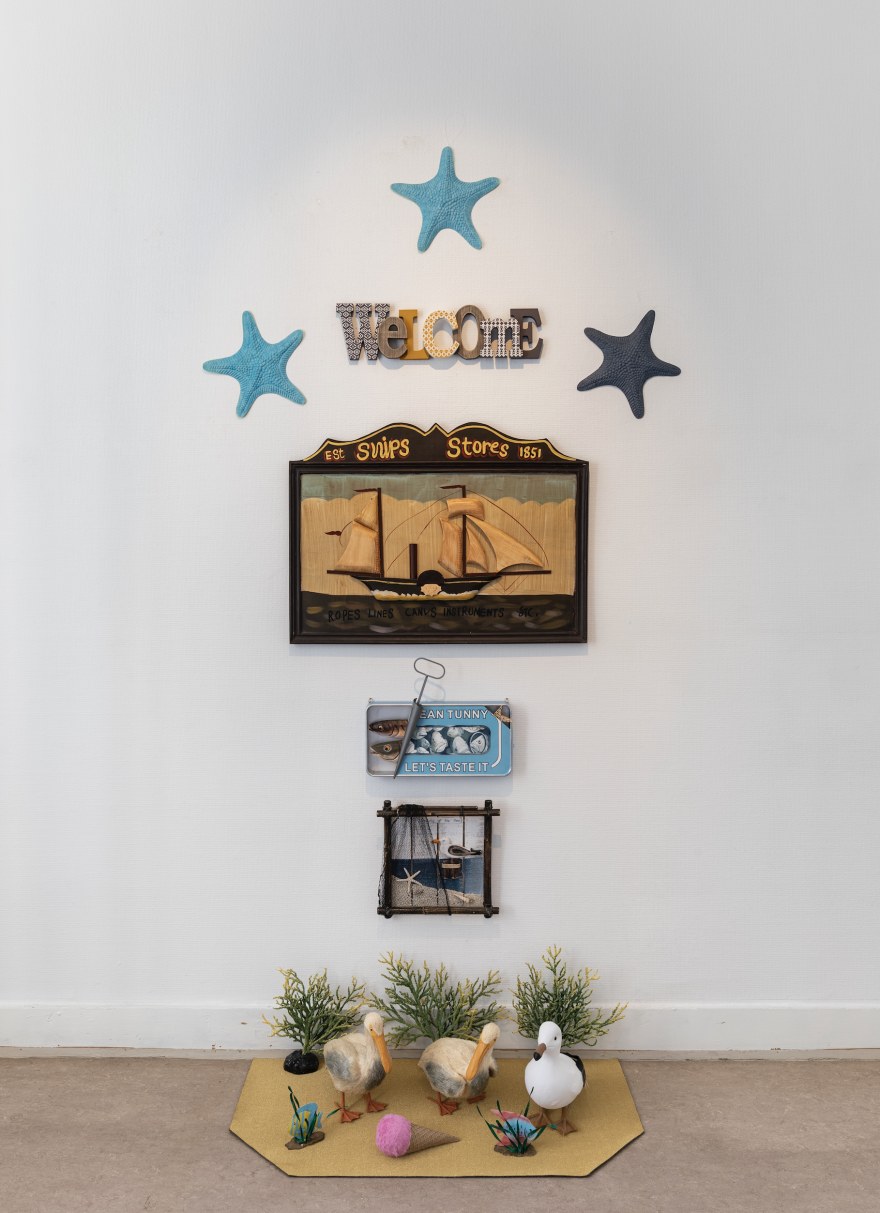
Guillaume Bijl, Sorry, 2022, TORCH Gallery
Antwerp-based artist Guillaume Bijl, represented in the Netherlands by Lumen Travo, has been doing something similar for decades. He creates installations and assemblages of objects that he arranges thematically. These are not expensive or rare objects, but quite the opposite. Items like starfish, letters spelling ‘Welcome’, decoy ducks and plastic ice cream cones in the Sorry series assemblage could all easily have come from stores like Action or Xenos. It’s cheap, tacky junk.
The initial reaction to such carefully curated silliness is a big smile. It draws you into Bijl’s universe. But immediately afterward, a flood of questions arises: Why these specific objects? Could I have made this? And ‘sorry’ for what or whom exactly? Is Bijl apologising because he couldn’t resist creating something so witty or is he apologising on behalf of humanity for needing so much plastic junk? Above all, what makes Sorry art? Is it the composition of the objects or is it the gallery context? Would I still appreciate it if it weren’t displayed in a gallery?

Guillaume Bijl, detail Religieuze Shop, TORCH Gallery
Religious Shop
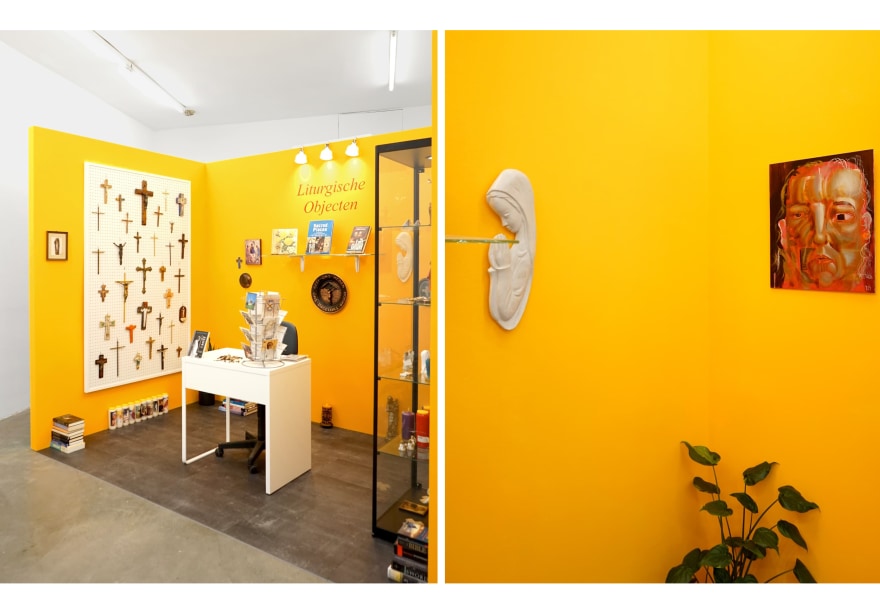
The Sorry assemblage offers little context beyond its nautical theme, but the Religious Shop installation in the back room is a different story. Bijl created this liturgical shop in 2019 for an exhibition on religion and art at an abbey in Leuven. The confusion among visitors must have been complete, as Bijl’s Religious Shop has everything you’d expect: a rich assortment of crucifixes—hanging on a pegboard, a display case with faded icons, a small white desk with a card rack and rosaries and stacks of books on the floor. The entire setup exudes the dreary atmosphere associated with such a shop and is therefore indistinguishable from a real one when unexpectedly placed in a museum setting. Only the shopkeeper is missing.
As with Sorry, nothing in the Religious Shop is left to chance. “We received the installation in boxes, along with photos of the layout,” Both explains. Everything was carefully considered, from the colour of the walls to the stacks of books. On the right wall, behind the display case, Philip Akkerman added a self-portrait in red and gold. The work blends in, as the colours match those of the icons in the case, creating a logical continuation.
Still, this intervention by Akkerman throws you off: just as you wonder with Sorry whether the context makes it art, you might ask whether Akkerman’s self-portrait in the Religious Shop turns everything in that context into a liturgical object.

Guillaume Bijl, Selfportraits Before & After Cloning, 1978, TORCH Gallery
Before Cloning / After Cloning
Near the entrance is Bijl’s installation Self-Portraits Before & After Cloning. The first passport photo, from 1979, shows an adult Bijl. Shortly after, he had himself cloned and in the following passport pictures, we see Bijl's clone gradually growing up until, in the 16th photo, we again see the same 1979 passport photo—now taken in 2013.
Bijl’s installation is no coincidence. It is a playful reference to Philip Akkerman’s self-portraits. For 40 years, Akkerman has painted himself almost exclusively. According to Both, one reason for this is that Akkerman can depict himself exactly as he wants, which would presumably be more difficult for others to do. This limited subject matter certainly hasn’t made Akkerman less productive. He produces over 100 works annually. According to the press release, Akkerman always works intuitively. “I always did what I thought I had to do. A theoretical foundation and deep thoughts about my work followed years later.”
This intuitive approach leads Akkerman in various directions. His work from the past three years ranges from realistic to abstract and everything in between. “Philip has mastered oil painting so well that he can execute anything that comes to mind. He thinks of a new form, executes it and then moves on to the next,” says Both. The only noticeable trend is that Akkerman has increasingly leaned toward abstract self-portraits over the years.
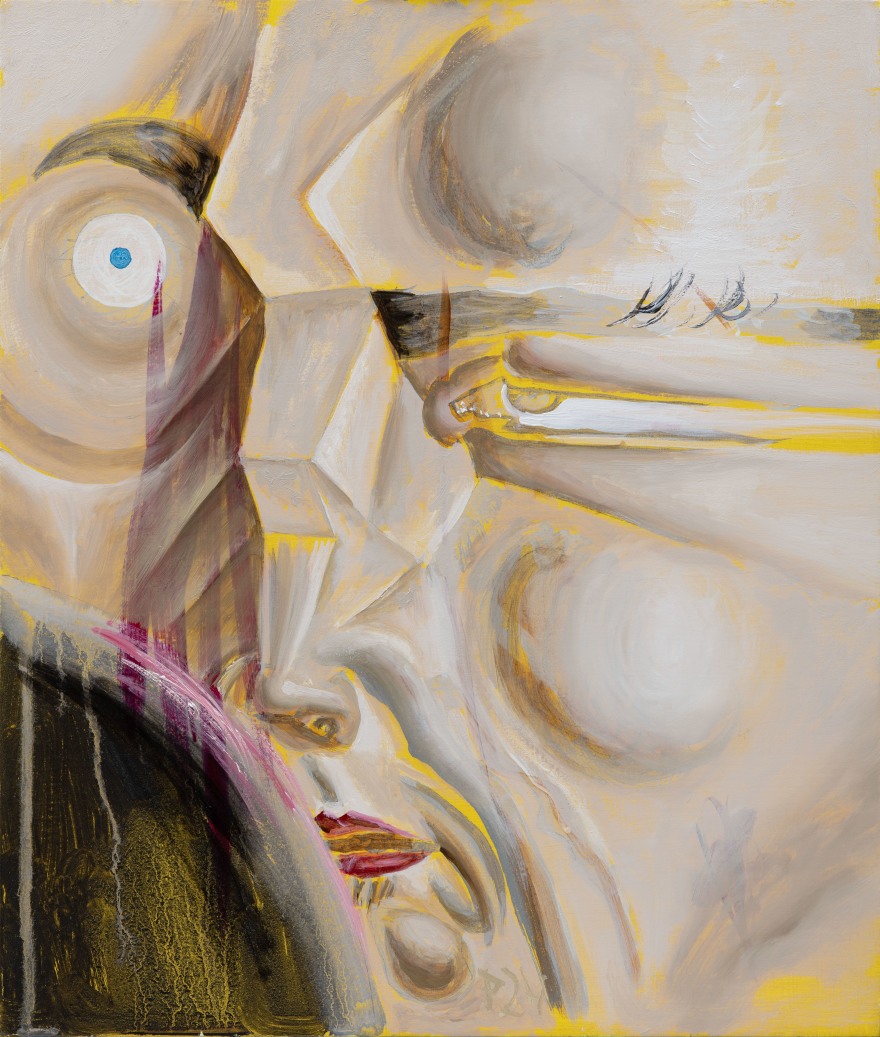
Philip Akkerman, Self-portrait 2024 no. 89, 2024, TORCH Gallery
