17 october 2024, Flor Linckens
Pietà, Millefleurs: a symbolic reflection
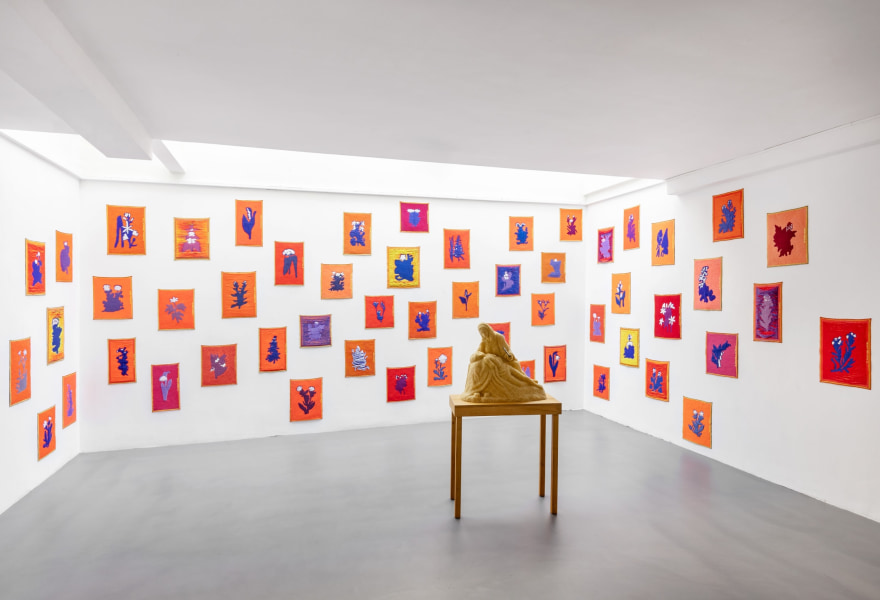
Until 26 October, Lumen Travo Gallery in Amsterdam presents the solo exhibition 'Pietà, Millefleurs' by Rini Hurkmans. This exhibition highlights the artist's multifaceted practice and showcases a wide range of works, including 55 woven pieces, sculptures in various formats, and photo and video works. Hurkmans’ multidisciplinary approach reflects her deep exploration of the complex interaction between art, ethics and the human experience.
A key aspect of Hurkmans’ work is her ongoing dialogue between art and society. Her work consistently returns to themes such as loss, absence, alienation, and the ethical and political implications of these concepts. She creates artworks that invite the viewer to reflect on moral questions in a world confronted with political, social and environmental crises. In doing so, she examines the relationship between art, politics and the human experience. This is clearly evident in her conceptual work "Flag of Compassion" (2002), in which she makes compassion tangible through a flag that raises ethical questions and bridges art with society. Hurkmans' artistic practice also has a research component. She explored the concept of loss in relation to ethics and politics for instance, and between 2010 and 2017 she was part of the research group LAPS, a scientific institute for art and public space.

Her exhibition at Lumen Travo Gallery is inspired by Michelangelo’s famous "Pietà" (1498–1499) and the six-part medieval tapestry series "La Dame à la Licorne" ("The Lady and the Unicorn"), which was created around the same time in Paris and Flanders, circa 1500.
The "Pietà", depicting a mother holding her deceased son, was severely damaged on 22 May 1972 by László Tóth, a man who was convinced that he was Jesus. With a hammer, he struck the iconic sculpture, destroying Mary’s outstretched left arm, symbolically stripping her of her crucial gesture toward the audience. Tóth was overpowered, a moment that was captured in a photograph. The image presents an intense and almost theatrical scene. The Pietà forms the backdrop for a dramatic reenactment of similar symbolism. As Tóth is subdued by bystanders and security guards, he lies in a posture that is reminiscent of the classical composition of Jesus' descent from the cross, with his body seemingly "carried" by those around him. The physical struggle, the chaos and the damaged sculpture in the background create a striking image. The scene evokes a sense of sacred disruption, as if the violence inflicted on the artwork resonates on a deeper symbolic level. This theatrical moment, in which Tóth appears as a tragic fallen figure, trapped in his belief, amplifies the dramatic character of the photograph.
When Hurkmans first (consciously) saw the photo 20 years later, she was an artist-in-residence at MoMA PS1 in New York. She decided to purchase the press photo and was inspired to further explore the complex layers of the image. In it, she saw a powerful symbol of loss and symbolic disruption, a theme she would continue to explore in her work. Hurkmans became fascinated by the different, occasionally conflicting meanings in the photo, which has since become the starting point for various works. One example is a series of Pietà-like self-portraits in which she depicts herself with a cocoon-like form, a project she continued for 18 years, with intervals of two years. Another example is the video work "Dear Son", which was shown at Huis Marseille in 2003. In this video, a mother figure is central, continuously folding and unfolding a white shirt on her lap, while reading a letter to her deceased son.

In her current exhibition at Lumen Travo Gallery, we see, among other works, a gesture of an outstretched hand emerging from the wall, referencing Mary’s arm. This hand offers the viewer a beeswax object, engraved with the word "courage". Additionally, a Pietà made of beeswax is displayed, in which Mary’s left arm appears to be replaced by an iron pin. Beeswax happens to be a symbolically charged material, known for its healing properties and used throughout history to preserve objects. It is also used in candles, linking the material to the symbolism of light, purity and spirituality. And candlelight serves as a symbol of hope and transformation.
The walls of the exhibition are filled with an impressive constellation of 55 small-scale tapestries, made from a combination of polyester, mohair, viscose, organic cotton, merino wool, acrylic, recycled PET and polyamide. The pieces are the result of a collaboration with the TextielLab in Tilburg. These tapestries are inspired by the six-part medieval tapestry series "La Dame à la Licorne", with each work symbolising one of the five human senses (sight, smell, hearing, taste and touch) and the heart. The delicate millefleurs style, a background motif of small flowers and plants used in various crafts, reflects our relationship with nature, another subject that intrigues the artist. In this exhibition, the tapestries are combined with the theme of the Pietà, exploring the disruption of human values and natural harmony. By intertwining contemporary and historical art, Hurkmans invites us to reflect on ethics and what it means to be human, showing that themes such as loss can transcend the boundaries of time.

