13 september 2024, Wouter van den Eijkel
Iva Gueorguieva - Recordings at Bradwolff & Partners
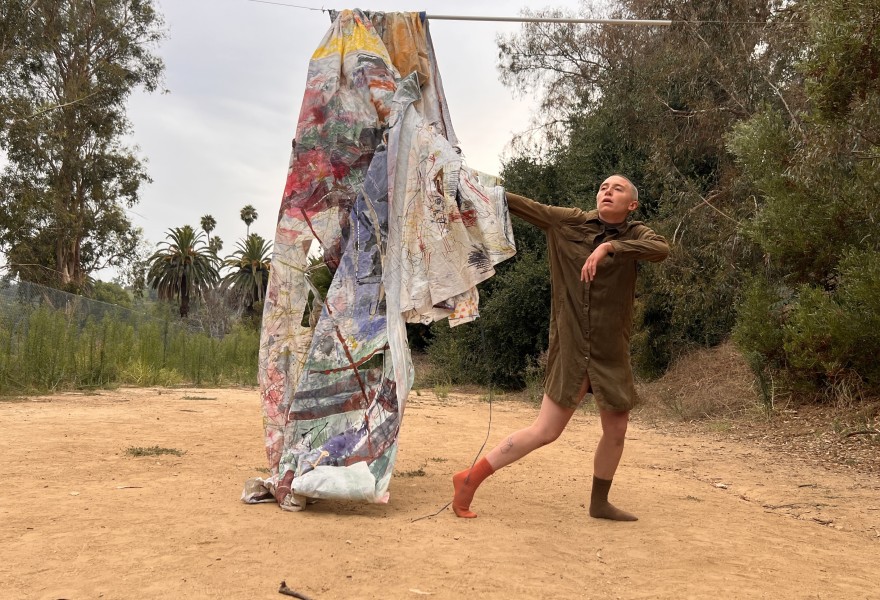
"I really like the title," Iva Gueorguieva says enthusiastically about Recordings, her exhibition at Bradwolff & Partners. "The word itself is wonderful, as it implies a tape that you can record and play back again. To me, a recording is similar to monoprinting on canvas. It's the literal absorption of the force I exert on it. When you do that often and layer upon layer, the paint accumulates, much like how reusing a cassette tape used to work."
"To me, the title also refers to artists and composers like John Cage, La Monte Young and Pauline Oliveros, who focus on the sonic materiality of the world around them and explore its qualities through field recordings, continuous tones or listening to silences. My own work involves a similar level of attention."
The names Cage, Young and Oliveros may not be widely known, but anyone who sees Gueorguieva's work will immediately understand the references. Her work explores the relationship between creation and destruction, order and chaos, and intention and instinct. Visually, the work of this Los Angeles-based Bulgarian artist balances between figuration and abstraction, connecting with various art-historical movements like Abstract Expressionism, Russian Constructivism, Dadaism and Supports/Surfaces, as well as cultural traditions such as the Bulgarian Kukeri, an ancient pagan ritual performed annually in February to drive away evil spirits.

Iva Gueorguieva, Kukeri: Glow (Birds), 2024, Bradwolff & Partners
Existential lasagna
Gueorguieva (Sofia, 1974) often combines colour, line and texture with collage techniques to disrupt surfaces both physically and conceptually. She cuts into linen canvases and adds mesh and stitching. The result is dynamic compositions consisting of multiple layers, both physically and in terms of meaning.
In the past, her work focused heavily on power relations, but in recent years, her approach has shifted. "I’ve shifted toward the body in relation to our surroundings." Those surroundings can be understood in the broadest sense of the word. For Gueorguieva, the human body is a nexus of personal, political and historical circumstances seamlessly intertwined. The works emerge from "an immersion in experience and time" in which everything leaves a trace, from overheard conversations on the street to political decisions and natural disasters. Like lasagna, there is no main ingredient. The work itself is an existential lasagna.
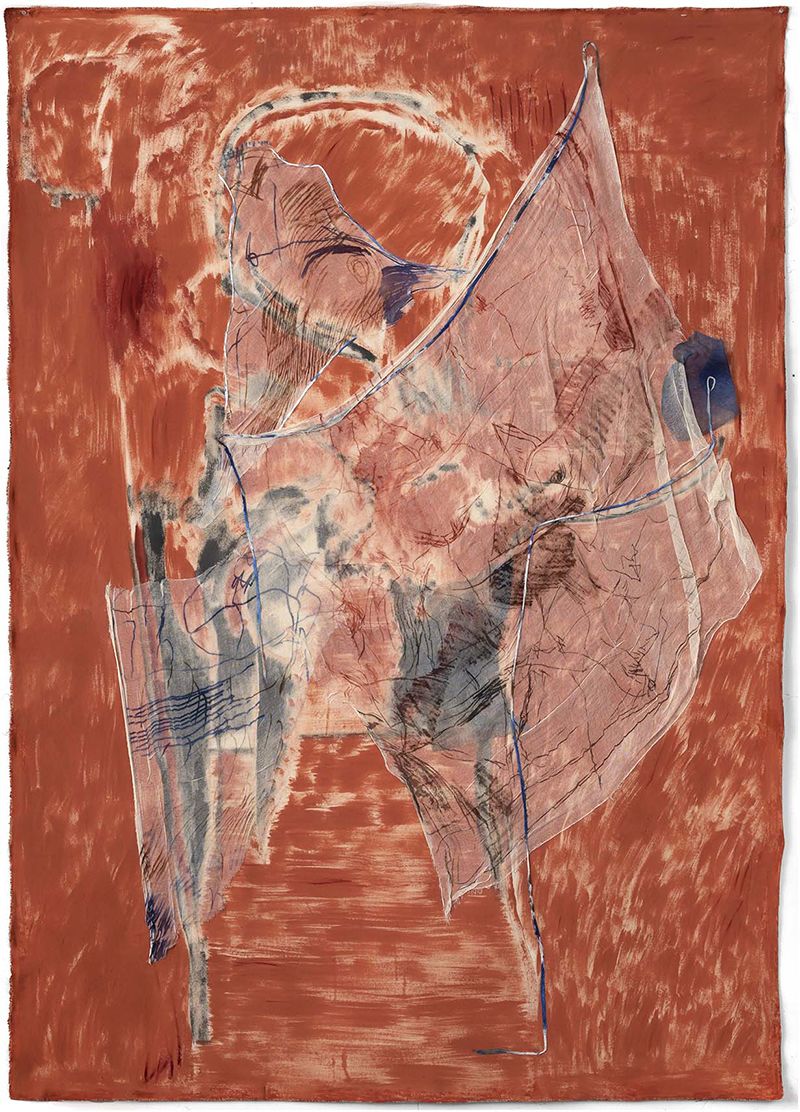
Iva Gueorguieva, Animal 3, 2024, Bradwolff & Partners
Animal
The exhibition on Lijnbaansgracht includes the Animal and Kukeri series. When asked about her preference for generic names, Gueorguieva explains what she means by shifting attention to other senses. To her, saying the title aloud is a physical act. "Animal is a beautiful word in a sculptural sense, but also in how it feels in the mouth because of the vowels and tones. The choice for Animal felt right. I often choose words that give the viewer a bit of firm ground, a word that opens your throat, allowing you to relax. This makes the drawing more accessible and you become more open to the world around you."
The intention behind Gueorguieva’s emphasis on the physical, on touch, becomes even more apparent in a work like Moth: Dappled Light (2023) from her Intersection project. Her stretched-linen paintings feature relief textures created with numerous layers of paint that vary in depth across the surface. In addition to a pen drawing, she treated the surface with a knife and also added mesh, the material we use to bind wounds, thereby suggesting that we are looking at a scar or suture. Through the combination of textures, mesh and cuts, the viewer gets the sense that the artist is focused on something tactile and physical.

Iva Gueorguieva, Butterfly, 2024, Bradwolff & Partners
Sound of a glacier
That layering is why Gueorguieva mentioned a cassette tape, on which you record your new favourite song over the old one repeatedly, rather than a noise-free FLAC file. With a cassette tape, you can ‘touch’ the music, you have to record and play the music yourself. With the rise of streaming, that tactile element has disappeared.
The lost tactile experience offered by cassette tapes is just one example of Gueorguieva's emphasis on the tactile. In the Intersection project, she approaches this idea more broadly. With the rise of the internet, the tactile experience has become less important. This manifests itself in the diminishing importance of public spaces as meeting places and decreasing human contact. By advocating the reassessment of tactile experiences and human touch, she attempts to restore these positive forces to a meaningful baseline.
The metaphorical Intersection, the cassette tape with a palimpsest of old recordings, the reliefs and the mesh, and the existential lasagna are all ways to describe the interweaving of experiences over time. Toward the end of the conversation, she returns to this when talking about environmental damage caused by human actions. "I’ll leave you with this. While painting, I often think about the sound of a melting glacier. I’ve never heard it personally nor have I looked it up online. In the northern U.S. and Canada, there are indigenous peoples whose entire collective memory depends on that sound. But what if glaciers cease to exist?"
Recordings by Iva Gueorguieva is on discplay until 26 October at Bradwolff & Partners, Lijnbaansgracht 314, Amsterdam.
An artist talk will be held at the gallery with Iva Gueorguieva and curator/writer Mark Kremer on Saturday 14 September at 4 pm.
