31 october 2023, Wouter van den Eijkel
The studio of... Patricia Paludanus
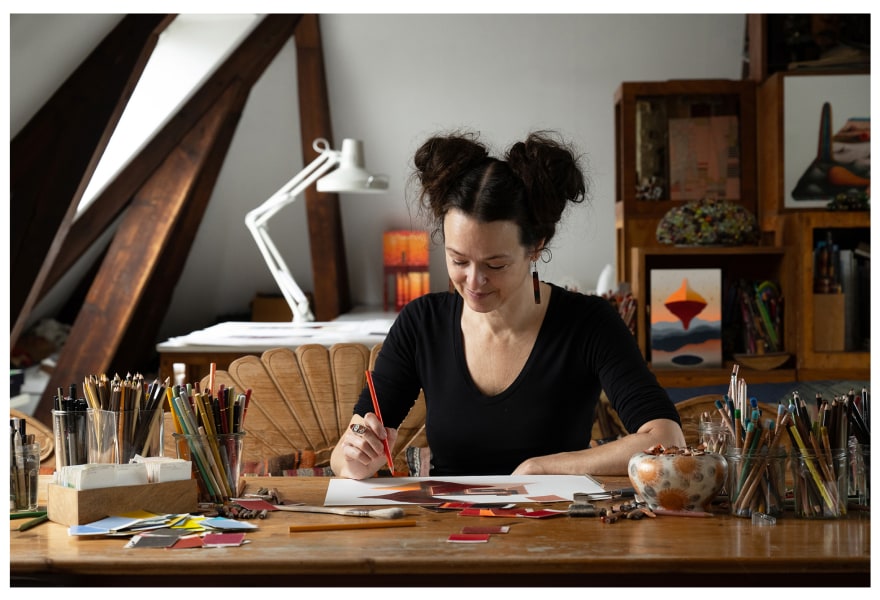
Patricia Paludanus lives and works in a former school building in the heart of Amsterdam. To her, there is no distinction between her work and personal life because her life is her work. She gets out of bed and dives into her creative pursuits seven days a week. "Obsessive, yes, but there's nothing I'd rather be doing."
Paludanus occasionally refers to herself as the slowest artist in the Netherlands, and when you see her colour pencil drawings, you immediately understand why. They must have been crafted with utmost concentration. She describes her work as landscapes of the mind that unlock something from the subconscious. "Often, such a 'mindscape' turns out to be the key that not only unlocks my own treasure chest."
Patricia Paludanus's drawings, along with works by Suzanne Jongmans, are currently on display at Galerie Wilms in Venlo.
Where is your studio and what does it look like?
My studio, located in Amsterdam's Dapperbuurt, also serves as my residence – and a museum filled with curiosities. It's the attic of an old school, a loft with sloping windows providing views of ever-changing cloudscapes and flooding the space with natural light. Many people prefer to keep their work and personal life separate, but my life is my work. I can start working straight from my bed, surrounded by inspiring objects, and continue for as long as I want, seven days a week. My drawings are highly labour-intensive and this setup allows me to fully dedicate myself. And when I'm not in my studio, I’m usually out exploring art elsewhere.

Patricia Paludanus, Passage, 2023, guest artist at Galerie Wilms
When I look at your work, I suspect it comes together slowly and with intense concentration. Is that so and do you work in silence or with music playing?
Your suspicion is correct. This is why I can't share my workspace; it demands absolute focus. But concentration and music go hand in hand for me. In fact, my deep love of music often plays a significant role, with moments in the creative process where I'm immersed in a sea of sound, listening to music that stimulates the right parts of my brain, creating wondrous, thrilling, sometimes disconcerting compositions, often by contemporary composers. It's like heaven, ecstasy – or stillness. Bach, for instance. My drawing is a descent into what lies beneath the surface, touching on deeply existential questions and sometimes serving as a form of exorcism – the right music can make something inside resonate that can't be reached in any other way.
What does a typical day in your studio look like?
With a cup of coffee in bed, I check my email and deal with social media, so that I can later focus on other things. I usually start drawing around ten whenever I can – there are lots of other tasks that come with being self-employed. At any rate, I typically work until around 8 pm without a break – I eat my lunch on the go – and often still find it difficult to stop even then. It's obsessive, yes, but there's nothing I'd rather be doing. The freedom to structure my days like this wasn't always a given, so perhaps I'm making up for lost time.

Patricia Paludanus, Possibility IV, 2023, guest artist at Galerie Wilms
You've been almost exclusively working with coloured pencils since 2016. Prior to that, you did sculpting and photography, among other mediums. Do you recall the moment when you thought, "This is it; I need to continue with this"?
In fact, I've worked with nearly every conceivable medium, from kinetic sculptures and moving paintings to light objects and sound. Back when my art was plugged into a socket, I could never have imagined returning to the simple material with which it all began. But, of course, I didn't anticipate the death of a partner, a lengthy period of depression and an injury that made my previous work impossible either. It was during a subsequent quest to rediscover a childlike delight I hadn't experienced in a long time that I rediscovered coloured pencils. You know those dreams in which you stumble onto a room in your own house that you didn't know existed? It was that hidden room I unexpectedly entered into when I picked up the pencil again and where I found the long-lost magic of my childhood in its purest form. Since then, I've merged with my passionate five-year-old self, which is infinitely more than I could have hoped for.

Patricia Paludanus, Echo, 2022, guest artist at Galerie Wilms
What is the appeal of working with coloured pencils? What does it offer that other techniques do not?
It's all about how I use it, which unintentionally ends up making the material unrecognisable to most. I apply thick layers of coloured pencil to watercolour paper, which can absorb a lot of pigment due to the rough texture, obscuring individual strokes and causing the surface to resemble leather, where colour almost becomes a tangible object, something you want to touch, put in your mouth. My experience of colour has always been very physical, something I literally feel in my stomach, and the specific texture of my works translates that experience like nothing else. This, combined with the hypnotic repetition of movement that has a meditative effect, is like walking in the mind; something starts to flow. I once embarked on a 40-day trek through the Himalayas and after about ten days, you reach a state that you never achieve during a casual stroll. A drawing is such a journey. Within that one square metre of my desk, I embark on grand voyages and my work reflects those journeys.
I read that you are very interested in abstract concepts like science, while your drawings appear very intimate and intuitive. How do you view the relationship between science and art?
They do not need to be polar opposites by any means. To me, both originate from a combination of profound love and awe, as well as unbridled curiosity about the world around us. I want to know everything and, as a child, I turned over every stone. Not surprisingly, scientists who make truly groundbreaking discoveries have a lot in common with artists and possess a childlike, playful spirit that allows them to think outside the box. I find it perplexing that some people believe that accumulating knowledge diminishes the mystery, whereas uncovering how wondrously, outrageously complex everything is actually amplifies the mystery, making it infinitely larger.

Patricia Paludanus, Old Timber to New Fires, 2022, guest artist Galerie Wilms
What is your approach? Your compositions seem well-thought-out, but I can also imagine that you can't preconceive such scenes.
You’re absolutely right. The compositions emerge during a lengthy process in which a build-up of loose associations leads to an image that is not straightforward, but has numerous layers of meaning. It's akin to dream logic, where elements from one's life come together to form a different reality. These are landscapes of the mind that unlock something from the subconscious, and such a ‘mindscape’ often turns out to be a key that fits not only my own treasure chest.
If I were to describe your work, I would say it's a journey through your inner world. Highly personal, yet simultaneously universal. Would you agree about the connection between the personal and universal in your art?
I have very early memories of both experiencing colour and form for the first time and encountering grand, abstract concepts like time and death before a compartment in my mind was designated for them. In my work, I attempt to return to that mode of experiencing, how you perceive as a young child before you understand the meanings of things, with a magical sense of association. It's a past we all share and one that may characterise not only our beginnings as individuals but even our beginnings as a species. Art, science, religion – does the origin of our human culture not lie in that initial gaze, the attempt to interpret dancing shadows on the walls of our cave?
The exhibition at Galerie Wilms is entitled The Space Within. What space are you and Suzanne Jongmans referring to?
It's the boundless universe contained within each of us. To me, there's enough material there for the next thousand years. I would need a series of lifetimes to explore it fully. I suspect that most of us experience this, but there may be a threshold to cross or an entrance yet to be discovered. Sometimes, art can crack that door open just a bit.

Patricia Paludanus, Return, 2022, guest artist at Galerie Wilms
How did your collaboration come about?
At the beginning of this year, Suzanne, who I got to know when she purchased one of my drawings, asked me to model for her. I was hesitant at first because that kind of thing is behind me, but when she explained her vision, it became clear that she understood and recognised my work. It wouldn't be a portrait of my physical appearance but of what I do, of what both of us do and are. A portrait of our artistry as it were. The next day, Carla from Suzanne's Wilms gallery proposed a joint exhibition after envisioning a combination of our works. I assumed that she and Suzanne had discussed it, but our collaboration was unknown to her, a curious alignment of circumstances that lead to this exhibition!
What do you recognise in Suzanne's work?
I've jokingly referred to myself as the slowest artist in the Netherlands, but Suzanne no slouch either! We both have a work process that involves a slow exploration. Our art emerges from capturing what goes unnoticed with bated breath. Our images crystallise gradually, from individual elements that we shift until they come together into something we feel can make an impact.
What are you currently working on?
I've been busy framing my work for the exhibition in recent weeks, so I can't wait to dive back into a fresh sheet of paper. Hopefully, at the time this interview is published, I'll be hunched over new work with a pencil in hand!

Patricia Paludanus, Perilous Pleasure, 2023, guest artist at Galerie Wilms
