03 october 2023, Indra Devriendt
Undesired visitors
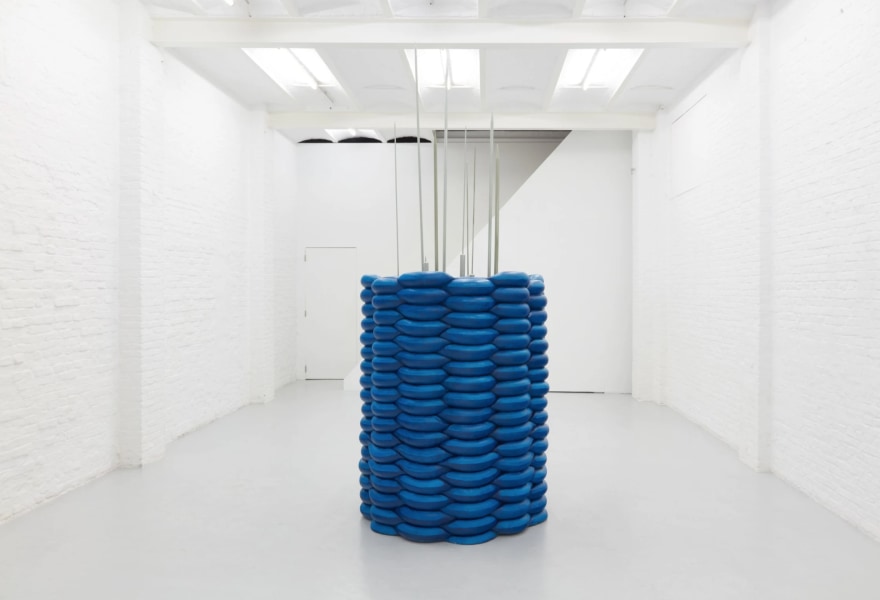
Elleke Frijters' sculptures evoke something recognisable, yet we are unable to immediately place them. They instil in us a sense of uneasiness, as if we are being told to stay away and pay attention because your visit will not go unnoticed!
Guarding my fence is the title of Elleke Frijters' first solo exhibition at Base-Alpha Gallery. The sculptures are placed like islands in distinct areas separated by a fence or high wall. The little we see is not particularly inviting. The sculptures define physical space through their size, volume and static appearance. They impress. The spines and peaks appear menacing. Outsiders are not welcome here. What is being guarded or hidden here? Our curiosity is aroused.
Unfortunately, the altitude robs us of the chance to see anything. While we have the tendency to want to peek, we also feel watched. Sculptures hang high on the walls, reminiscent of lighting or cameras. Light or recordings catch intruders. The standing sculptures clearly define an area: this is mine! They also denote casings. We sense an interior space or safe environment that is intended to provide protection from an external threat. The sleek design and predominantly grey tones reinforce the sense of gloom and feeling of coldness. What is going on here? We would like nothing more than to understand and identify, so we look for an explanation in the hopes of being rid of our discomfort.
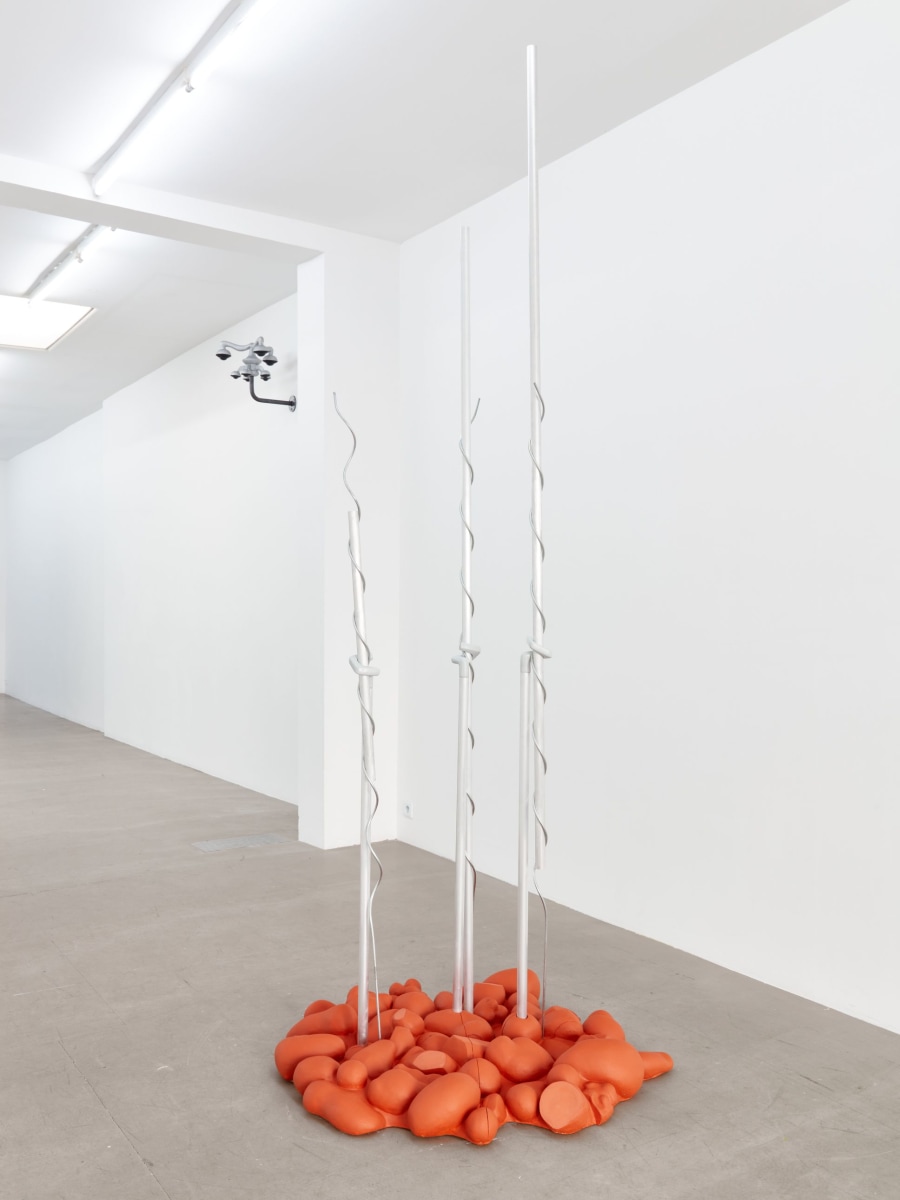
Elleke Frijters, Planted land, 2023, Base-Alpha Gallery
Frijters chooses sculptures that do not evoke a clear meaning. She gives us little guidance, so we have to rely on our own experience. Although her work responds to our need for a frame of reference, she does give a hint. “The sculptures shown could be elements from city gardens,” she explains. “We clearly define our gardens and employ a special garden aesthetic. A fence provides privacy and creates a feeling of security, but there is something oppressive about it and a lack of ‘things’. Your view of the outside world is blocked and interaction is no longer possible.”

Elleke Frijters, My fence makes your shadow, 2023, Base-Alpha Gallery
Standing in front of My fence makes your shadow, we see that this revealing title belongs to an anthracite-coloured fabric that forms a closed, high fence. We only see two skewers and a lamp sticking out above it. “We decorate our gardens with castings of natural materials,” says Frijters. “We also often choose these plastic fabrics for garden furniture. The lamps and skewers are cast ornaments you can buy at any hardware store to weld onto something to make it look like wrought iron. Many of those ornaments have a rustic character. I wanted to create an alienating effect with the structure inside, which gives the impression of highlighting something you cannot see as a visitor. The zigzagging spears refer to Japanese knotweed, a plant that grows rampant near my studio in Mons.”
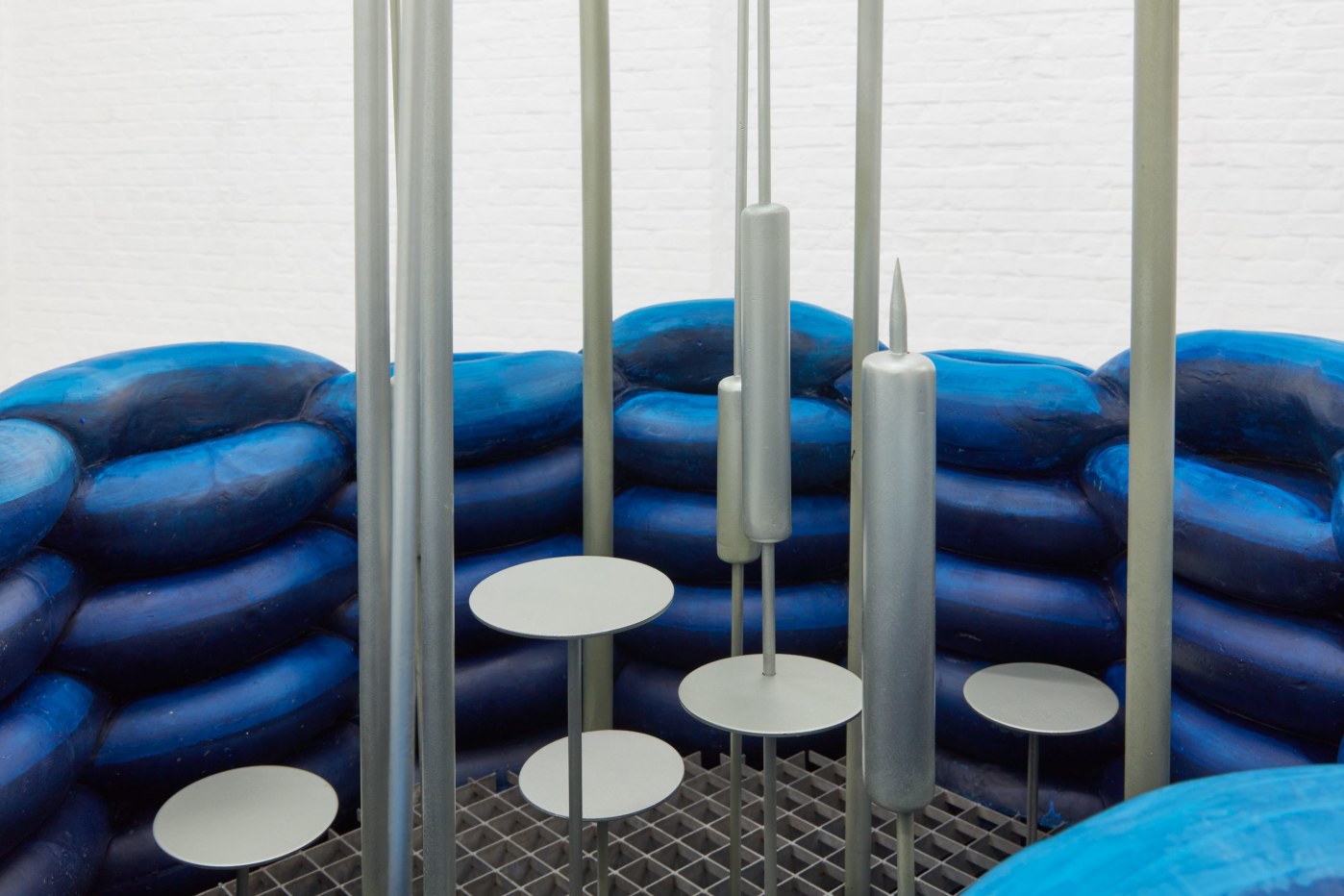
Elleke Frijters, Detail, I wish I'm doing well, 2022, Base-Alpha Gallery
Reflections
The urge for control and structure in our environment is also reflected in Frijters' sculptures in her preference for a sleek, static and vertical design language, a translation of the appearance of many gardens. Frijters plays subtly with light and colour. The anthracite-coloured fabric is painted with bands of green. From a distance this creates a fascinating light reflection. The same effect is achieved with I wish I'm doing well, a sculpture with blue bands. The surface shines and vibrates and it feels as if we were standing in front of a fortress, guarded by an army. “I am a huge fan of medieval art,” says Frijters. “I like how they simplified complex shapes and presented an alienating perspective. My interest is mainly in the setting in which people are depicted. In medieval paintings you see references to willows and fences. The gardens were displayed privately. They were iconic images in which the good and safe was on the inside and the wild and unknown on the outside. The twigs that represent the fences were not painted separately, but en masse. I also use that sausage-like representation in my sculpture. The colour refers to a carpet-like weave from the Middle Ages and the peaks that stick out are inspired by reed.” Different meanings or storylines come together in her work, which we interpret based on our own frame of reference.

Elleke Frijters, Forbidden fruits, 2023, Base-Alpha Gallery
Abstractions
Boundaries can also be found in the form of espaliers or posts. Forbidden fruits is a ceramic sculpture. “The shape refers to espalier trees that we train to grow along a structure, usually along a driveway,” says Frijters. “We want it to look neat and our car has to fit next to it. The clay colour is a reference to medieval sandstone reliefs. The people were depicted centrally and the background was filled in with nature.” Frijters once again shows how we manipulate nature to define our property. Cameras or fruits hang at either end. The title tells us to stay away. Certain sculptures refer more to the furnishings of our property, such as a parasol base consisting of plastic terracotta stones or a structure for climbing plants. One sculpture breaks somewhat with the verticality and has a more organic shape. That works well in this setup because it looks like a plant. The title For the corner of your balcony provides some explanation. Although Frijters often sculpts, we do not see this in her sculptures. She opts for an industrial look. “I choose to sculpt certain shapes. If I were to cast them, they would refer directly to reality. I like to manipulate shapes and make abstractions, so that they feel alienating. In this way I hope that the viewer is not able to immediately recognise and identify them.”
Frijters points out how we define and shape our property. Why do we imitate nature and design a private piece of land as a beautiful, controlled environment, while nature intends just the opposite? Nothing is clear and everything is constantly changing. As humans we never have control over such things. How absurd is our urge for control, demarcation and order? How does this benefit us? An even greater sense of insecurity and fear? Can we drop those physical boundaries and welcome (unexpected) visitors with open arms?

Elleke Frijters, Guarding my fence, Base-Alpha Gallery
