Connexion
S'inscrire
FR
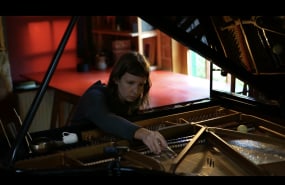
Zoë d’Hont (1990) lives and works in Rotterdam and has a background in music, visual arts and art science. Composition, the placing of visual or sonic material, is her starting point. In her work she investigates how people experience space and place, how they move through it and how they relate to it. Her site specific installations and performances are a counterreaction to the current trend of disconnection and extreme fluidity in the experience of time and space. By collaborating with the architecture of a place and introducing ritual and delay, the perception is shifted to here and now, providing room for silence and contemplation. In her work she aims to create a moment in which time, place and the mind synchronize.
Due to her background in classical music, and with that reading sheet music, Zoë has become interested in the concept of “notation”: interpreting and performing a specific language or system. Since then she has been investigating the possibility of including notations as a methodology in her art practice. Studying, interpreting and performing compositions, language systems and instructions require a certain concentration and respect for the things that are there. Autonomous eloquence and authorship do not necessarily arise from originality and renewal, re-situating and reenacting the existing can evoke this as well.
With the use of slow, meditative and tactile techniques, I create space for silence and paying attention. In a world with an abundance of information, where the eye dominates over the ear and we shout each other down, emptiness and listening are very much needed. Complete silence does not exist, not even in an anechoic chamber, but when you really start to listen, attention arises for the layered complexity and subtlety of everything around us.
In addition to my visual work, which always contains references to an auditory world, I am working on the Temple for the Ear; a physical space where the visitor is invited to various forms of attunement. Deep Listening workshops take place here, and sound works are presented in which the revaluation of ambient sound and noise is central.
Anechoic chamber and Echocamber
This diptych represents the experience of visiting an anechoic chamber and an echo chamber.
While visiting an anechoic chamber I sensed a loss of space. Everything was there at the same time, there was no direction. I became the space itself. The lack of sound throws you back to yourself, which can be a frightening and revealing sensation at the same time. While visiting an echo chamber, singing was all I could do. The sound of my voice traveled infinitely in repetition. The use of green thread, refers to a virtual space, due to digital space can be experienced as an amplification of your own beliefs.
Inhabit the universe is an imagination of the ear as a transcending organ. The collision of a sound wave on the cochlea ends in the transcendent of the finite into the infinite. The process of hearing is comparable with a mirror cabinet, everything that ends up in it is multiplied by its own reflections. The presence and absence of doors and windows symbolizes the possibility to in- or exclude auditive information.
Noise Spectrum is a series of glass works that originates from a long-lasting interest in sound. The series is inspired by the noise spectrum; a range of eight different sound signals, named as colours, that correspond to a particular frequency, which the listener couples with specific material associations and states of mind. This sense of colour for noise signals is similar to the concept of timbre in music.
Noise-cancelling foam is used to mold pieces of glass in a rippled pattern, resembling sound waves. The reflective surface of the glass gives the pieces an even more liquid, transformative appearance. The collection of glass works is presented in foam-lined boxes, as jewels meant to amplify the beauty of noise.
Due to her background in classical music, and with that reading sheet music, Zoë has become interested in the concept of “notation”: interpreting and performing a specific language or system. Since then she has been investigating the possibility of including notations as a methodology in her art practice. Studying, interpreting and performing compositions, language systems and instructions require a certain concentration and respect for the things that are there. Autonomous eloquence and authorship do not necessarily arise from originality and renewal, re-situating and reenacting the existing can evoke this as well.
With the use of slow, meditative and tactile techniques, I create space for silence and paying attention. In a world with an abundance of information, where the eye dominates over the ear and we shout each other down, emptiness and listening are very much needed. Complete silence does not exist, not even in an anechoic chamber, but when you really start to listen, attention arises for the layered complexity and subtlety of everything around us.
In addition to my visual work, which always contains references to an auditory world, I am working on the Temple for the Ear; a physical space where the visitor is invited to various forms of attunement. Deep Listening workshops take place here, and sound works are presented in which the revaluation of ambient sound and noise is central.
Anechoic chamber and Echocamber
This diptych represents the experience of visiting an anechoic chamber and an echo chamber.
While visiting an anechoic chamber I sensed a loss of space. Everything was there at the same time, there was no direction. I became the space itself. The lack of sound throws you back to yourself, which can be a frightening and revealing sensation at the same time. While visiting an echo chamber, singing was all I could do. The sound of my voice traveled infinitely in repetition. The use of green thread, refers to a virtual space, due to digital space can be experienced as an amplification of your own beliefs.
Inhabit the universe is an imagination of the ear as a transcending organ. The collision of a sound wave on the cochlea ends in the transcendent of the finite into the infinite. The process of hearing is comparable with a mirror cabinet, everything that ends up in it is multiplied by its own reflections. The presence and absence of doors and windows symbolizes the possibility to in- or exclude auditive information.
Noise Spectrum is a series of glass works that originates from a long-lasting interest in sound. The series is inspired by the noise spectrum; a range of eight different sound signals, named as colours, that correspond to a particular frequency, which the listener couples with specific material associations and states of mind. This sense of colour for noise signals is similar to the concept of timbre in music.
Noise-cancelling foam is used to mold pieces of glass in a rippled pattern, resembling sound waves. The reflective surface of the glass gives the pieces an even more liquid, transformative appearance. The collection of glass works is presented in foam-lined boxes, as jewels meant to amplify the beauty of noise.
Oeuvres d'art
Articles
Médias
Points forts
Recommandations
Collections
Expositions
Position sur le marché
CV
Oeuvres de Zoë d’Hont




expositions



Abonnement gratuit au magazine
Articles, interviews, spectacles et événements. Livré dans votre boîte aux lettres chaque semaine.